Name the boundary · practise saying and respecting no
“Please Stop”: The Song That Taught My Son—and Me—How to Say No
How a children’s song helped my son and me understand consent, bodily autonomy, necessary care, and why a child’s no must matter.
- Published
- Last reviewed
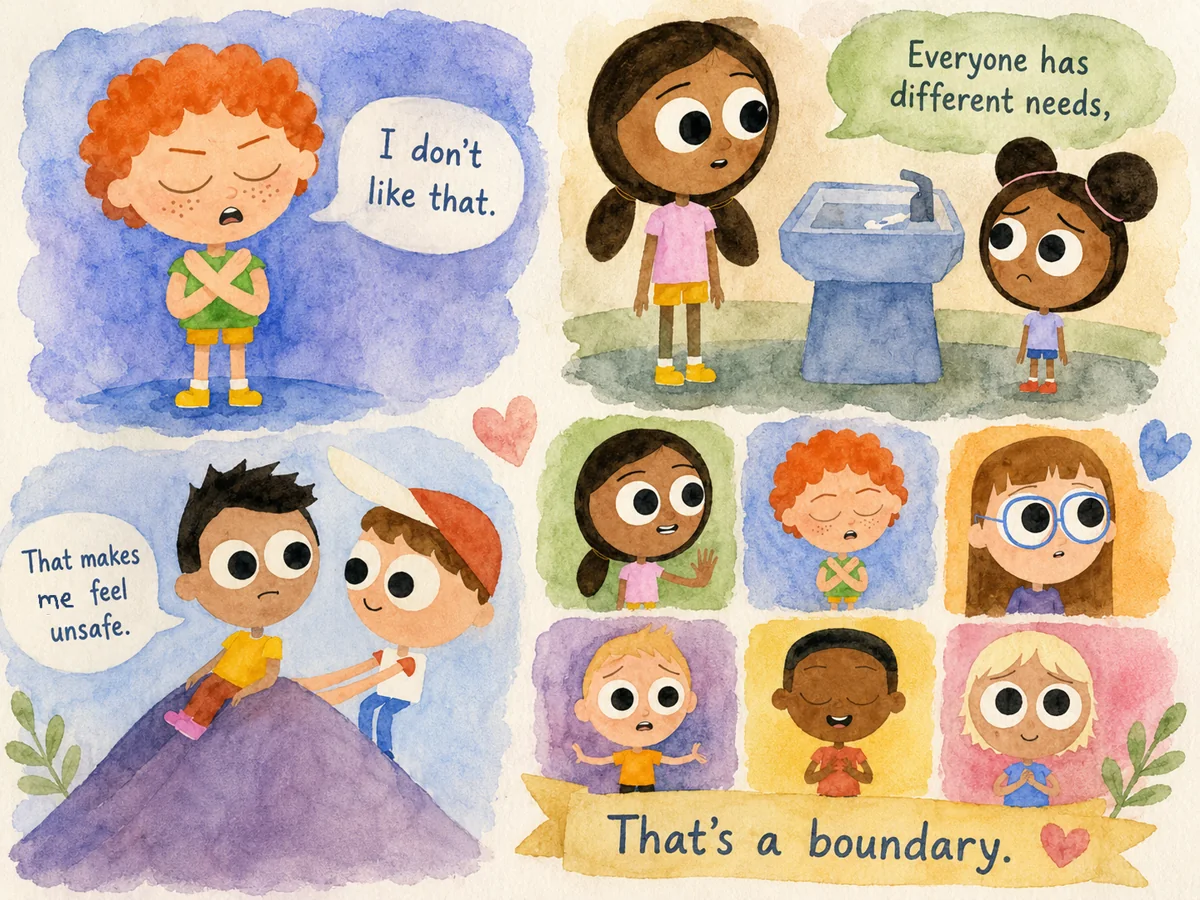
There is a children’s song on YouTube called The Boundaries Song – “That’s a Boundary.” by Hopscotch. I played it for my son because songs help him learn. I did not expect it to teach me so much. I am almost thirty-six. My son is six. Somehow, we are both learning about boundaries at the same time.
For a long time, I did not really understand what a boundary was. I thought boundaries were something rude or difficult people used when they wanted to push others away. I thought saying no meant creating a problem. I thought quietly enduring discomfort was part of being polite—especially when the person making me uncomfortable was older, related to me, or “just joking.” Then this simple song explained something I had needed language for my entire life:
A boundary is not a wall. It is not a punishment. It is not another way of saying, “I hate you.” A boundary says: this is where I begin, this is where I end, and this is how you can be close to me without hurting me.
That distinction matters. I am also learning another important distinction: a boundary is not a command that forces another person to behave exactly as I want. It is a clear statement of what I am comfortable with and what I will do if that limit continues to be ignored.
The magic of the song is not that it teaches children to be rude. It teaches them to be clear. It teaches that some people like hugs, tickling, closeness, and sharing, while other people do not. It teaches that feelings matter, even when you are small. It teaches that people cannot read each other’s minds, so asking before doing something helps us avoid crossing another person’s limits. Most importantly, it teaches that when someone says they are uncomfortable, we stop. It teaches children that they can say no without trying to be mean. Honestly, that is not something many of us grew up learning.
Love Does Not Erase Consent
In many families and cultures, affection is treated as something children owe adults. A grandparent wants a hug, so the child is expected to hug. An uncle or aunt wants to kiss their cheek, so the child is expected to stand still. Someone says, “I love you. Come here,” and suddenly the child’s discomfort is treated as bad manners. But we forget that love does not erase consent. Being adored does not mean being permanently available for touch.
I think about this often because so many things we normalize with children are actually boundary violations dressed up as affection, discipline, or fun:
- Forced hugs and kisses.
- Picking up a child who does not want to be held.
- Squeezing cheeks, pulling hair, or poking bodies.
- Tickling after a child has said stop.
And then there are the jokes. I was shamed for being a chubby child. I was poked because my shorts were considered too short. My hair was pulled because it looked like Maggi noodles. It was all supposed to be fun. It was all dismissed as teasing. But my body still remembers that those jokes happened to me, not with me. That difference matters too.
When a child says stop, the joke is over. If the adult continues, it is no longer a joke. It becomes a lesson:
- Your discomfort is funny to us.
- Your no is optional.
- Someone older, bigger, or louder can ignore your boundary as long as they call it love, teasing, or family.
That is not an idea that quietly disappears when we grow up.
Your Feelings Count Even When You Are Small
The song says, in its own simple way, that feelings are important regardless of someone’s size or age. That matters because so much of childhood is spent being told—directly or indirectly—that adult feelings are bigger than yours. Their disappointment matters. Their embarrassment matters. Their desire for a hug matters. Their wish to show affection matters. Your discomfort? That is called attitude. Your refusal? Disrespect. Your tears? Too sensitive. Your silence? Moodiness.
But the song says the opposite: your feelings count even when you are small. That is a radical thing to teach a child. It is also a radical thing to learn as an adult.
One of the most useful things the song gives children is language. Not theory. Not a lecture. Actual words:
“Please stop.”
It is direct. It is simple. It is usable. Children—especially children who rely on prepared scripts—may not be able to improvise under stress. When they are overwhelmed, embarrassed, frightened, or overstimulated, they may not have access to a beautifully worded explanation of what they need. So we give them phrases they can reach for:
- “Please stop.”
- “I don’t like that.”
- “I need space.”
- “Don’t touch my body.”
- “I don’t want a hug.”
- “Please don’t do that in front of me.”
- “That is mean.”
- “Ask me first.”
- “I changed my mind.”
- “I need you to listen when I say stop.”
- “I need a break.”
- “I need help.”
These are not magic words. Saying them does not guarantee that everyone will listen. But having the words is still better than being trapped inside discomfort without any way to name it.
Unlearning Alongside My Son
I am not only teaching these words to my son. I am learning them myself. I am learning that a child saying, “No hug,” is not rejecting love. A child saying, “Don’t tickle me,” is not ruining the fun. A child saying, “Don’t say that,” is not automatically being disrespectful. They are giving us information. They are not saying, “I don’t love you.” They are saying, “This is my boundary.”
As an adult, I am learning to say:
“I will not continue a conversation in which I am being insulted. If this continues, I will leave.”
That is not an attack. I am identifying the line and explaining what I will do to protect it. That is still difficult for me. I grew up believing that if someone was older, closer to me, louder, or more socially accepted, then perhaps their comfort mattered more than mine. I learned to laugh when I was uncomfortable. I learned to freeze when I did not know how to object. I learned to explain other people’s behavior away because confrontation felt worse than discomfort. Now I am trying to unlearn those habits beside my son.
Many boundary violations happen because adults assume closeness gives them automatic access:
- “I’m your grandmother.”
- “I’m your aunt.”
- “I changed your diapers.”
- “I’m family.”
But a relationship does not remove the need to ask. Family should be the first place where a child learns that their no is safe.
That does not mean teaching children that only their comfort matters. It means teaching them that everyone’s body, words, time, space, and feelings matter—including theirs. Boundaries work both ways. My son is learning that he can say no to unwanted touch, but he must also stop when someone else says no. He can need space, and so can another person. Loud sounds may hurt him, while being grabbed may distress somebody else. His feelings matter, and other people’s feelings matter too. That is not selfishness. That is respect.
What About Necessary Care and Safety?
Respecting a child’s bodily autonomy does not mean leaving every medical, hygiene, or safety decision entirely to the child. Sometimes an adult must intervene to keep a child safe or provide necessary care. A child cannot be allowed to run into traffic simply because they said no when we tried to stop them. Medical treatment, bathing, toileting, dental care, or another essential task may sometimes need to happen even when the child dislikes it.
But necessary care does not make respect unnecessary. Even then, we can explain what is happening and why. We can prepare the child in advance when possible. We can offer meaningful choices, avoid unnecessary force or surprise, use the least intrusive approach available, and acknowledge the child’s distress. If something frightening or unavoidable happens, we can return to it later. We can explain, listen, apologize for any preventable harm, and rebuild trust.
Safety may sometimes require us to override a child’s immediate preference. It should never become an excuse to stop treating them like a person.
How We Help Children Practise and Protect Boundaries
Give them exact words
We do not simply say, “Speak up.” We teach the sentence and practise it when everyone is calm. “What can Teddy say if someone takes his toy?” “What can you say if someone hugs you and you don’t want it?” “What can you say if you said yes before but have changed your mind?” The more familiar the words become during calm moments, the easier they may be to reach during stressful ones.
Offer alternatives
If a child does not want to hug, they can wave, high-five, fist-bump, blow a kiss, or simply say hello. Affection does not have to be physical to be real. The alternative should be an option, not another performance the child is forced to provide. Sometimes a quiet hello—or no interaction at all—is enough.
Back them up publicly
This is crucial. If a relative says, “Come give me a kiss,” and the child says no, the parent can calmly say:
“He said no. You can ask whether he would like to wave or give you a high-five instead.”
No lecture. No drama. Just support. That one sentence tells the child:
- I heard you.
- Your no matters.
- I will not push you into discomfort to keep someone else happy.
Model our own boundaries
This is the part I did not expect to be so difficult. My son is learning to say, “That’s not okay.” I am learning to say it too. I am learning to say, “Enough is enough.” I am learning that if someone repeatedly crosses my boundaries, I do not have to keep standing there and hoping they will suddenly understand. I can end the conversation. I can leave the room. I can limit someone’s access to me. I can stop returning to situations that repeatedly cause harm. Not because I am cruel. Because I am allowed to protect my peace.
Healing Together
Boundaries are not merely words we teach children so they behave nicely in therapy rooms or classrooms. Boundaries are a way of living. They are how we teach people to come close without causing harm. They are how we stay connected without disappearing.
When my son learns to say, “Please stop,” I am not only watching him learn something new. I am watching a younger version of myself finally receive the words she needed. My son is six. I am almost thirty-six. He is learning that his body belongs to him. I am learning that my peace belongs to me. We are learning together.
Maybe that is what healing sometimes looks like: a children’s song playing in the background while two people—one small and one grown—finally learn where they begin and where the world must stop.
References and Further Reading
- The American Academy of Pediatrics advises parents not to force or guilt children into hugs or kisses and recommends teaching body autonomy and offering alternatives such as waving or high-fives. Teaching Body Safety and Boundaries
- The NSPCC’s Talk PANTS resources teach that children have the right to say no to unwanted touch, including from relatives, and should tell a trusted adult when something makes them uncomfortable. NSPCC Talk PANTS
- The NSPCC’s guidance for autistic children also explains that adults may sometimes need to override a child’s immediate preference for safety, but should explain why and support the child’s understanding. Talk PANTS Guide for Parents and Carers of Autistic Children