Name it clearly · notice the pattern
We Are Losing Blood, Not Honour.
Auntie Gyn-y’s plain-language guide to menstrual biology, shame, severe pain, heavy bleeding, suppression, contraception, and bodily autonomy.
- Published
- Last reviewed
Listen up, kiddo.
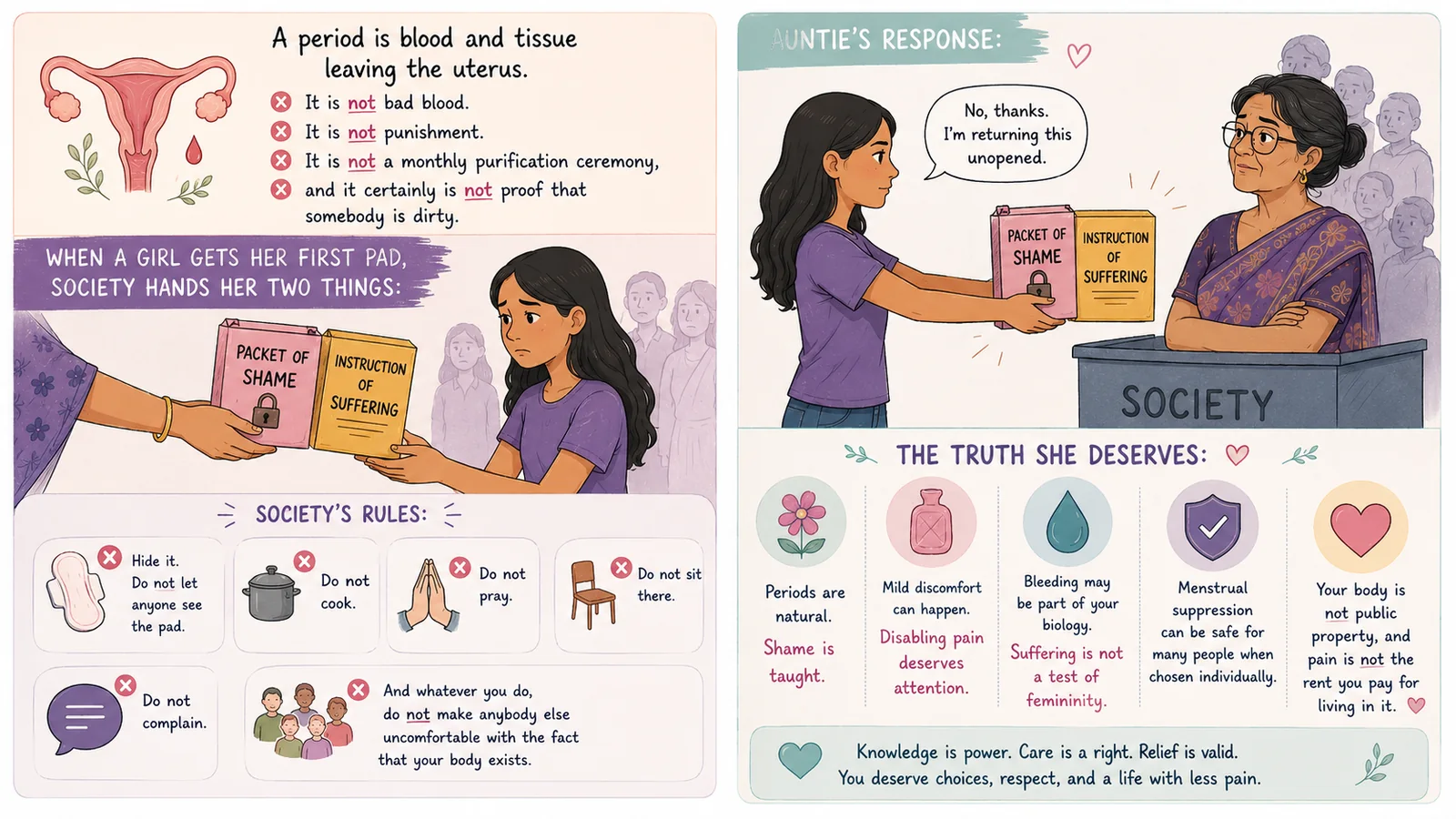
A period is blood and tissue leaving the uterus. It is not bad blood. It is not punishment. It is not a monthly purification ceremony, and it certainly is not proof that somebody is dirty.
Yet for generations, girls have been handed two things with their first pad: a packet of shame and an instruction to suffer quietly.
Hide it. Do not say the word. Do not let anyone see the pad. Do not cook. Do not pray. Do not sit there. Do not complain. And whatever you do, do not make anybody else uncomfortable with the fact that your body exists.
No. Auntie is returning that package unopened.
Periods are natural. Shame is taught. Mild discomfort can happen. Disabling pain deserves attention. Bleeding may be part of your biology. Suffering is not a test of femininity.
Your body is not public property, and pain is not the rent you pay for living in it.
First, what is a period?
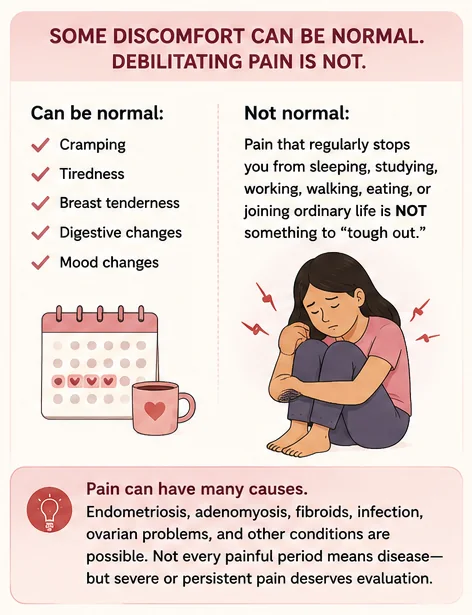
During a menstrual cycle, hormones prepare the lining of the uterus for a possible pregnancy. If pregnancy does not occur, that lining breaks down and leaves through the vagina as blood and tissue.
That is the whole unglamorous biological story.
Your uterus is not a rubbish bin. A period is not “toxins” escaping. Menstrual blood cannot ruin food, kill plants, weaken men, or contaminate a room. If somebody wants to practise a personal or religious tradition during menstruation, that is their choice. But choice disappears when a girl is frightened, shamed, excluded, or forced.
A freely chosen practice is one thing. A rule used to control somebody else’s body is another.
How shame becomes control
Not every menstrual taboo began with one villain plotting against women. Human beings have attached meanings to blood for thousands of years, often without modern knowledge of anatomy or infection. Some customs may have grown from practical needs for privacy, rest, water, or clean materials.
But do not let a tidy origin story distract you from what a rule does now.
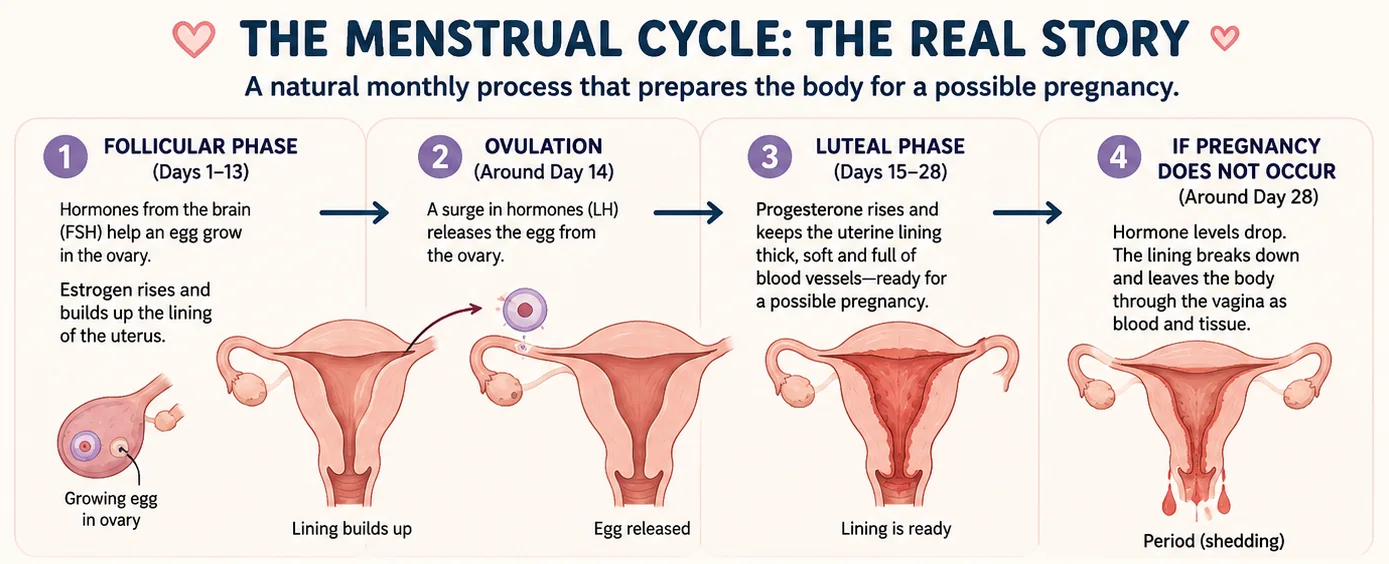
When a menstruating girl is labelled impure, people can bar her from school, worship, food preparation, family life, or leadership. When her first period is treated as permission for marriage or sexual attention, puberty becomes a weapon against a child. When she learns that mentioning pain is embarrassing, she becomes easier to dismiss.
That is how ordinary embarrassment starts doing political work.
Menstrual exile can also be physically dangerous. Practices such as chhaupadi in parts of Nepal have forced girls and women into huts or animal shelters during menstruation, exposing them to cold, smoke, animals, assault, and isolation. A tradition does not become harmless because it is old.
And the modern world should not feel too smug. A girl hiding a pad in her sleeve, a student missing class because the toilets are unsafe, or an employee pretending she is fine while bleeding heavily are living with the same message in quieter clothes: manage your body without inconveniencing anybody else.
“Common” is not the same as “fine”
Here is one of the slipperiest words in women’s healthcare: normal.
It can mean expected. It can mean common. It can mean harmless. Or it can mean, “We have dismissed this so often that nobody investigates it anymore.” Those meanings are not interchangeable.
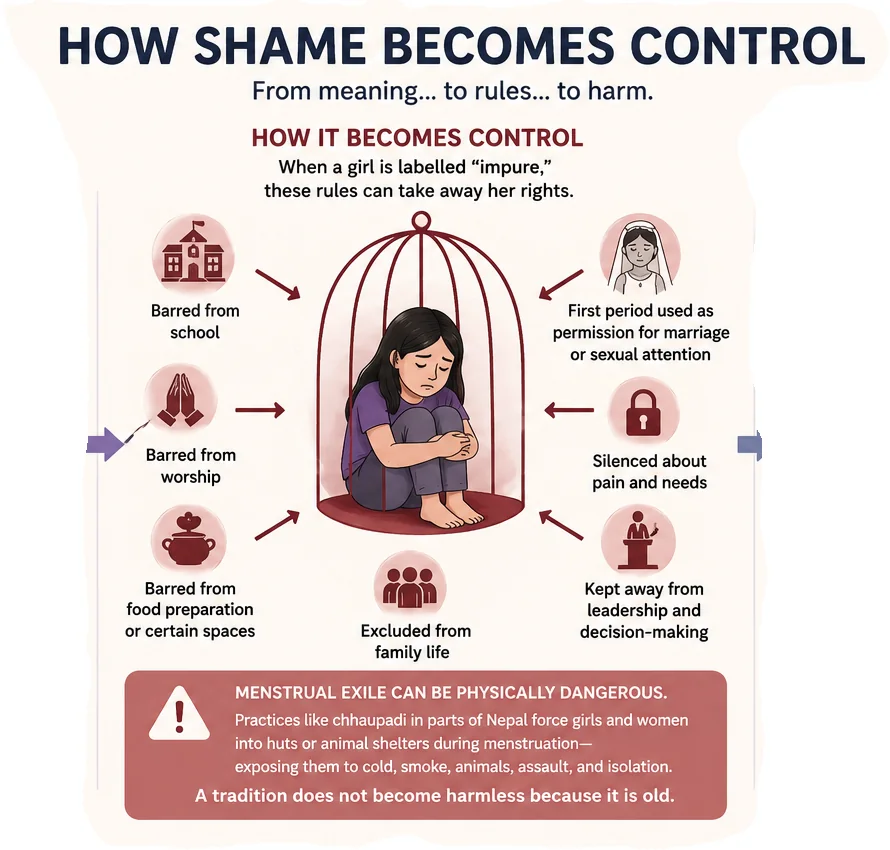
Some cramping, tiredness, breast tenderness, digestive changes, or mood changes can occur around a period. But pain that regularly stops you from sleeping, studying, working, walking, eating, or joining ordinary life is not something you should be told to “woman up” and endure.
Very painful periods can have several causes. Endometriosis is one possibility; adenomyosis, fibroids, infection, ovarian problems, and other conditions can also cause pain. Not every painful period means disease—but severe or persistent pain deserves a proper conversation and, when needed, an evaluation.
Heavy bleeding deserves attention too. Speak with a qualified healthcare professional if you:
- bleed for more than seven days;
- soak through a pad or tampon every hour for several hours;
- need to use more than one menstrual product at a time to contain the flow;
- repeatedly bleed through clothes or bedding;
- pass clots that seem unusually large for you;
- feel unusually exhausted, weak, dizzy, short of breath, or faint; or
- have periods that repeatedly stop you from attending school, work, or normal activities.
Heavy bleeding can lead to iron-deficiency anaemia, and in teenagers it can sometimes be a clue to a bleeding disorder. Keep a simple record of bleeding days, products used, flooding, clots, pain, medicines, and missed activities. You are not building a court case to prove that you hurt; you are giving a clinician useful information.
If you are fainting, struggling to breathe, having severe or rapidly worsening pain, or bleeding heavily while you might be pregnant, seek urgent medical help where you live.
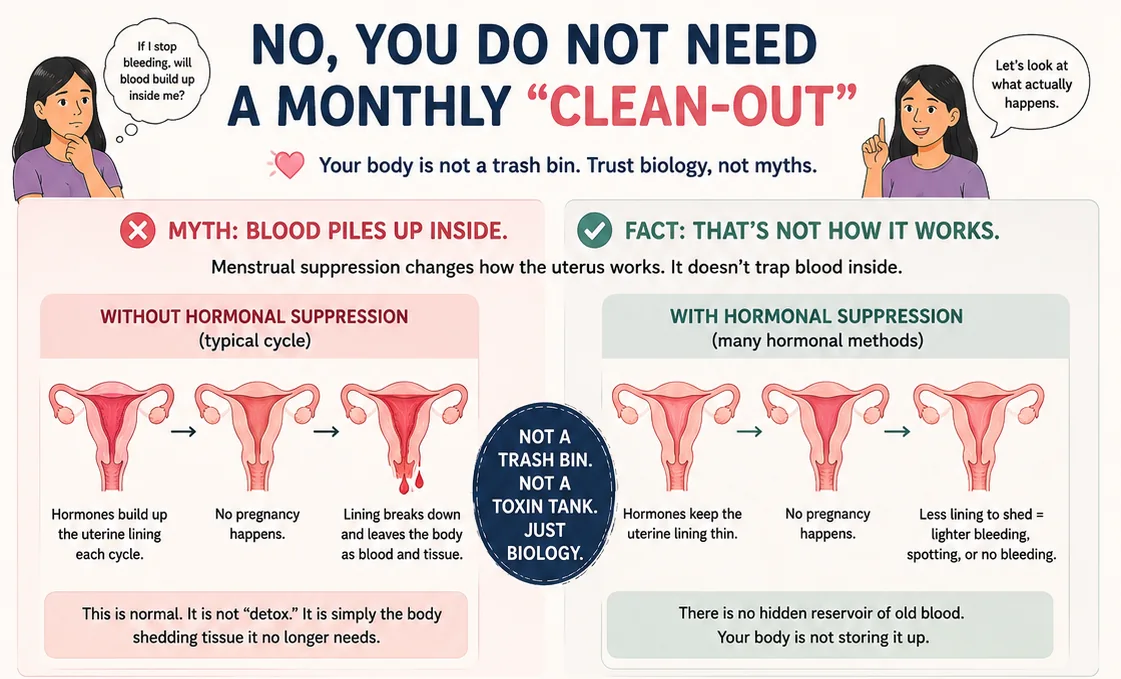
No, you do not need a monthly “clean-out”
Some people worry that using hormonal medication to delay or stop bleeding makes blood pile up inside the uterus.
That is not how menstrual suppression works.
Many hormonal methods keep the uterine lining thinner, so there is less material to shed. Less lining can mean lighter bleeding, irregular spotting, or no bleeding. There is no secret reservoir of old blood waiting to poison you.
For many people, medically appropriate menstrual suppression is a legitimate healthcare choice. It may be considered for heavy bleeding, painful periods, endometriosis, adenomyosis, anaemia, menstrual migraine, disability, trauma, gender dysphoria, limited access to bathrooms—or simply because monthly bleeding makes life harder.
Yes, quality of life counts. You do not have to win the Suffering Olympics before asking what your options are.
But Auntie will not replace one commandment with another. You do not have to suppress your period to be liberated, and you do not have to bleed every month to be “natural.” Autonomy means receiving accurate information and making the decision that fits your health, priorities, and comfort.
Your options deserve a real conversation
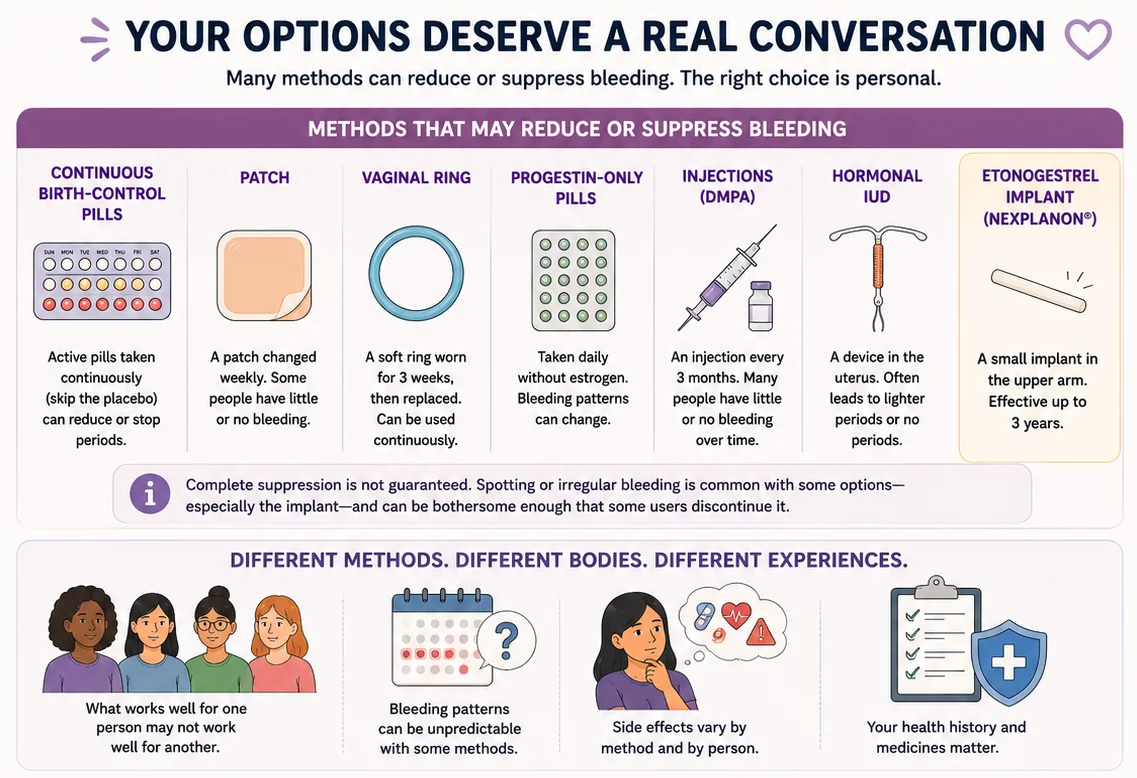
Methods that may reduce or suppress bleeding include certain birth-control pills used continuously, patches, vaginal rings, progestin-only pills, injections, hormonal intrauterine devices, and the etonogestrel arm implant sold under names including Nexplanon.
Different methods behave differently in different bodies. Complete suppression is not guaranteed. Spotting or irregular bleeding is common with some options—especially the implant—and can be bothersome enough that some users discontinue it. Other possible effects depend on the method and the person. Your health history matters too; a method that suits your friend may not be suitable for you.
Ask the prescriber:
- What result is realistic—no bleeding, lighter bleeding, or unpredictable spotting?
- What side effects and warning signs should I know about?
- Does my medical history or any medicine I take change the risks?
- How long should I try it before deciding whether it suits me?
- What happens if I want to stop or remove it?
- Does it prevent pregnancy, and do I still need STI protection?
Hormonal menstrual suppression does not protect against sexually transmitted infections. Depending on the method, condoms or other barriers may still matter. And if pregnancy is possible, an unexpected change in bleeding may need a pregnancy test or medical advice.
A good clinician should explain, not pressure. “This is what I recommend and why” is healthcare. “Do as I say; you would not understand” is chauvinism wearing a lanyard.
About Nexplanon: useful, not magical
Nexplanon is a small implant placed under the skin of the upper arm. It releases etonogestrel, a progestin, and is primarily used to prevent pregnancy. Some people also have lighter bleeding or less period-related pain while using it. Others experience frequent, prolonged, or unpredictable bleeding. In clinical studies, changes in bleeding were the most common reason users stopped the implant.
So let us keep both truths on the table: it can be a liberating option for some people, and a frustrating option for others.
That is not a contradiction. That is informed consent.
Nobody should sell you a miracle, frighten you away from a reasonable option, or dismiss side effects because a method is convenient for the system. You are allowed to ask questions. You are allowed to change your mind. You are allowed to request removal.
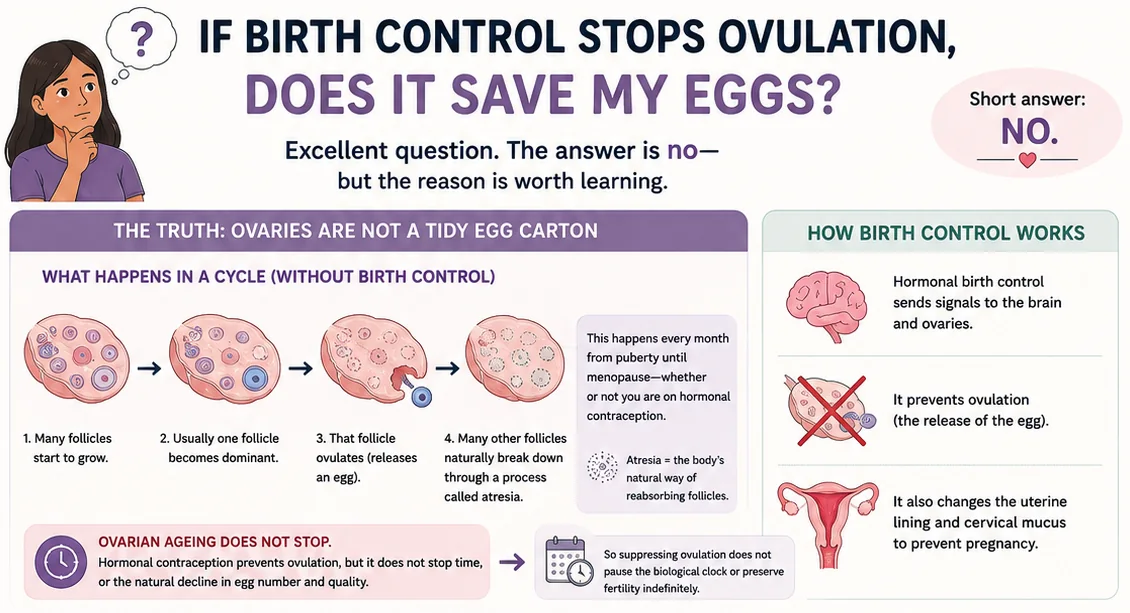
“If birth control stops ovulation, does it save my eggs?”
Excellent question. The answer is no—but the reason is worth learning.
The ovaries are not a tidy egg carton that releases exactly one egg each month while every unused egg waits untouched. In a cycle, a group of follicles begins to develop. Usually one reaches ovulation; many others naturally break down through a process called atresia. Ovarian ageing and changes in egg number and quality continue with time even when hormonal contraception prevents ovulation.
So suppressing ovulation does not pause the biological clock or preserve fertility indefinitely.
Egg freezing, embryo freezing, and—in selected medical situations—ovarian-tissue freezing are different procedures intended to preserve reproductive options. They involve costs, procedures, uncertainties, and no guarantee of a future baby. Age at freezing and the number of eggs or embryos stored affect the chance of success.
Menstrual suppression may not preserve eggs, but it can still preserve something precious: days of school, work, sleep, movement, concentration, and ordinary life.
Relief does not need to extend fertility to be worthwhile.
“Natural” is biology, not a moral instruction
Periods are natural. So are headaches, infections, poor eyesight, miscarriage, and disease. “Natural” tells us that something occurs in nature; it does not tell us that the thing is harmless, desirable, compulsory, or morally superior.
We use glasses to see. Insulin to live. Anaesthetic during surgery. Wheelchairs to move. Medicine to treat pain. Human beings have always used knowledge and tools to make bodies safer and lives more liveable.
Then a girl asks for relief from period pain and suddenly somebody becomes a philosopher of nature.
How convenient.
The suspicion is rarely just about medicine. It comes from an old expectation that women and girls should absorb discomfort without disturbing the room. Be pleasant. Be productive. Be fertile—but only at an approved time. Be attractive—but not sexual. Bleed—but keep it invisible.
That double standard is not anatomy. It is social control.
Medicine does not get a free pass either
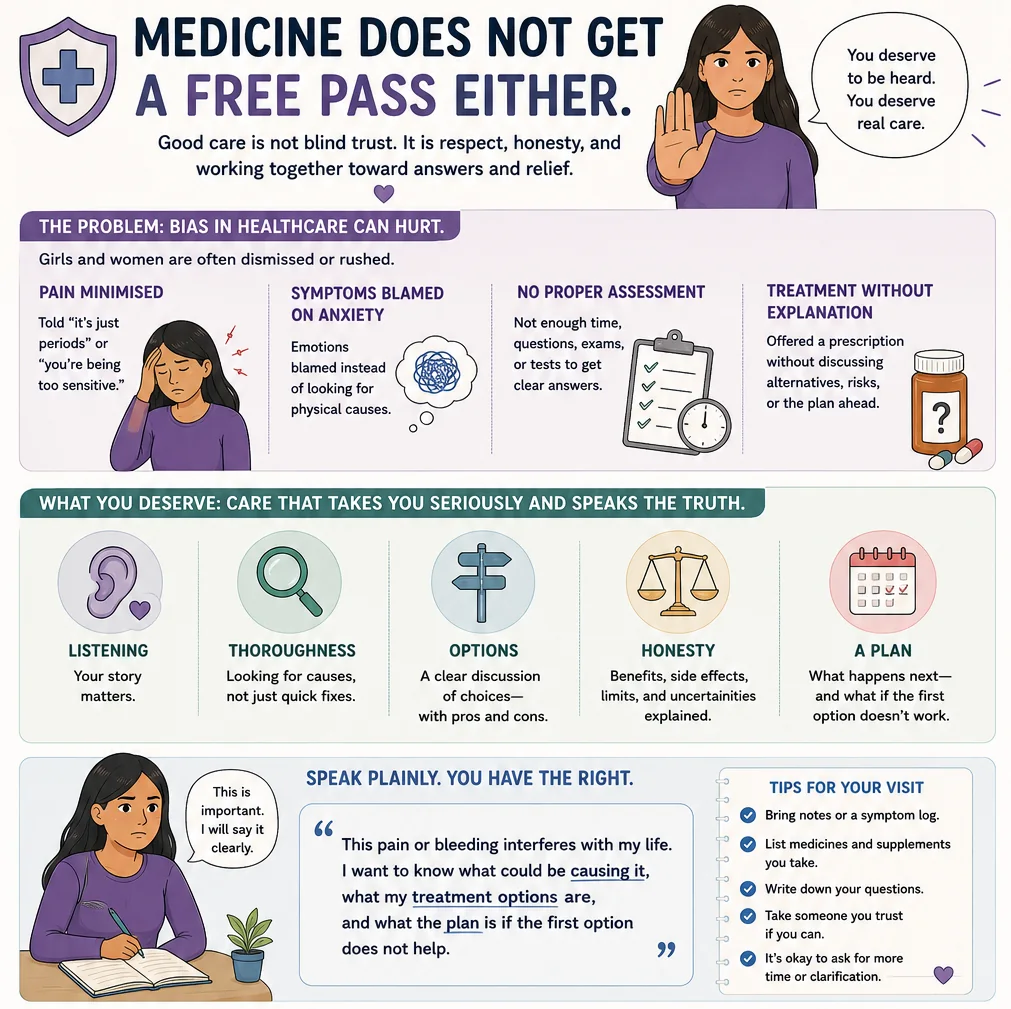
Tradition is not the only place where girls are dismissed. Healthcare can repeat the same bias when pain is minimised, symptoms are blamed on anxiety without proper assessment, or treatment is offered without explaining alternatives.
You deserve care that takes you seriously. You also deserve honesty: sometimes the first treatment does not work; sometimes a diagnosis takes time; sometimes evidence is incomplete; and every medicine involves trade-offs.
If you can, bring notes and say plainly:
“This pain or bleeding interferes with my life. I want to know what could be causing it, what my treatment options are, and what the plan is if the first option does not help.”
If you are dismissed, seeking another qualified opinion is reasonable. Being young does not make your symptoms imaginary. Being female does not make suffering your destiny.
What every girl deserves to learn
Before her first period, every girl should know:
- A period is a biological process, not dirt, punishment, or proof of womanhood.
- Menstrual blood is blood and uterine tissue; it is not poison.
- Bodies and cycles vary, especially in the first years after periods begin.
- Severe pain and very heavy bleeding deserve attention.
- Period products are tools, not objects of shame.
- Hormonal medicine has uses beyond preventing pregnancy.
- Menstrual suppression can be safe for many people, including adolescents after periods have begun, but the method must be chosen individually.
- No method guarantees a perfectly bleed-free life.
- Consent applies in healthcare: explanations, questions, privacy, and choice matter.
- Not every girl menstruates, not everyone who menstruates is a girl, and nobody’s gender or worth is proved by bleeding.
Most of all, she should learn this:
You do not earn dignity by suffering quietly.
Auntie’s last word
The question is not whether menstruation is natural. Of course it is.
The better questions are:
Why are we quicker to defend the tradition of suffering than the person who is suffering?
Why are people more frightened by the idea of safely stopping a period than by a girl missing school every month from pain?
Why is silence praised as maturity when speaking up could lead to care?
You may choose to menstruate without medication. You may ask about reducing or suppressing bleeding. You may try a treatment and decide it is not for you. None of those choices makes you more or less feminine, pure, grown, strong, or worthy.
Your body is not dirty.
Pain is not a moral duty.
Relief is not betrayal.
And anybody who needs your silence in order to keep you obedient is not protecting you.
— Auntie Gyn-y
Sources Auntie checked
- WHO: Menstrual health
- WHO statement on menstrual health and rights
- UN Women: Abolishing chhaupadi and breaking menstrual stigma in rural Nepal
- ACOG: General Approaches to Medical Management of Menstrual Suppression
- ACOG: Screening and Management of Bleeding Disorders in Adolescents With Heavy Menstrual Bleeding
- ACOG: Dysmenorrhea—Painful Periods
- FDA: Nexplanon prescribing information
- ASRM: Fertility preservation in patients with medical indications
- ASRM: Planned oocyte cryopreservation