“I Wanna Go to Platform 9¾”
My love letter to Harry Potter—and a plea to J K Rowling.
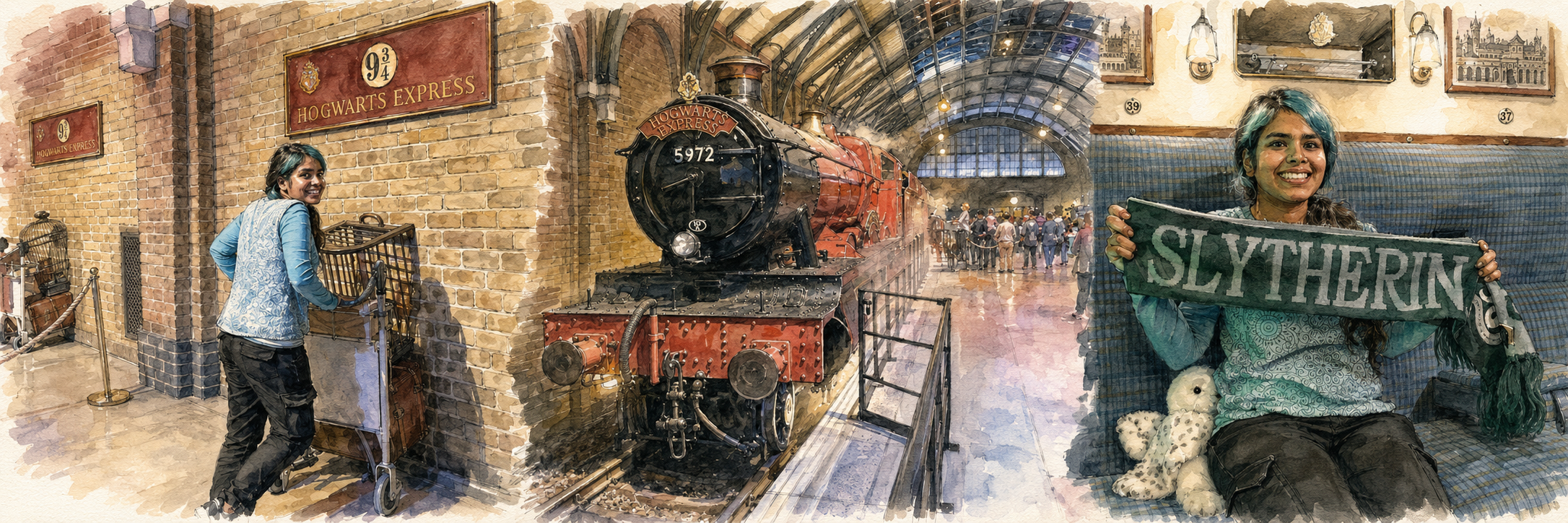
My husband recently asked me what I wanted to do for my birthday. I thought and thought, and then I remembered: this year marks twenty-five years since the first Harry Potter film came out.
The answer was obvious. I want to go to the real Platform 9¾ at King’s Cross. Yes, that is what I would love to do for my thirty-sixth birthday.
The timing could not be more perfect. In the Harry Potter world, September 1 is the day students board the Hogwarts Express and return to school. Twenty-five years after Harry Potter and the Philosopher’s Stone first reached cinemas, I want to stand beside the luggage trolley embedded in the wall at King’s Cross and pretend, just for a moment, that I am going too. The real Platform 9¾ display is in the station, where anyone is welcome to take a photograph for free.
At thirty-six, I am still that child.
I still love Harry Potter, even though I can now see the gaping plot holes staring sharply back at me. I have read countless other books. I minored in literature. I became a mother. I learned to examine stories critically and recognise the troubling parts of the things I love.
But the magic is still magic.
My history with Harry Potter actually began with a lie—or, more accurately, an unnecessary performance of confidence that has embarrassed me ever since.
In 2001, my computer teacher asked me whether I liked watching movies. I did not know how to say yes, or perhaps I did not know how to continue the conversation, so I simply shook my head. Then he asked whether I had watched Harry Potter.
I had no idea what he was talking about.
But I was too proud to admit that, so I said, with entirely undeserved arrogance, “I don’t watch movies.”
I have regretted that sentence ever since.
I am almost certain that teacher does not remember me saying it. It probably did not matter to him at all. It may not even have registered as an unusual interaction. But it left a wound in me—the kind created not by what another person did, but by the humiliation of remembering the person you were unable to be in that moment. I wanted to be someone who knew what he was talking about. Instead, I pretended not to care.
I did not properly discover Harry Potter until 2004, when Prisoner of Azkaban came out. At the time, the five of us were living in a tiny studio apartment in Dubai. For my birthday, Mum took us to Toys“R”Us. There, we saw life-size posters of Daniel Radcliffe, Emma Watson, and Rupert Grint dressed in Muggle clothes, their hair looking wonderfully messy and cool.
I became obsessed before I even knew what I was looking at.
I convinced Mum to buy us the movie. We promised we would not ask for anything else for an entire year. I do not know whether any child has ever honoured a promise like that, but Mum eventually relented.
We went home and watched the third movie. Then we searched everywhere for copies of Philosopher’s Stone and Chamber of Secrets. Once we had all three, we watched them again and again because they were all we had. We watched until we had memorised every scene and almost every line of dialogue.
That was it. There was no going back.
I had read books before then, in both Bangla and English—David Copperfield, Aesop’s fables, and many others. But I had never read anything that brought me that much joy. Once I found the Harry Potter books, I devoured whatever had been published. From then on, I read the books and watched the available movies almost every year.
The habit stayed with me. So did the excitement.
This year, I bought the Timbits and the hoodie. I tried the promotional doughnuts. I am still looking for the colour-changing wand. I visited the Harry Potter experience in London. I have collected Lego sets and the beautiful MinaLima editions of the books. My husband spent a buttload of money so I could watch Harry Potter and the Cursed Child with Tom Felton playing Draco Malfoy as an adult—and I kept almost everything from that day. Felton returned to the role on Broadway more than a decade after last playing Draco on screen.
My eleven-year-old self could never have imagined any of this. My thirteen-year-old self would be violently jealous.
Even now, whenever anything related to Harry Potter appears, part of me becomes that child again—the one who lived in a cramped studio apartment but had somehow found a doorway into an enormous castle. That is what these books did for me. They made the walls move. They gave me somewhere bigger to live inside my own head.
And they did something like that for millions of other people.
Tolkien created Middle-earth. Mary Shelley gave us Frankenstein. Louisa May Alcott gave us Jo March. Robert Jordan, George R.R. Martin, and Brandon Sanderson built worlds large enough for readers to disappear into. But Rowling achieved something unprecedented: Guinness World Records recognises her as the first billion-dollar author. Forbes now estimates that more than 600 million Harry Potter books have been sold and that the eight original films earned almost $7.7 billion worldwide. It currently estimates Rowling’s fortune at approximately $1.2 billion.
That is more than wealth. It is cultural power. It is the power to introduce words, characters, values, and entire moral frameworks into the childhoods of generations.
And that is why what J.K. Rowling chooses to do with her voice matters so much.
I know this is not the clean answer that will satisfy everyone’s political purity test. Some people believe that continuing to love Harry Potter makes me morally suspect. Others believe that criticising Rowling makes me ungrateful—or that any criticism of her is automatically an attack on women.
I do not accept either position.
I am a Harry Potter fan. An avid one. I am also an adult living in the post-COVID 2020s, watching Trump-style cruelty become disgustingly and increasingly normal, while people like Mamdani and Carney feel like rare gems fighting to level the playing field, all while trying to repair damage left by our parents’ and grandparents’ generations. They fight for—and speak about—public power as a responsibility rather than merely a weapon.
Rowling holds a kind of power most writers could never have imagined. Yet so much of her public presence now appears to be spent fighting an exhausting internet war over sex and gender—and belittling people who disagree with her.
When Emma Watson said that she still treasured Rowling despite their disagreement and hoped people with opposing views could continue to love one another, Rowling responded by calling her “ignorant of how ignorant she is.”
Threatening Rowling is wrong. No political disagreement justifies threats of rape, torture, or death. But experiencing cruelty does not give anyone a permanent licence to pass cruelty forward.
To me, publicly calling Emma Watson ignorant after Watson expressed affection despite disagreement did not look like a careful defence of women’s rights. It looked like a powerful person choosing humiliation over conversation. It looked petty. And from the woman who created Hermione Granger, it was especially heartbreaking.
Rowling has already demonstrated that she can use her influence for extraordinary good. She founded Lumos, an organisation working to replace institutional care with family- and community-based support for children. Her philanthropy has also supported women, children, people living in poverty, and neurological research through the Anne Rowling Regenerative Neurology Clinic. Her own website lists these projects and the causes she has funded. Forbes estimates that she has given more than $200 million to charity.
That matters. I do not want to erase it simply because I disagree with her now.
In fact, it is precisely because she has done meaningful good that I find her current choices so frustrating. She knows how to direct money, attention, and influence towards people who need them. She has already proved that she can change lives outside the pages of her books.
So why choose to spend so much of that influence making the world feel smaller?
J.K. Rowling, nobody is asking you to walk into the Forbidden Forest to die for the world, as Harry did. Nobody is asking you to surrender your beliefs, stop caring about women, or remain silent when you genuinely believe something is wrong.
I am asking you to remember the lessons you wrote for the rest of us.
Power reveals character. Cruelty does not become righteous merely because we believe our side is correct. The people we fear or misunderstand are still human. And when we possess more power than almost everyone around us, the burden to use it carefully becomes greater—not smaller.
Speak better. Do better. Be better.
You gave generations of children a story about resisting authoritarianism, questioning inherited prejudice, protecting people treated as less than human, and choosing love even when hate was easier. Please do not now ask those children—many of whom are adults—to pretend those lessons only applied inside the books.
I want to pass Harry Potter on to my child. I want to show him the moving staircases, the enchanted ceiling, and the Marauder’s Map. I want to watch his face when he discovers the magic for himself.
I do not want to hand him the books with an apology attached.
So please, Jo: speak better, do better, be better, so that we can happily pass the torch of the Harry Potter fandom to our children’s generation—and so the magic can survive for generations after us.