Too Busy for Breakfast. Available to Choose My Husband.
The Parenting Playbook — Part 6: helicopter parenting, the temptation to take over, and helping a child participate without withholding the support they need.
The Parenting Playbook — Part 6: Exploring Helicopter Parenting
My parents were not helicopter parents.
Need breakfast? Clothes? Someone to help you avoid a beating at school?
Not their department.
But you are eighteen, and there is a forty-five-year-old mechanical engineer you could marry?
Suddenly, my mother was very available.
Buying a house? Take this one.
Your child feels lonely? Have another baby, doll.
There was considerable interest in the major decisions. The everyday support was harder to locate.
I remember barely sleeping three hours on a school night, then trying to gobble down bread while running to catch the boat I needed to reach the road. Some help with breakfast—even spreading the mayonnaise properly—would have been welcome.
Apparently, helicoptering at that altitude was beneath my parents.
Marriage, property and reproduction, however? Excellent flying conditions.
So, what exactly is helicopter parenting?
Before I give the helicopter an unfairly specific job description, there is a distinction worth making.
My parents’ involvement in major life decisions sounds more like selective control than the sustained hovering usually associated with helicopter parenting. They were not constantly supervising my schoolwork, solving my problems or preventing me from making mistakes. Quite the opposite. Many ordinary responsibilities were left entirely to us, even when we were too young to manage them comfortably.
But when it came to decisions that would shape my adult life, they apparently had plenty of opinions.
Helicopter parenting generally involves excessive parental involvement: making decisions, taking over tasks, managing conflicts or solving problems that a child could reasonably handle with appropriate support. The parent is constantly hovering, ready to intervene before the child has had much opportunity to try.
What counts as excessive depends on the child’s age, abilities and circumstances. A six-year-old needing help is not the same as a twenty-year-old having every email written by their parent. Researchers also differ in how they define and measure helicopter parenting. Research on helicopter parenting and overprotection.
So I do not have a childhood full of someone doing everything for me to draw from.
I have to imagine that part.
What does hovering actually look like?
Imagine a child working on a school project. The parent notices something crooked. Fixes it. Changes the colours. Rewrites a sentence. Eventually, the child is sitting beside an adult completing a project about the importance of independent learning.
Excellent teamwork. One person has learnt something about glue.
Or a child has an ordinary disagreement with a friend. Before helping them work out what happened or what they might say, the parent calls the other family and manages the entire conversation.
Or a teenager needs to send a straightforward message to a teacher. The parent writes it, edits it and sends it because doing it themselves is quicker, safer and more likely to produce the desired result.
These are imagined examples, not memories of my upbringing. But the underlying question is the same: is the parent helping the child participate, or repeatedly replacing the child’s participation with their own?
The distinction matters because childhood is not only about arriving at the correct outcome. It is also about learning how to get there. Making decisions, trying things, getting them wrong, correcting them and occasionally dealing with a little disappointment are all opportunities to practise.
If an adult keeps doing those things for the child, the finished project may look wonderful. But who actually learnt how to make it?
I can understand the temptation, though
After growing up with so little everyday support, I can understand wanting to make sure my own child never feels that alone.
And sometimes I wonder whether I go too far in the other direction.
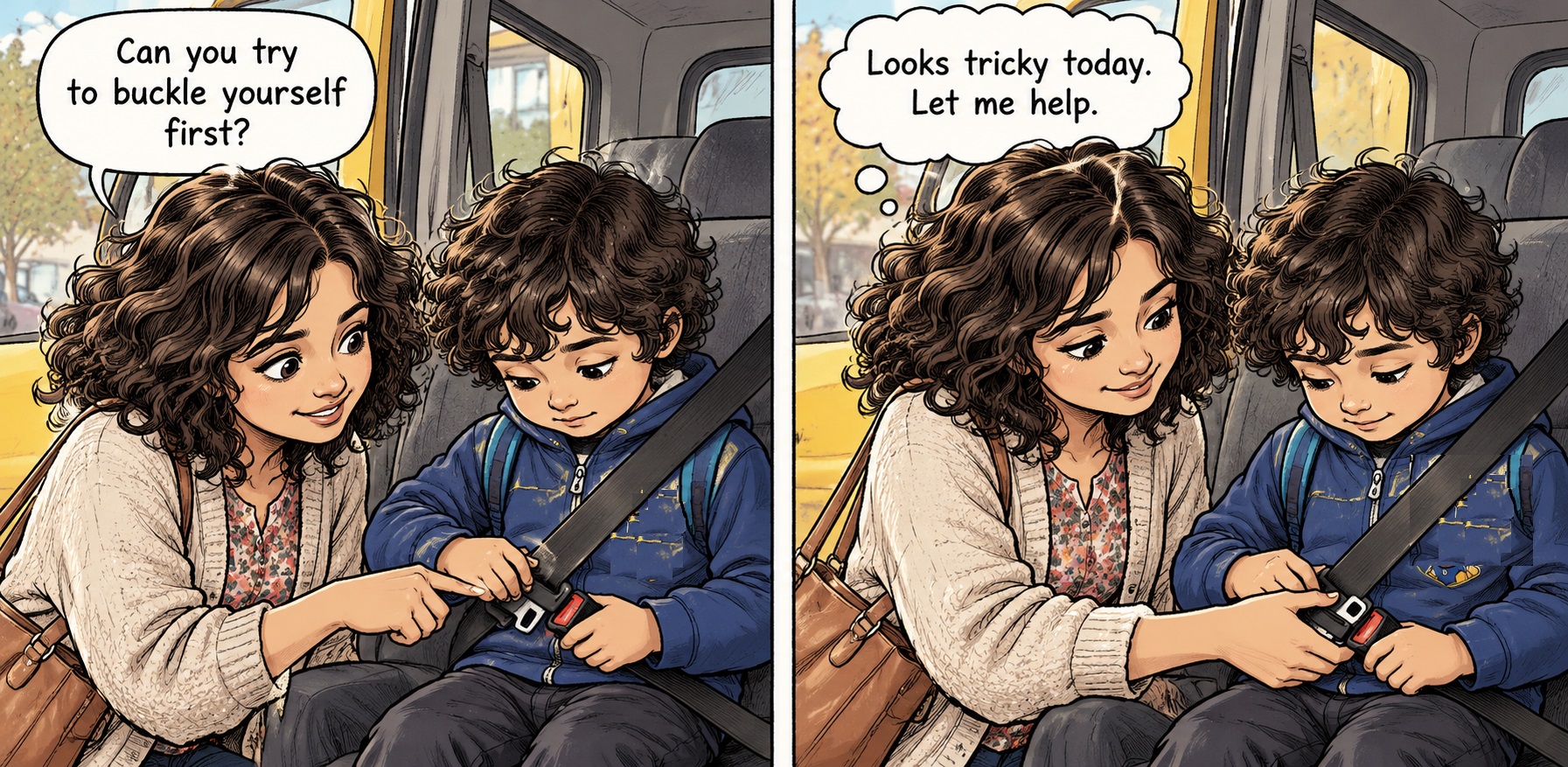
Today, for instance, I buckled my son into his seat when he got into the school van. Apparently, he buckles himself on the way home.
So what am I doing here? Helping him, or unnecessarily doing something he can already manage?
I know he can buckle himself. I also know that mornings can be difficult for us. Sometimes I help because we are rushing, sometimes because he asks, and sometimes I do things without really stopping to consider whether he needs me to.
Does that make me a helicopter parent?
Not necessarily. One instance of helping him with a seat belt does not establish a parenting style. But it does give me something useful to examine.
Could I ask him to try first? Could I stay beside him while he does it? Could I help only with the part he finds difficult?
Of course, a seat belt is a safety issue, and I remain responsible for making sure he is properly secured. Independence does not mean letting him travel incorrectly buckled just so I can say he did it himself.
But perhaps I can make room for the attempt without compromising the outcome.
And this is where I think helicopter parenting becomes complicated. Attention matters. Advocacy matters. Being available matters. But does being available require preventing every manageable mistake?
Can too much help actually hurt?
Research suggests there may be a cost to overprotective parenting, particularly when it limits opportunities to develop autonomy and confidence.
A systematic review of helicopter parenting and mental health examined 38 studies involving adolescents and adults, including studies of related controlling or overprotective parenting. Most found associations between helicopter parenting and symptoms of anxiety or depression. However, the researchers also identified substantial limitations, particularly in establishing cause and effect.
So I cannot say that hovering necessarily causes anxiety or depression. Nor can I predict how any particular child will turn out based on one parenting behaviour.
But the concern makes sense to me. If someone else always solves the problem, how does the child find out whether they could have solved it themselves? If every disappointment is prevented, when do they practise recovering from one?
The intention might be protection. The result might be fewer opportunities to develop confidence through experience.
There is also a difference between supporting a child through something difficult and removing every difficulty before the child encounters it.
The question is not whether parents should help.
It is whether the help is building the child’s ability to manage more, or making the parent increasingly necessary for things the child could learn to do.
But what about children who genuinely need more support?
This is where I need to be particularly careful, because I have an autistic son.
I am not interested in turning necessary support into another parenting offence.
My son uses visual schedules. He sometimes needs help with communication, transitions and personal-care tasks. I advocate for him at school, work with his coaches and try to understand why something that looks simple from the outside can be so difficult for him.
That is not automatically helicopter parenting.
A child who needs assistance does not become excessively dependent simply because an adult provides it. Nor does independence have to mean doing everything without help.
For my son, I would rather ask whether the support gives him more access, more participation and more opportunities to make choices.
Sometimes I may need to demonstrate something. Sometimes I may need to break it into smaller steps. Sometimes I may need to help physically. Other times, I may need to stay nearby and let him work through it.
His abilities also change depending on the task and the circumstances. Being able to do something once does not necessarily mean he can do it independently every time.
The objective is not to withdraw support just because he has reached a particular age. It is to understand which support he needs and whether we can gradually give him more room to participate.
There must be something between doing everything and doing nothing
In the previous article, I wrote about my sister asking our father for help with schoolwork and receiving a lecture about dependence instead.
That is certainly not the alternative I want.
There has to be room between refusing to explain a task and completing it while the child watches.
Show me. Let me try. Stay available.
For me, that is probably the most useful lesson from examining helicopter parenting. I do not have to choose between being involved in everything and leaving my child to figure everything out alone.
I can offer help without automatically taking over. I can let him make manageable mistakes without withholding support when he genuinely needs it. I can advocate for him without assuming that he will never be able to advocate for himself in ways that suit his abilities.
And when he asks for help, I can consider what kind of help he actually needs.
“Would you like me to show you?”
“Do you want help getting started?”
“Would you like me to stay beside you while you try?”
Or perhaps he needs me to do the task with him that day. That is okay too. What matters is recognising the difference between responding to a need and taking over out of habit.
What I want to carry forward
I want my son to know that he can ask me for help without receiving a lecture about dependence.
I also want him to have opportunities to discover what he can do himself.
Those two things are not opposites.
There will be times when I need to step in. There will be times when I need to step back. And there will probably be plenty of times when I get the balance wrong and have to reconsider.
But I want to be conscious of it.
I do not want to become so afraid of repeating my parents’ neglect that I end up managing every part of my son’s life. Nor do I want to mistake withholding help for teaching independence.
And when he is older, I hope I can offer an opinion about his choices without appointing myself the final authority on his house, partner or family size.
I know how it feels to have adults deeply invested in controlling my future while remaining strangely unavailable for the ordinary things I needed from them.
I do not want to repeat that, in either direction.
For now, I would rather pay attention to what my son actually needs and give him room to do what he can.
Sometimes that means stepping back.
Sometimes it means staying beside him.
And sometimes, for heaven’s sake, it means making breakfast!
About this series: The Parenting Playbook explores parenting philosophies through personal experience and research. Helicopter parenting is not a standalone diagnosis or a label that can be assigned from one act of helping. My aim is to examine when support is useful, when it becomes excessive and how that distinction changes with the child's needs, abilities and circumstances.