Authoritarian Parenting, Criticism and the Cost of Being a “Good Girl”
The Parenting Playbook — Part 3: what obedience, constant criticism and the need to be acceptable taught me—and what I want to teach my child differently.
The Parenting Playbook — Part 3
Content note: Childhood humiliation, body-shaming, abusive relationships and an ableist slur.
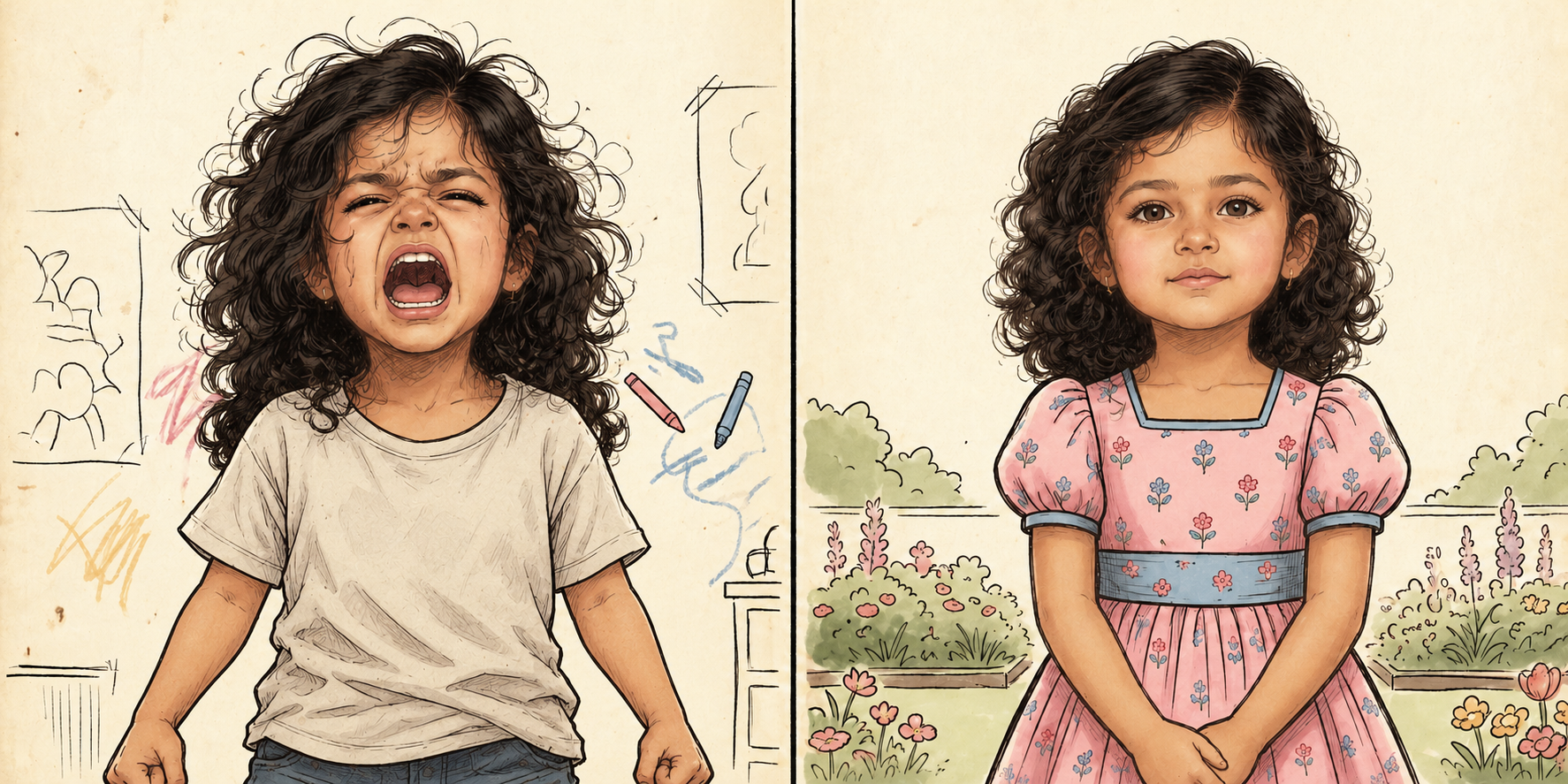
There is a difference between my mistakes and my regrets.
I have made mistakes because I wanted something, misunderstood something or made a decision that turned out badly. Those are mine. But many of the things I regret most came from trying to become the person the adults around me insisted I should be. I did not necessarily want those things. I wanted to be acceptable.
This series began with a question: does a well-behaved child necessarily mean a child who is doing well? In Part 2, I looked at a difficult morning with my son and explored authoritative parenting—how to listen without abandoning the expectation, and how to guide without turning everything into a battle.
This time, I am looking at the other side of that relationship. What did it feel like to be the child? What did I learn while the adults were busy teaching me how to behave?
Because I learnt a lot. Just not always what they thought they were teaching.
What makes parenting authoritarian rather than simply firm?
Authoritarian parenting places greater emphasis on obedience and control, with less responsiveness to the child’s perspective. Authoritative parenting combines expectations with warmth, explanation and support. Both can involve rules. The distinction is how the relationship works around those rules: whether the child’s perspective is something to understand or an obstacle to obedience. https://www.apa.org
For me, that is the difference between “I am responsible for guiding you” and “My authority settles the matter.”
A firm instruction is not automatically authoritarian parenting. I am not suggesting that stopping a child from running into the road requires a committee meeting. The question is what happens across the relationship: does the child have room to ask, explain, make mistakes and be heard? We are looking at a recurring approach, not classifying an entire family from one impatient morning.
My parents were not following one book or one recipe. Their approach did not fit neatly into a single category. What is clear is that they did not take over tasks and do everything for us. They demanded conformity while repeatedly making us feel that we were not good enough.
There was something wrong with how we cracked an egg, cooked a vegetable, ironed their clothes or wiped the floor. Remember, I am talking about things we were doing when I was between six and nine.
Being endlessly corrected was not the same as receiving useful guidance.
When correction becomes a judgement about the child
Growing up, there was apparently something wrong with almost every way I existed. I laughed too loudly. I danced too freely. I sang too loudly, ran too much, walked funny and talked funny. I was a gossip. I could not keep a secret. My butt was too big. My breasts were too big. I looked too much like an adult woman, but somehow I was also too rough, too gangly and not womanly enough.
Even my laugh became something to discuss in terms of whether it would attract a boy—and this was coming from my mother! My body was apparently too womanly, but my behaviour was not womanly enough. Excellent. Very clear instructions for a child.
The message I understood was that I needed to dial myself down. So I tried to fix my walk, fix my voice and fix my reactions. I wanted to look neat, with my hair properly done—but not so well done that I was trying to attract attention. Just enough to be a nice girl. ভালো মেয়ে. Whatever that was supposed to look like. And I kept trying.
There is a related term that helps me understand another part of this: psychological control. Researchers use it to describe intrusive or emotionally manipulative parenting, including guilt, shaming, personal attacks and invalidating feelings. It is different from setting expectations about a child’s behaviour. DOI
“Please lower your voice because someone is sleeping” gives me a reason to adjust what I am doing. Mocking the way I laugh teaches me to question something about myself.
I am not saying every authoritarian household looks like mine. I am examining what happened when the demand for obedience came with relentless criticism and body-shaming. Those things were tangled together in my life. No single parenting label captures all of that.
I remember being a happy child who loved jumping around. Then I was told that I was developing breasts and that jumping looked vulgar. I was six! Instead of being allowed to move comfortably in my own body, I became conscious of how that body might look to grown men. Thirty years later, I still hold my chest when I jump because part of me is still responding to that instruction. The adult does not have to be standing beside me anymore. I remember what they said.
The same thing happened with my laugh. I used to laugh with my mouth open, showing all my teeth. Someone mocked it. Now, even while laughing, I can find myself wondering whether the people beside me are making fun of me. Do they think I look ridiculous? Are they noticing how I move, how I speak, how I sound?
I want to be able to enjoy something without simultaneously assessing whether I am enjoying it in an acceptable way.
These were not lessons about avoiding harm or respecting another person. I was not hurting anybody by laughing or jumping. I was learning that even joy needed to be checked before it was allowed out.
The “good girl” rules did not stay in childhood
When someone was mean, I was supposed to avoid saying what came to mind and say what a nice girl should say instead. When something did not interest me, I was supposed to keep at it. Giving up was what losers did.
Those instructions did not stay neatly confined to childhood manners.
The first time a guy mistreated me, I did not react the way I wish I had. I was kind. I pretended it was okay. I even said it was okay.
When people avoided me, I went towards them more. I wanted to prove that I was not mean, that I cared, that I would stay. I made myself available to people who repeatedly hurt me because being dependable had become more important than asking whether the relationship was good for me.
I held on to jobs I hated. I held on to a friendship with someone I had come to despise because of how often they hurt me. I stayed in abusive relationships partly because I did not want to be the kind of girl who moved on after being intimate. I wanted to be loyal. Reliable. Someone who did not give up on people.
Looking back, I hate how often I stayed.
But my difficulty defending myself did not make someone else’s mistreatment my fault. Saying “it’s okay” did not make it okay. The responsibility for hurting me belonged to the people doing it.
What I regret is how thoroughly I had learnt to distrust the part of me that wanted to leave. I had learnt persistence without enough permission to recognise when persistence was costing me too much.
Research describes affection and approval that depend on meeting a parent’s expectations as parental conditional regard. A meta-analysis covering 31 samples associated it with more internally pressured behaviour, self-worth dependent on meeting expectations, more depressive symptoms and less relational closeness. These were associations, not proof of what caused any individual person’s difficulties. But the idea of needing to meet conditions before feeling acceptable is painfully familiar to me. PubMed
I wanted to be a good person. Somewhere along the way, I learnt that being good meant being endlessly available for things that hurt.
A quiet child is not necessarily a comfortable child
Around 2006, my physics teacher asked me something I did not comprehend. I stared at him, trying to understand, and he called me “a retard” in front of the whole class.
I sat there. I did not know what the correct reaction was. I knew it hurt. I did not know what I was allowed to do with that hurt.
There were other times when people, including my mother, called me a liar to my face. I heard them. I understood them. I cursed myself internally. But I did not defend myself because I had not been asked a direct question.
That detail still bothers me. I was being accused of something, but I was waiting for permission to respond.
My teacher was not my parent, obviously. But I recognise something familiar in my silence: before I could respond to what someone had done, I was trying to work out what an acceptable response would look like.
This brings me back to the question in Part 1. From the outside, perhaps I looked composed. Inside, I was hurt and uncertain. Silence did not mean agreement. It did not mean I was fine.
I do not want to look back at that child and accuse her of failing to stand up for herself. There were adults in those situations. They had responsibilities too.
What can I say about the effect on my mental health?
I can describe the constant self-monitoring. Before laughing, speaking, reacting or leaving, I learnt to ask whether I was doing the right thing. Whether I was feeling the right thing. Whether I was showing too much, or showing it incorrectly.
I think that fed my anxiety. It certainly made trusting myself harder.
But I need to separate what feels connected from what I can establish. I cannot turn my childhood into a neat explanation for every diagnosis or assume that every habit I developed belongs to a particular condition.
What I can say is that these experiences hurt me, shaped how I responded to people and left patterns I am still trying to understand. I am not trying to prove the origin of every diagnosis. I am saying the way I was treated was harmful to me.
That distinction lets me acknowledge the harm without pretending I have solved every question about my brain.
Can authoritarian parenting have positive effects?
This series is supposed to examine parenting approaches, not just assign them a villain costume. So the question deserves a real answer.
Parents may want obedience because they associate it with safety, discipline, perseverance or respect. Some people raised in strict households do become capable, conscientious adults. But that alone does not establish which practices helped, which hurt or what other support made a difference.
Research distinguishes behavioural control, such as rules and monitoring, from harsh or psychological control. A meta-analysis of 1,435 studies found small associations between behavioural control and fewer externalising difficulties, such as aggression or disruptive behaviour. Harsh control, psychological control and authoritarian parenting were associated with more of those difficulties. These are patterns across studies, not predictions for every child. PubMed
So the useful ingredients—structure, expectations and responsibility—do not require humiliation. They are not exclusive to authoritarian parenting.
Nor does culture make this a simple question. The APA’s research overview acknowledges variation across cultural contexts and the difficulty of separating parents’ influence on children from children’s influence on parents. There is more to understand than one label can tell us. https://www.apa.org
But acknowledging complexity does not require treating humiliation as a useful teaching method. The American Academy of Pediatrics advises against shaming and verbal abuse; its discipline guidance describes aversive methods as minimally effective in the short term and ineffective in the long term. PubMed
For me, the question is not only whether an instruction produces obedience. It is what the apparent success costs.
I did become more careful about how I laughed. I did stay in situations I wanted to leave. I did sit quietly when someone insulted me. The instructions changed my behaviour. That is not the same as saying they helped me.
Same situation, different lesson
In Part 2, I looked at what I could change in a school morning without abandoning the expectation. Here, I want to make a similar distinction between correcting an action and making the child feel defective.
These are illustrative contrasts—not quotations from my childhood, things I claim to get right every time, or scripts guaranteed to work.
| Situation | A controlling or shame-based response | What I want to do differently |
|---|---|---|
| My child makes a mistake during an age-appropriate task. | Treat the mistake as evidence that something is wrong with the child. | Show him what needs changing, offer appropriate help and give him a chance to practise. |
| My child is loud while someone is resting. | Mock his voice or laugh. | Explain that someone is resting and ask for a quieter voice. The situation needs adjusting, not his personality. |
| My child is happily jumping somewhere safe. | Make his body or movement a source of shame. | Ask myself whether anything needs correcting at all. |
| My child questions a rule. | Treat the question itself as disrespect. | Hear the question, explain the reason and maintain a necessary limit. |
| My child says somebody has mistreated him. | Prioritise politeness or avoiding a scene. | Take his account seriously, understand what happened and help him consider a safe response. |
The lesson is not “never correct my child.” It is correct what needs correcting without making being himself the offence.
I can value responsibility without teaching him that he must endure mistreatment. I can value perseverance while teaching him that some situations are worth leaving. I can teach consideration for other people without making his own discomfort the least important thing in the room.
And I can remember that the things I regret were not all decisions I made freely and then disliked. Many were decisions I made because I was still trying to satisfy someone else’s definition of a good girl.
I do not want that to become my son’s version of being a good boy.
What I want to carry forward—and what I am still unlearning
I wish I had been taught that kindness includes me. That being dependable does not mean being permanently available to people who hurt me. That intimacy does not create an obligation to remain in an abusive relationship. That leaving is not always failure, and answering back is not always disrespect.
I wish someone had helped me become comfortable being myself instead of making self-correction my constant responsibility.
As a mother, that is the part I want to pay attention to. My son needs guidance, limits and help understanding how his behaviour affects others. But I do not want him to come away from every correction believing that he, as a person, needs fixing.
I want there to be a difference between “that action hurt someone” and “there is something wrong with you.” I want him to tell me when something feels wrong without first checking whether a good child is allowed to feel it.
That is the question I am taking from this third part of the series: am I helping my child develop judgement, or am I mainly teaching him to avoid my disapproval?
I am still trying to give myself permission to make that distinction too. I have not reached some beautiful stage where I dance freely, laugh without hesitation and never second-guess a boundary. I still hold my chest. I still notice myself checking other people’s reactions. Knowing where an instruction came from does not immediately stop me from following it.
But I am starting to question what I used to accept as goodness.
I regret the times I stayed. The times I reassured someone who had hurt me. The things I did to prove I was the right kind of girl. I wish those decisions had been more mine.
I cannot go back and make them again. What I can do now is stop treating every old rule as something I still owe obedience to.
I still want to be kind. I just do not want being kind to require abandoning myself.