Does a Well-Behaved Child Mean They’re Okay?
Rethinking what we inherited, what we pass on, and what it means to parent.
The Parenting Playbook — Part 1
The Parenting Playbook: Part 1 — You are here · Part 2: School Starts at Nine. Our Negotiations Start at Eight. →

Growing up, our parents constantly told us how good we had it. They had apparently climbed mountains and swum across rivers to get to school. We, on the other hand, had food ready on the table and rides to school arranged. We had a roof over our heads. We should be grateful. And gratitude, among other things, meant finishing everything on our plates. Being full was not sufficient. Somewhere, someone had struggled to provide that food, and our stomachs were expected to respect the sacrifice. Beating was part of the package too. Discipline was something our parents owed us. If they didn’t discipline us, they were doing us a disservice. Raising us properly meant making sure we knew how to behave.
Now, however, we tell our children to listen to their bodies. If you’re full, you don’t have to finish everything. We can serve less next time. You don’t need to eat past the point of comfort to prove that you appreciate lunch. We try to be kinder. We explain things. We acknowledge feelings. And then we still find ourselves in the middle of a grocery aisle with a crying child screaming, “I hate you.” At which point, we begin to think. Were our parents onto something? Because we were well behaved. Sure, some of us are fucked in the head with a collection of mental traumas, but the behaviour? Excellent.
The difficulty is that “well behaved” tells you what other people could see. It doesn’t necessarily tell you what it felt like to be that child. A quiet child might understand a rule. They might also be frightened of what happens if they question it. From the outside, those can look remarkably similar. That doesn’t mean every childhood difficulty comes from parenting, or that a child shouting in a supermarket proves a parent is doing something right. It means that volume is a very limited way to measure whether our parenting is working.
The American Academy of Pediatrics recommends teaching and guiding children without hitting, threatening or shaming them. Being able to stop a behaviour in the moment is not the same as helping a child learn how to manage it. AAP guidance on discipline
Still, becoming a parent has made me less certain that I can neatly divide the generations into people who got it wrong and people who now know better.
My mother beat me. She also sent me to school. Her parents did not let her finish school and become a doctor; instead, they got her married after Grade 9. Her dad wasn’t even sent to primary school; he was sent to a factory at ten. There is progress in this history. There is harm too. I don’t have to erase either to acknowledge the other.
I can see ways my mother gave me opportunities she didn’t have, while still wishing she had done some things differently. And now I am raising a child, making decisions with the information I have, and discovering how often love comes with uncertainty. You can read, research, ask questions, think carefully, and still make a mistake. Sometimes you only understand the mistake later.
I hope our children will do better than us too. At 36, I speak four languages; my son already speaks seven at the age of six and does maths like a crazy robot. I can’t keep up. My friends say he is definitely my son.
But he isn’t me. He is me 2.0 and much, much more. The hope is that the update comes with useful improvements.
My younger brother is now a first-time parent. He has access to more research and information than I did. He also has access to a buttload of advice, much of it delivered with the confidence of someone who has personally solved childhood. Going through all of it can become a job of its own. So I’m writing a series of ten articles: an introduction, six closer looks at different approaches, and three everyday scenarios where we compare how parents might respond—and what those responses might mean for both parent and child.
What Do We Mean by Parenting?
Before we start choosing a parenting style, what exactly are we talking about when we say parenting?
Parenting is the ongoing work of caring for a child, keeping them safe, helping them learn, and gradually supporting them to do more for themselves. There are the visible jobs: food, clothes, school, appointments, sleep. Then there are the less visible ones. Noticing when something is wrong. Listening. Setting a limit. Showing a child how to handle a mistake. Letting them attempt something you could do faster yourself.
For young children, nurturing care includes health, nutrition, safety, responsive caregiving, and opportunities to learn. Responsive caregiving means noticing a child’s signals and responding appropriately. It puts the relationship alongside the practical care, rather than treating it as an optional extra. WHO’s nurturing care framework
In ordinary language: the child needs someone to notice them, teach them, and be available while they learn. That includes boundaries. Children need opportunities to make choices, but they also need adults to make decisions they are not yet equipped to make. The interesting part is how we do that.
Imagine a child refusing to turn off a tablet.
One parent threatens a punishment. Another says “five more minutes” until five minutes has become a flexible philosophical concept. Another takes over every setting and decision. Another says, “I know you want to keep watching. Tablet time is finished.”
Same tablet. Same disagreement. Different ideas about what the child needs and what the parent’s job is.
The Four Classic Parenting Styles
Researchers commonly describe parenting styles using two dimensions: warmth and demandingness. Warmth concerns affection and responsiveness. Demandingness concerns expectations and guidance. Together, they help describe the emotional climate in which rules happen. APA overview of parenting styles
Demandingness is a slightly unfortunate word. Here, it doesn’t mean demanding seven languages and a mathematics qualification before breakfast. It means having expectations, providing structure, and following through.
The classic framework describes four styles:
- Authoritative parenting combines warmth with clear expectations.
- Authoritarian parenting emphasises obedience and control, with less room for the child’s perspective.
- Permissive parenting offers warmth but relatively little consistent structure.
- Uninvolved parenting involves limited responsiveness and guidance.
The first two names are so similar that I would like to speak to whoever approved them. To make the differences more concrete, imagine an eight-year-old spilling juice. The following are illustrations, not a test that can diagnose a family from one sentence.
These illustrations show recurring patterns; one response alone does not define a parenting style.
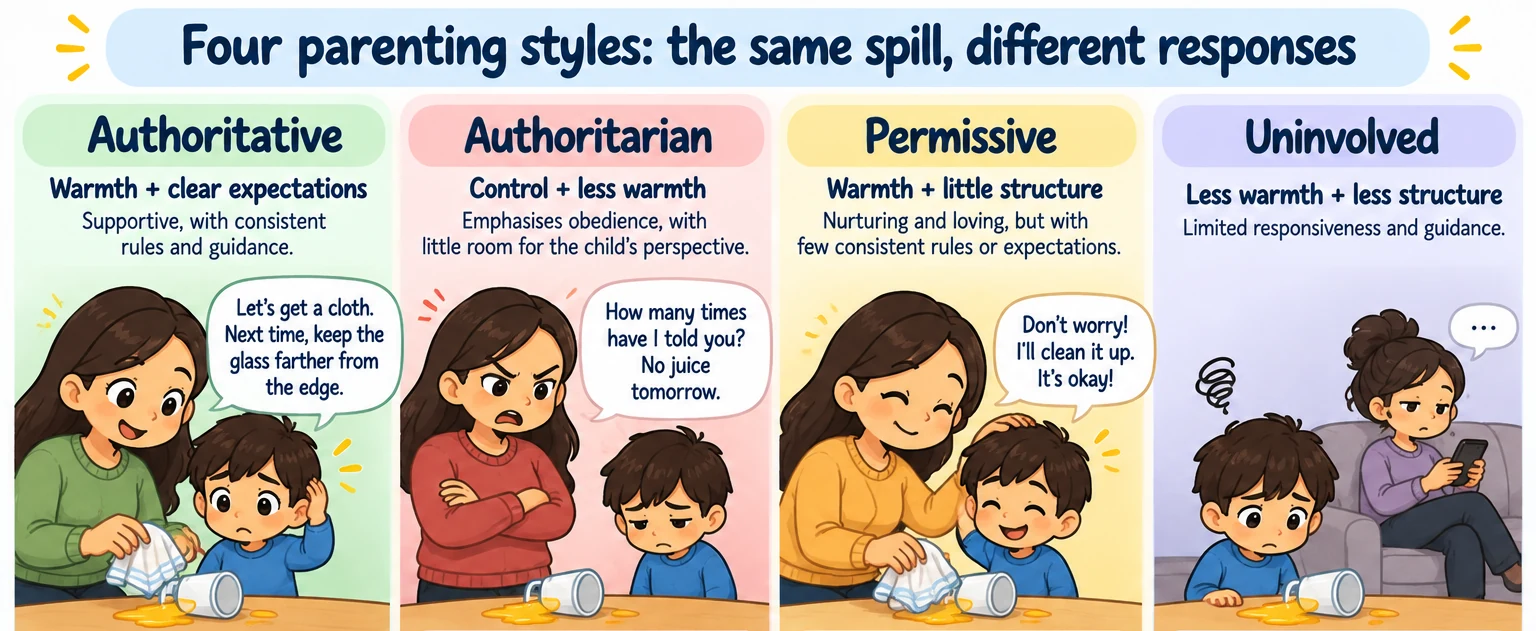
Authoritative parenting provides help, an expectation to participate, and something useful to try next time. Authoritarian parenting makes the mistake an opportunity for punishment. Permissive parenting may take the stress out of the moment, but it can also mean repeatedly cleaning everything without expecting the capable child to help. Uninvolved parenting might mean the child repeatedly receives neither help nor guidance. Is this the same as encouraging independence?
The distinction is the recurring relationship, not whether an exhausted parent once cleaned up a drink without delivering a lesson.
Helicopter Parenting and Gentle Parenting
Two newer approaches appear frequently in parenting conversations nowadays: helicopter parenting and gentle parenting. They overlap with the classic styles rather than forming two additional boxes in the same framework.
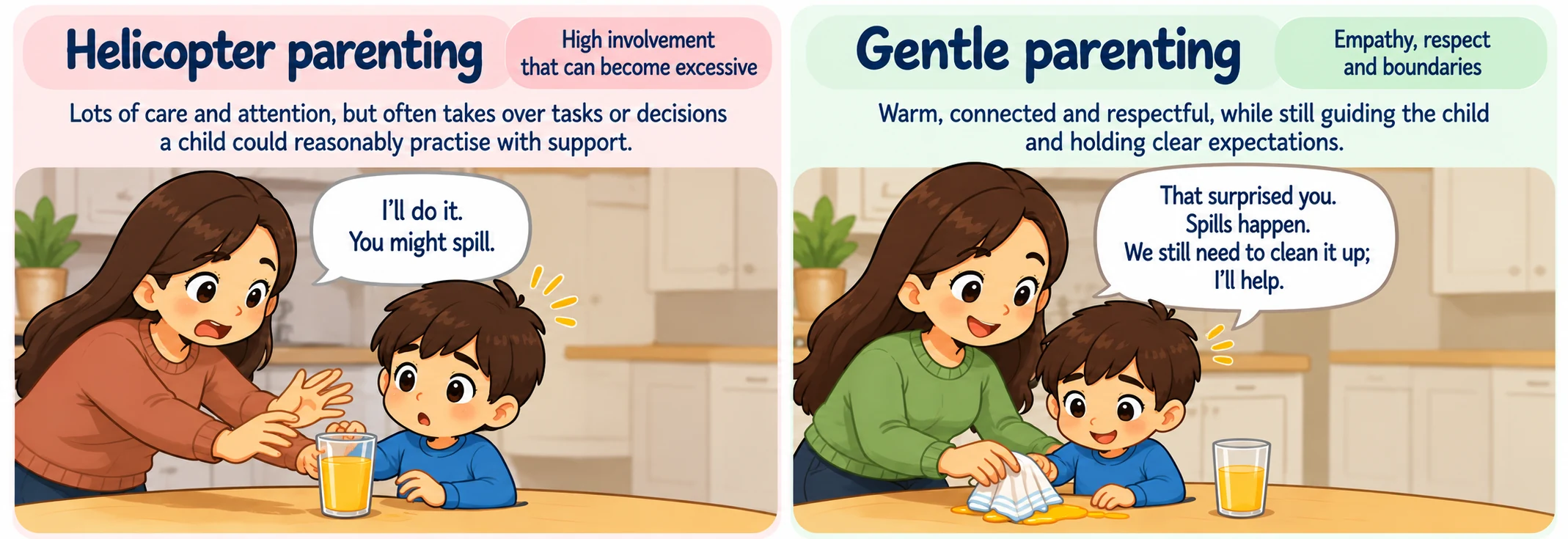
Helicopter parenting describes involvement that becomes excessive: taking over tasks or decisions a child could reasonably practise with support. In our juice example, it might mean routinely refusing to let a capable child pour or carry a drink because something could spill. Attention and advocacy can be valuable. The question is whether our help allows the child to participate more—or leaves them with fewer opportunities to try.
Research has linked overparenting with anxiety and other difficulties, although those associations do not prove that overparenting alone caused them. Much of this evidence concerns older adolescents and young adults. Meta-analysis of overparenting and mental health
Gentle parenting generally emphasises empathy and respectful responses, although people use the term differently. Research exploring how parents understand it has found themes including emotional attention, parental self-regulation, and boundaries. It is not a single, uniformly defined programme with established long-term outcomes. Study exploring gentle parenting
At the juice spill, a gentle response might be: “That surprised you. Spills happen. We still need to clean it up; I’ll help.” Does it sound very much like the authoritative response? Yes. Exactly. These approaches can overlap.
These illustrations show recurring patterns; one response alone does not define a parenting style.
Acknowledging a feeling doesn’t require cancelling the expectation. “You are angry” and “I won’t let you hit me” can belong in the same conversation. Back in the grocery aisle, we can acknowledge that a child desperately wants something while still declining to buy it. They may remain upset. We may remain embarrassed. A reasonable boundary does not necessarily produce an immediately delighted child. And we will not deliver every response with the calm voice we practised in our heads.
The Parent Is a Person Too
We bring our own childhoods into these moments. We bring beliefs about respect, fears about safety, money worries, tiredness, and whatever support we do or don’t have. Sometimes we hear ourselves repeating a sentence we swore we would never say. That is a reason to pay attention to our patterns, rather than deciding that one terrible afternoon tells the whole story.
The child matters too. A toddler and a teenager need different expectations. Temperament, disability, communication needs, culture, and circumstances all deserve consideration. Support that allows one child to participate might be unnecessary interference for another. Preventing harm, providing an accommodation, or helping with an inaccessible task should not automatically be dismissed as hovering. Likewise, a quiet child isn’t automatically thriving, and a loud child isn’t automatically badly raised.
Across this series, I want to look at the useful things we are trying to offer: warmth, predictability, attention, emotional understanding, and opportunities to become more independent.
I also want to leave room for the parent as a person. Someone with limits. Someone who can apologise, reconsider a rule, ask for help, or try again tomorrow. I don’t expect to discover a method that guarantees our children will have nothing to discuss with a therapist. I would, however, like us to think beyond whether they behaved well enough to keep the adults comfortable.
So before we ask which parenting style we use, perhaps we can start with a more familiar moment:
What do I usually do when my child’s needs collide with my own?