School Starts at Nine. Our Negotiations Start at Eight.
A real school-morning negotiation becomes a practical look at authoritative parenting: warmth, limits, sleep, school resistance and a tired mum’s capacity.
The Parenting Playbook — Part 2: Exploring Authoritative Parenting
The Parenting Playbook: ← Part 1: Does a Well-Behaved Child Mean They’re Okay? · Part 2 — You are here
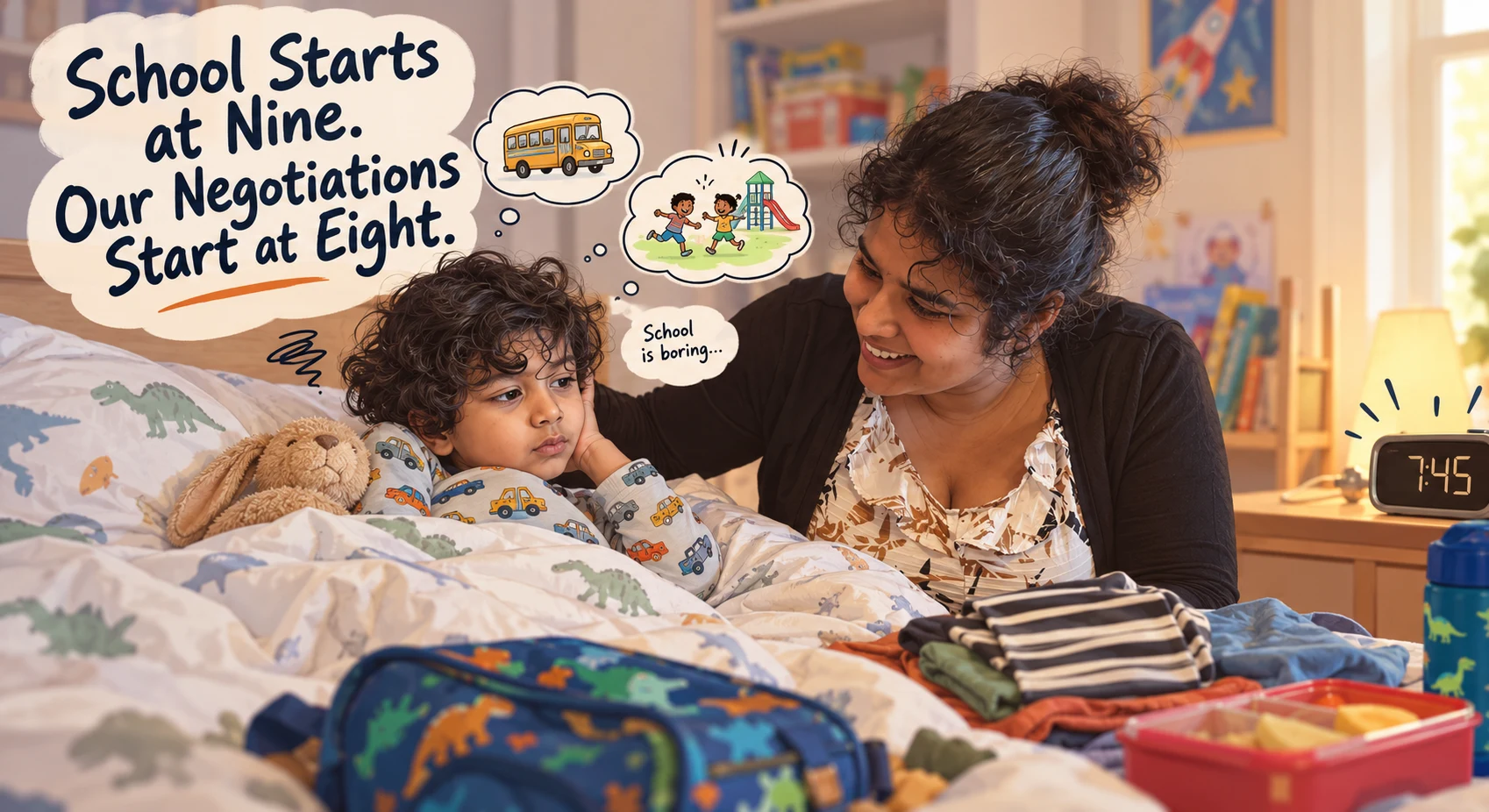
I took a couple of days to think about how to introduce this parenting approach. I could have invented a tidy scenario. Instead, I have one fresh out of the oven from this morning.
My alarm rang at 7:45. I rolled around in bed, trying to wake up, and wasted some time there, honestly. I am not an early riser or a particularly organised person. But I get up because my son needs the structure. So, grunting, I got out of bed, packed his lunch, prepared his breakfast and clothes, and went to wake him.
My son did not want to get up. I spent thirty minutes hugging, kissing, giving him time and trying again. When none of that worked, I brought Saturday’s playdate into the conversation.
No school, no playdate. One happens only after the other.
Guess what? That did not work either.
We go through some version of this struggle every morning, and it exhausts us both. So I told him that he needed to go to school, that I did not like how our mornings were going, and then I asked what would help.
He wanted me to drop him off after 9:17 instead of taking the school van. I thought about it. That morning, it was something I could manage, so I agreed. He brushed his teeth, peed, got dressed, ate and had a nice conversation with me. Later, I showed him the time: 9:23. He put down his food, dusted off his hands and announced that it was time to go.
By himself.
We were already late, so I am not presenting this as an exemplary school-morning routine. But something had changed. The child I had spent half an hour trying to get out of bed was now telling me it was time to leave.
What worked? What did not? And what would authoritative parenting actually look like here?
Authoritative, Not Authoritarian. The Words Are Annoyingly Similar.
Authoritative parenting combines warmth and responsiveness with clear expectations and limits. The parent listens, explains and provides support while remaining responsible for setting boundaries. According to the American Psychological Association, hearing the child’s perspective does not mean agreeing with everything the child wants. APA guide to parenting styles
Authoritarian parenting places greater emphasis on obedience and control, with less responsiveness. Permissive parenting offers warmth but fewer consistent limits. Authoritative parenting brings structure and responsiveness together. It is neither “because I said so” as the entire explanation nor “whatever you want” as the answer to every disagreement. APA research overview of authoritative parenting
For our morning, I understand that as: school attendance matters, and so does understanding what makes getting there difficult. Listening to my son does not mean making school attendance a daily referendum. It means using what he tells me to work out how to support him.
The challenge is keeping both parts present. I do not want to become so focused on getting him through the door that I stop hearing him. But I also cannot turn every morning into an open-ended negotiation about whether school should exist.
Before Deciding What to Change, I Need to Know What Is Difficult
He wakes reasonably well with kisses and hugs. It is the mention of school that changes things. “School is boring.” “School isn’t nice.” Then the bathroom routine brings more resistance: using the potty, peeing and brushing can each become another fight.
But once he is ready, things often get easier. Eating and waiting for the van are more manageable. When it arrives, he may run ahead, climb into his seat and buckle himself in.
How can getting to school be such a problem when getting into the van apparently is not? Perhaps those are different parts of the process, and I have been bundling them together as one enormous refusal.
His willingness to board the van does not cancel his complaints about school. Equally, his complaints do not establish that the van is the problem. Maybe beginning the morning is difficult. Maybe personal care is difficult. Maybe something at school is difficult. Several things could be true at once.
Sleep needs attention too. At night, he does not want to sleep. On weekday mornings, he does not want to wake up. On weekends, he somehow manages to wake before us. কী মুশকিল। But that pattern alone does not tell me whether he is sufficiently rested. Children aged six to twelve generally need nine to twelve hours of sleep in twenty-four hours, according to the American Academy of Sleep Medicine. I need to consider when he actually falls asleep, not just when bedtime negotiations begin. American Academy of Sleep Medicine consensus recommendation
We already have an Individual Education Plan, and the school is trying different things to make his days more interesting. He no longer has one-to-one support from an educational assistant, although scheduled toilet breaks remain. I want to share the specific morning pattern and ask what staff see after he arrives. What does he enjoy? Where does he struggle? Did anything change around the change in support?
That does not mean the support change caused the problem. It gives us something concrete to examine. The American Academy of Pediatrics recommends working with school staff and seeking clinical support when school avoidance persists. I do not have to solve the entire situation from our bedroom doorway. HealthyChildren.org guidance on school avoidance
My Morning, With a Few Possible Changes
This is where the philosophy becomes more useful to me: not as a description of the ideal parent, but as a way to reconsider an actual morning.
Some of what I did already fits. The affection does not need replacing. Neither does asking what would help. What needs work is the clarity, the follow-through and the part where an unrelated Saturday gets dragged into the argument.
These are possible responses consistent with authoritative parenting, not a prescribed script or a guarantee of cooperation. They are what I could try—not things I am claiming I have already mastered.
| Moment | What I did | What I could try within an authoritative approach | What would actually change |
|---|---|---|---|
| Waking him | I used kisses and hugs, gave him time and tried again. | I could keep the affection, then introduce a predictable first step: “Hug, then sit up. I’ll stay beside you.” | My warmth stays. I add a clearer sequence instead of repeating open-ended attempts to get him moving. |
| He protests school | I tried to get him moving while managing his complaints and my exhaustion. | I could acknowledge the objection and guide the next step: “You don’t want school today. We’re getting ready, and I’ll help you start.” I would make time to explore his concerns outside the rush. | I can hear him without trying to resolve the entire school problem before he gets dressed. |
| Saturday’s playdate | I said that not going to school would mean no playdate. | I could leave the playdate out of this difficulty and first identify what is preventing him from getting ready and what support he needs. | I replace an unrelated loss with help addressing the actual obstacle. I do not need to attach a consequence to every difficulty. |
| Asking what would help | I asked, and he requested that I drive. | I would keep this question and follow up later: “What felt better about going with me?” | I was already listening and considering his perspective. The addition is understanding what his answer means. |
| Driving him | I changed the transport arrangement that morning, although I cannot do that every day. | I could drive when feasible while explaining the limit: “I can drive today. Tomorrow is a van day; let’s plan for that.” | I make the adjustment’s availability clear rather than leaving it open to daily negotiation. |
| Bathroom and brushing | I faced more resistance. Yesterday, I dropped morning brushing to get him out. | Outside the rush, I could explore what makes each task difficult and work out the sequence and assistance with him. | I develop a repeatable support plan instead of deciding what to abandon under pressure. I do not assume more firmness will resolve pain or sensory discomfort. |
| Showing him 9:23 | I gave him a concrete time cue, and he independently prepared to leave. | I could notice that success and try a familiar clock or schedule cue again. | I build on something that appeared useful while checking whether it helps consistently. One successful moment is not yet a solution. |
| Trying to prevent tears | I compromised partly because his crying takes a toll on both of us. | I could aim for a supported, predictable morning while accepting that he may still be disappointed or upset. | I take tears seriously without assuming I must change every reasonable expectation. Persistent distress still needs investigation. |
| My own limits | I kept improvising despite being tired and finding mornings difficult myself. | I could choose a small plan I can realistically repeat, involving the school where appropriate. | My capacity becomes part of the plan, rather than something I am expected to keep stretching indefinitely. |
One qualification matters here: saving a longer school conversation for later does not mean postponing a response to pain, illness or a disclosure that he feels unsafe. I need to hear what he is actually telling me, not automatically classify every objection as something to discuss after breakfast.
Firmness Is Not the Same as Finding a Better Threat
Saturday’s playdate is the part I keep coming back to. I reached for something important to him because I was frustrated. But what did losing a playdate do to help him get out of bed?
The CDC’s guidance for younger children recommends consequences that are immediate and logically connected to the behaviour. That resource is aimed at toddlers and preschoolers, so it is not a complete guide to my six-year-old. Still, it gives me a useful question: was my consequence connected to the problem, or was it simply something I thought would matter enough to get a reaction? CDC guidance on responding to behaviour
I can revisit that with him: “I brought the playdate into our argument because I was frustrated. We still need to work on getting ready for school, but that threat was not helping us.”
That does not remove the expectation. It means I am willing to reconsider how I tried to enforce it.
The same distinction applies to driving him. Agreeing once does not have to become an indefinite arrangement. Nor does one successful morning establish that I should always drive. I want to understand whether he needed my company, more time, a clearer departure plan or something else. I cannot learn that merely by congratulating myself that we eventually left.
And Where Do I Fit Into This Lovely, Sensible Plan?
Because I am tired AF. I do not enjoy waking up either. I am not naturally disciplined, but I get up and do the routine because he needs structure. A parenting philosophy that requires me to become infinitely patient before breakfast is not going to get very far in this house.
For me, the practical next step is to make fewer decisions during the argument. Decide when we need to leave, which steps come first and what help I can provide. Keep the affectionate waking. Try a simple sequence or time cue. Offer two choices I can genuinely manage, rather than several arrangements I will later regret promising.
I also need to remember that 9:23 was not the only thing that changed. I had agreed to drive. He had more time. We had stopped arguing. He knew the arrangement. The clock may have helped, but I cannot isolate it from everything else and declare the case closed.
And no, I am not expecting him to wake tomorrow, thank me for respecting his autonomy and proceed graciously to the bathroom. He may still complain. I may still get frustrated. What I want is a routine we can keep improving, not another standard against which I can declare myself an inadequate mother.
What I Am Taking From This Approach
I want my son to know that his voice matters, that expectations have reasons and that difficulty can be met with help. I also want him to understand that other people have limits, including me.
Those are aims, not promised outcomes. Authoritative parenting is a useful framework to explore, but the APA’s research overview acknowledges unresolved questions about how it works, differences across cultures and the ways children influence their parents as well as the other way around. A label does not explain an entire family. APA research overview of authoritative parenting
For now, I can see things worth keeping: the hugs, the routine, asking what would help. I can see things worth changing too: the unrelated threat, the improvisation, the expectation that I should somehow absorb everyone’s frustration while also remembering the lunchbox.
School still starts at nine. My son still needs support. I still need a morning I can manage. The point is not to choose which of those matters. It is to make a plan that takes all three seriously.
I would appreciate it if the research could also get me out of bed. But apparently, my participation is still required.
About this series: The Parenting Playbook explores different parenting philosophies rather than declaring one the answer for every family. Authoritative parenting is our first individual approach. I am examining what seems useful, what needs adapting and what may not fit. The important questions are whether a practice is safe, coherent, appropriate for the child and workable for the family. None comes with a guarantee of a quiet morning.