Name it clearly · notice the pattern
Giving choices does not make you a weak parent
Why bounded choices can support children’s autonomy and cooperation without giving up adult boundaries, safety, or structure.
- Published
- Last reviewed
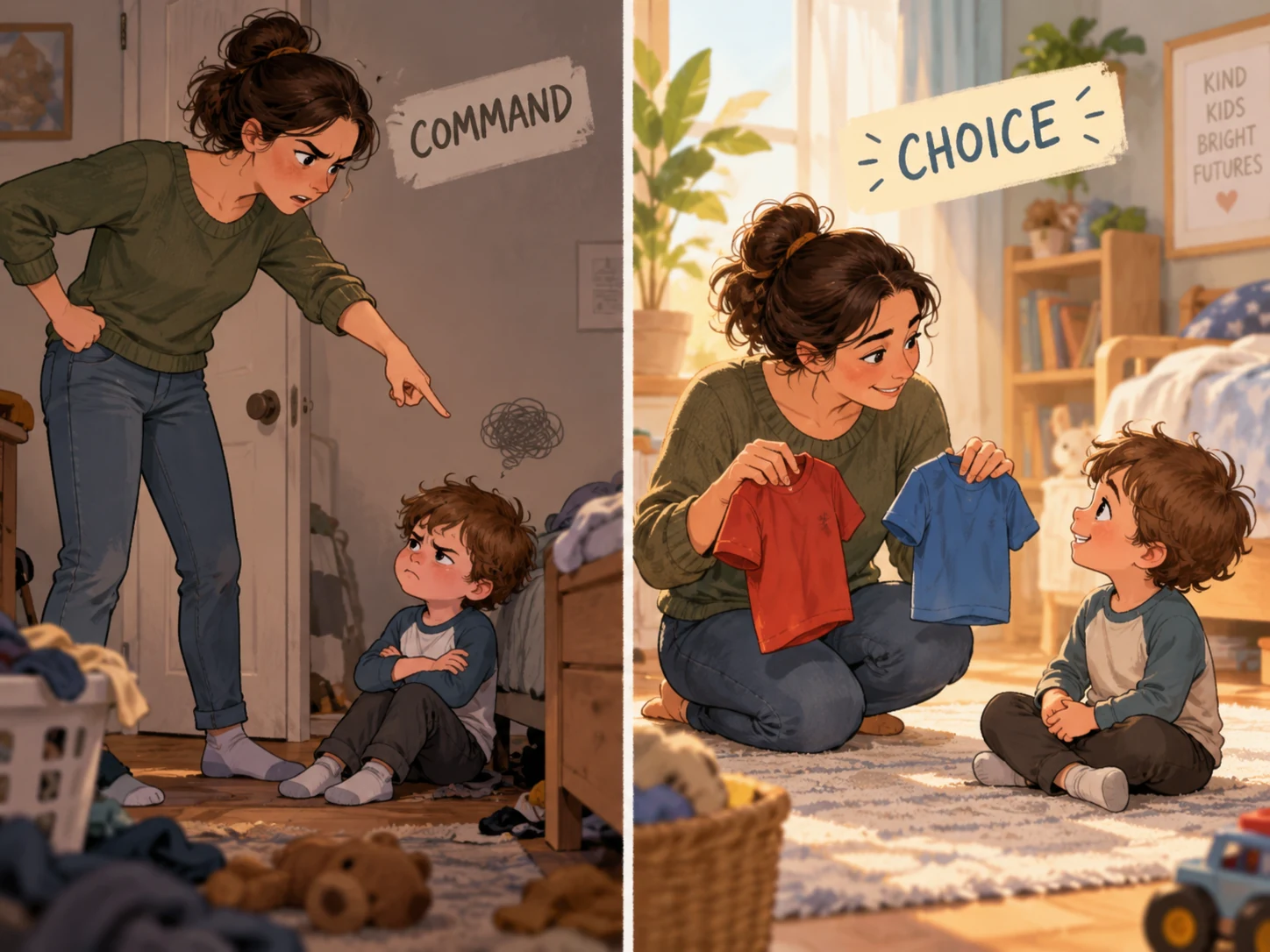
There is a version of parenting many of us inherited where the adult says something and the child is supposed to obey immediately.
“Put your shoes on.”
“Eat your food.”
“Stop crying.”
“Come here now.”
“Because I said so.”
And if the child does not listen, the adult escalates. Louder voice. Sharper tone. Bigger threat. More control. The whole thing becomes less about the shoes or the food or the crying, and more about who is going to win.
I hate that. Not because children should run the house like tiny landlords with sticky fingers, but because I do not think a child’s mind grows well inside constant power struggle. A child who is always commanded is not being taught to think. They are being taught to submit, resist, or sneak.
And yes, sometimes children need firm instructions. “Do not run into the road” is not the moment for a democratic committee meeting. Safety is safety. But most of daily parenting is not road-running emergency. Most of it is ordinary life: clothes, food, bath, homework, bedtime, transitions, cleaning up, leaving the house. And in those ordinary moments, giving a child a small choice can change the whole temperature of the room.
Not unlimited choice. Not “Would Your Majesty like bedtime today or next Thursday?” I mean bounded choice.
“Do you want the red shirt or the blue one?”
“Do you want to brush teeth before pyjamas or after?”
“Do you want to walk to the car or hop like a bunny?”
“Do you want to clean the blocks first or the books first?”
The adult still holds the boundary. The child gets some agency inside it.
This is not weak parenting. This is parenting with fewer unnecessary wars.
Limits Without Emotional Suffocation
And the research actually supports that idea.
Self-Determination Theory, one of the major frameworks in motivation research, describes three basic psychological needs: autonomy, competence, and relatedness. Autonomy does not mean “do whatever you want.” It means feeling that your actions have some personal ownership instead of feeling pressured, controlled, or pushed around. When those needs are supported, people tend to show more motivation, well-being, and engagement. When they are thwarted, motivation and well-being can suffer.
That makes sense to me. Nobody flourishes by feeling powerless all the time. Not adults. Not children. Not me. Definitely not me before breakfast.
A large 2024 meta-analysis of 238 samples across cultures found that parental autonomy support was positively linked with child well-being, while psychological control was linked with child ill-being. The important part is that these were distinct patterns: supporting autonomy was beneficial even when the researchers accounted for psychological control, and psychological control was harmful even when they accounted for autonomy support.
So the message is not “children need no limits.” The message is:
Limits do not need to come with emotional suffocation.
A child can be guided without being crushed.
This is where I think many parents get stuck. We confuse obedience with success. A child who obeys quickly looks easier. The adult feels effective. The house looks under control. But quick obedience is not the same as healthy development. Sometimes obedience means trust. Sometimes it means fear. Sometimes it means the child has learned that their feelings, preferences, and internal signals do not matter.
And sometimes the child does not obey at all, because being constantly commanded makes them fight harder for the tiny scraps of control they can still find.
That is not just my dramatic parenting philosophy talking. Research on adolescent defiance, using both psychological reactance theory and Self-Determination Theory, found across four studies that controlling parenting was associated with autonomy-need frustration and reactance—basically that pressured, do not control me feeling. Reactance, in turn, was related to more internalizing and externalizing problems.
In normal-person language: when people feel their freedom is being taken away, they often push back. Children and teenagers are not broken for doing this. They are human.
Sometimes No Is the Beginning of Selfhood
Even toddlers show that resistance is not always “bad behaviour.” A Child Development study of one-year-olds and young two-year-olds found that mothers’ supportive behaviour predicted willing compliance. But active resistance in these very young children was also associated with things linked to maternal competence, including supportive behaviour and autonomy-granting control. The researchers argued that early resistance can reflect children’s motivation to control events, not simply poor parenting or a bad parent-child relationship.
That part matters so much. A child saying no is not always disrespect. Sometimes it is the beginning of selfhood.
Of course, selfhood can be extremely annoying when you are late and the selfhood refuses socks. I am not pretending this is always cute. Sometimes it is very much not cute. Sometimes you offer two choices and the child invents a third illegal option.
“Red shirt or blue shirt?”
“No shirt.”
Thank you, small lawyer.
But even then, the answer does not have to be domination. It can be: “Shirt is not optional. Red or blue?” Calm. Boring. Repeated. Boundary stays. Power struggle does not get fed.
Choice Can Make Cooperation Easier
There is also direct evidence that choice can help children cooperate. A small 1994 Journal of Applied Behavior Analysis experiment gave three elementary students with emotional and behavioural challenges choices among academic tasks. In the choice conditions, task engagement increased and disruptive behaviour decreased.
A later meta-analysis of 13 single-case studies involving 30 participants found that providing choice opportunities produced clinically significant reductions in problem behaviour across the studies reviewed. That evidence base was small and largely involved children and young people with disabilities, so it should not be turned into a promise about every child. But it does support a useful possibility: giving someone a meaningful choice can change how trapped a task feels.
This does not mean choice is magic pixie dust. It does not mean every child will melt into cooperation because you said “blue cup or green cup?” Some children will still yell. Some days will still be garbage. Some nervous systems are on fire, and no cup colour can fix that.
But choice can reduce the feeling of being cornered. And a child who is not cornered has a better chance of cooperating.
The same thing applies to adults, by the way. This is not some “children these days” softness. Adults hate being controlled too. Try telling an adult, “You must do this now because I said so,” and see how peaceful your evening becomes. We understand autonomy perfectly when it is ours. Somehow when it is a child’s autonomy, we call it attitude.
The Scripts We Inherited
I think part of this is inherited. Many of us were raised in homes where commands were normal and questioning was treated like rebellion. You did not ask why. You did not negotiate. You did not have preferences. You were “good” if you were easy for adults.
Then we grow up, become parents, and suddenly a child’s normal resistance can feel like disrespect. Not because the child is doing something monstrous, but because something old inside us hears:
I was not allowed to say no. Why are you?
That is where the cycle starts.
Research does show some intergenerational continuity in parenting. A 1991 study of 451 two-parent families found that grandparents’ aggressive parenting predicted parents’ harsh parenting practices in the next generation. Another study found reported continuity in authoritarian and permissive parenting styles across generations, even though current parents described themselves as less authoritarian than their own parents.
So no, it is not imaginary. The way we were parented can become the way we parent, unless we stop and examine the script.
And sometimes stopping is hard because command-based parenting feels efficient. It gives the adult a sense of control. But control is not the same as connection. Control is not the same as teaching. Control is not the same as raising a child who can make decisions, understand consequences, and trust their own mind.
Power struggle makes children wither. Not always dramatically. Sometimes quietly. They may become very compliant and lose practice making decisions, or become oppositional because fighting is the only way they can feel like a person. Neither is flourishing.
Choice, when done well, does something different. It says:
I am still the adult. I will keep you safe. I will hold the boundary. But you are also a person inside this boundary.
That is nourishing.
It gives children practice choosing. Practice feeling capable. Practice having preferences. Practice making small decisions before life hands them big ones. It teaches them that their voice matters without teaching them that their voice is the only voice in the room.
Bounded Choice, Not Tiny-CEO Parenting
And this is where we have to be sensible: too much choice can overwhelm some people in some situations. In a famous set of experiments, Iyengar and Lepper found that people were sometimes more likely to act—and felt more satisfied with what they chose—when offered a limited set of options rather than a huge one.
So the goal is not to hand a child 47 options and then wonder why they are crying under the table. The goal is bounded, meaningful choice.
Two options. Maybe three. Both acceptable to the adult. Both safe. Both real.
Not: “What do you want for dinner?” when the answer could be Skittles and floor dust.
Better: “Do you want rice first or chicken first?”
Not: “Do you want to go to school?” because no, probably not, and also too bad.
Better: “Do you want to wear your boots or sneakers today?”
Not: “Are you ready for bed?” because this is a trap and they will say no.
Better: “Do you want to pick the book or should I pick?”
This is not permissive parenting. This is not letting the child become the CEO of the household. This is structure with dignity.
And honestly, that is the whole point for me.
I do not want to raise a child who only knows how to obey commands. I want to raise a child who can think. Who can choose. Who can hear a boundary without feeling erased. Who can cooperate without needing to be dominated. Who can respect others without losing himself.
Children do not become strong by being made powerless every day. They become strong by being guided, respected, corrected, trusted, and given chances to practise being a person.
So no, giving choices is not weak parenting.
Sometimes it is the strongest thing we can do: refusing to turn every ordinary moment into a battle just because battle is what we were taught.
Boundaries matter. Safety matters. Respect matters.
But so does the child’s sense of agency.
Because a child is not a remote control where you press buttons until the behaviour changes. A child is a growing human being. And growing humans do not flourish under constant command.
They flourish when they are rooted, guided, and given enough room to stretch toward the sun.
Not unlimited room. Not unsafe room.
Just enough to grow.