I Wanted Someone to Take My Side. Is That Permissive Parenting?
The Parenting Playbook — Part 4: hearing a child’s side, choosing battles, and distinguishing warmth and flexibility from boundaries that keep disappearing.
The Parenting Playbook — Part 4: Exploring Permissive Parenting
Content note: Childhood physical punishment and humiliation.

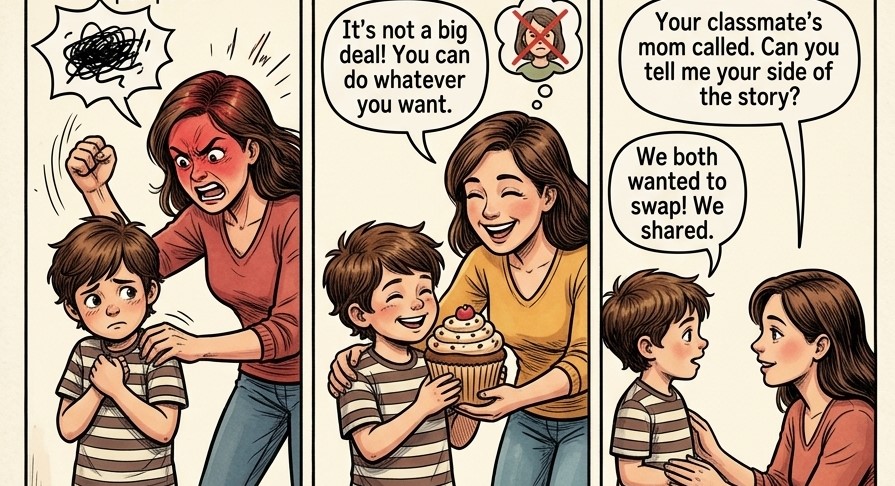
When I was a child, I shared food with a classmate. Let’s call her Mou. After school, her mother called my mother to complain that I had eaten her daughter’s food. My mother got angry. Another parent had called to complain about me, and apparently that settled the matter. My mum did not ask whether I had shared my food too. She did not ask what had happened between us. She did not ask for my side of the story before deciding what to do.
She beat me.
Then she fed everyone ice cream. I mean EVERYONE. Except me. Just to make a point.
So, in response to an incident involving food, my mum’s solution was to give me less food and a slice of beating. Excellent. What didn’t happen was a conversation about the original incident.
I keep returning to that missing conversation. Not necessarily a grand defence of my character. Not a declaration that I was an innocent child incapable of doing anything wrong. Just a question. “What happened?”
As a parent now, I find myself thinking about what taking my child’s side should mean. Does it mean believing everything he says? Defending every action? Making sure he never feels bad? Or can I stand beside him while still helping him recognise when something needs changing?
This brings me to the fourth part of The Parenting Playbook: permissive parenting. And to an uncomfortable question about my own parenting. When I avoid escalating things, choose my battles or change an arrangement, am I being thoughtful? Or am I saying yes because I am tired AF and cannot manage another argument?
What happened in my childhood, and what does that have to do with permissive parenting?
In Part 3 of this series, Authoritarian Parenting, Criticism and the Cost of Being a “Good Girl”, I explored an approach that places greater emphasis on obedience and control, with less responsiveness to the child’s perspective. My mother’s response fits some features of that pattern. My account was not sought; punishment came first. It also involved physical violence and humiliation.
These are related observations, but they are not interchangeable definitions. Not every authoritarian response involves hitting, and describing something as a parenting style does not make hitting acceptable.
The American Academy of Pediatrics advises against physical punishment, threatening, insulting, humiliating or shaming children. Its guidance describes these methods as having little short-term benefit and being ineffective in the long term. We have better evidence and guidance now, even if attitudes towards physical punishment have not disappeared everywhere.
I cannot tell you precisely what was happening inside my mother’s head. Perhaps she felt embarrassed. Perhaps she believed punishment was her responsibility. Those are possibilities, not things I know. What I know is that another adult’s complaint received an immediate response. My perspective did not even receive a question.
Even if I had done something wrong, there was still something to understand before deciding how to address it.
So why am I discussing permissive parenting when the incident itself was anything but permissive? Because I sometimes wonder whether my desire to give my son what I did not receive might lead me to the other extreme. I want him to feel heard, protected and supported. But does supporting him mean agreeing with him? Where do I draw the line between being understanding and being permissive?
What is permissive parenting?
Permissive parenting is generally described as high in warmth and responsiveness but low in consistent expectations and boundaries. Sometimes called indulgent parenting, it involves parents who are affectionate and accepting but may struggle to establish or follow through on developmentally appropriate limits. The American Psychological Association’s guide to parenting styles makes this distinction.
That does not mean every permissive parent says yes to everything. Nor does it mean comforting a child, listening to their opinion or allowing them some freedom makes a parent permissive. Parenting styles describe broader patterns, not individual decisions.
In my childhood incident, a permissive response might have been to dismiss the complaint entirely. “Oh, leave it. It’s only food.” If there were a genuine problem—taking food without permission, leaving another child hungry or ignoring a known rule—the parent might avoid addressing it because the conversation could upset the child.
But here is something I do not want to overlook.
We have not established that sharing the food was wrong in the first place.
If we willingly shared with each other and no relevant rule or safety concern was involved, there might have been nothing to punish or correct. A parent who investigates a complaint and concludes that the child has done nothing wrong is not being permissive simply because nobody loses a privilege.
I do not want to recreate my childhood incident with a softer voice while keeping its original assumption: an adult complained, therefore the child must need correcting.
Same phone call, different responses
To understand the distinction, I tried looking at how different parenting responses might have handled that phone call.
| Response | What might happen | What the child could learn |
|---|---|---|
| What actually happened | My mother became angry, beat me and deliberately excluded me from ice cream without asking for my account. | An adult’s accusation could lead to punishment before I had a chance to explain. |
| A possible permissive response | The parent dismisses the complaint and avoids necessary follow-up, even if there is evidence of a problem. | Their feelings may be protected, but an important boundary or responsibility could go unexplained. |
| A curious, supportive response | The parent listens to the complaint, asks what happened and checks the relevant facts before deciding whether anything needs addressing. | Being heard and being accountable can coexist. There may also be no wrongdoing to address. |
These are illustrative responses, not additional memories or claims about how every parent in a category behaves.
A different response could have started with something as ordinary as, “Mou’s mother called about lunch. Tell me what happened.”
Then some actual questions. Did she offer her food? Did I ask? Did we both share? Was anyone left without enough to eat? Was there a rule we knew about?
Today, food-sharing can involve genuine allergy concerns. Food Allergy Canada recommends no-food-sharing policies as part of school allergy precautions. That is useful guidance for families now; it does not establish that allergies or such a policy had anything to do with my childhood incident.
If I had taken something without permission, my mother could have explained why that was wrong and helped me put it right. If we had willingly shared but broken a school rule, she could have explained the rule. If the complaint had been a misunderstanding, she could have clarified that with the other parent.
Different circumstances would require different responses. Asking questions would have helped establish which response was actually needed.
And none of those possibilities required beating me.
Taking my child’s side does not require declaring him right
This is the distinction I want to carry into my own parenting.
I want my son to know that he can tell me what happened without first calculating whether his account will make me angry. But I also want him to understand that other people’s boundaries matter. Those two expectations belong together.
If someone complains about him, I can listen without immediately offering up a punishment. I can hear his account without promising that I will agree with every part of it. I can take his dignity seriously while helping him repair something he has done.
Taking his side can mean making sure he is heard and treated fairly. It does not have to mean declaring that he has never been wrong in his life. He is a child. There will presumably be occasions. There will also be occasions when an adult misunderstands him.
What I needed back then was not an adult who automatically agreed with me. I needed someone who would at least find out whether I had done anything wrong before deciding that I deserved to suffer for it.
Am I permissive because I choose my battles?
This is where the subject becomes less comfortable than examining somebody else’s parenting.
In Part 2, School Starts at Nine. Our Negotiations Start at Eight., I wrote about our school-morning negotiations. I hugged and kissed my son awake, gave him time and eventually threatened to cancel a playdate. When that failed, I asked what would help. He wanted me to drive him instead of taking the school van, and that morning, I agreed. On another morning, I let brushing go because getting out of the house had already become difficult enough.
Does that make me permissive?
Those moments alone do not establish a parenting style. But they give me something to examine.
He still went to school. I changed how we got there. That is different from abandoning the expectation altogether. But I also know that sometimes I compromise because his distress takes a toll on me. I want us both to have a less miserable morning. I am trying to get through the day while remaining someone my child feels safe with.
There is a difference between a considered exception and a limit that repeatedly disappears because I cannot manage the reaction. From the outside, both might look like a mother changing her mind. The reasoning behind the decision—and what keeps happening afterwards—matters.
The American Academy of Pediatrics’ discipline guidance encourages positive discipline, clear expectations and consistent guidance. But it also acknowledges the importance of parents managing their own reactions. Avoiding an escalating argument is not, by itself, an absence of discipline.
So I tried to break down the situations where I am most likely to question myself.
| What I might do | When it can be useful flexibility | When I need to reconsider |
|---|---|---|
| Stop arguing | We settle, and I return to a necessary task with appropriate help. | The task repeatedly disappears, and I have no plan to address the difficulty. |
| Choose a different arrangement | I can manage it, and it still meets the important need. | Every disagreement requires a new arrangement I cannot sustain. |
| Change my mind | New information shows that my original expectation was unnecessary or unsuitable. | I repeatedly reverse a reasonable limit mainly to end the reaction. |
| Help him do something | My help makes participation possible while he develops the skill. | I routinely take over something he could practise with suitable support. |
| Let something small go | I have decided it does not actually need a rule. | I keep avoiding an important issue and become increasingly frustrated about it. |
These are questions about patterns, not a test that awards or removes my parenting licence.
And there is another consideration. My son is autistic. A task that looks simple to me might involve sensory discomfort, difficulty with transitions, anxiety or something else I have not understood. Providing necessary support is not indulgence. Nor is an expectation automatically appropriate just because I can state it firmly.
That is part of what makes this difficult. I cannot simply ask, “Did I give in?” I also need to ask, “Was the original demand reasonable, and what was he struggling with?”
Is there anything worth keeping from permissive parenting?
Yes. The warmth. The affection. The willingness to listen. The acceptance that children have preferences, personalities and opinions that do not have to match their parents’.
These qualities are worth keeping, but they are not exclusive to permissive parenting. Authoritative parenting values warmth too, alongside appropriate limits and expectations. The distinction is not whether I love and listen to my child. It is whether I consistently provide the guidance and structure he needs.
I do not want to become so frightened of being permissive that I start treating every disagreement as an opportunity to demonstrate authority. My child does not need a limit simply because I have thought of one.
But he does need guidance around things that matter: safety, other people’s boundaries, responsibilities he can reasonably manage and the fact that I have limits too.
If important expectations keep disappearing, he may lose opportunities to practise meeting them with support. I may also end up taking on more and more while becoming increasingly resentful. That does not make him a bad child. It tells me that our arrangement might need reconsidering.
The useful qualities of permissive parenting—warmth, affection and responsiveness—do not require avoiding every difficult conversation.
I can understand that he wants something and still say, “I know you want this. It isn’t something I can do today.”
I would like to be able to say that without sounding like my mother. I would also like to remember that a calm no does not become cruel simply because my child dislikes hearing it.
What I wish had happened after that phone call
I wish my mother had asked.
That is still the part I keep coming back to.
I do not need to rewrite the memory so that an imaginary mother declared the other parent ridiculous, produced extra treats and assured me I could do whatever I wanted. I wanted someone to find out what had happened before hurting me for it.
If there was something to learn, I could have been taught. If there was something to put right, I could have been helped to put it right.
Neither required a beating.
Now, with my own child, I want to leave room for his account without making his account the only one that matters. I want to choose my battles carefully without allowing exhaustion to make every decision for me. I want him to be comfortable coming to me with something difficult, while also knowing that I will help him take responsibility when he needs to.
I will not always get that balance right. Some days I will change my mind for a good reason. Some days I will say yes because I have run out of energy. I want to notice the difference without turning every tired decision into another reason to hate myself.
The question I am taking from this fourth part of The Parenting Playbook is:
Am I making room for my child’s voice while still offering the guidance he needs?
And when another adult calls to complain, I hope I remember that I am allowed to begin with a question.
About this series: The Parenting Playbook explores different parenting philosophies through lived experience and research, rather than declaring one approach the answer for every family. This article does not classify my entire family—or yours—from one incident. Readers can consider, adapt or combine useful practices, while keeping safety, the child's needs and the family's capacity in mind.