I Learnt to do things Myself. That Wasn’t the Same as Being Ready.
The Parenting Playbook — Part 5: uninvolved parenting, childhood responsibility, and the difference between supported independence and having nobody to ask.
The Parenting Playbook — Part 5: Uninvolved Parenting
Content note: Childhood physical punishment, emotional neglect, sexual abuse, and ableist language.
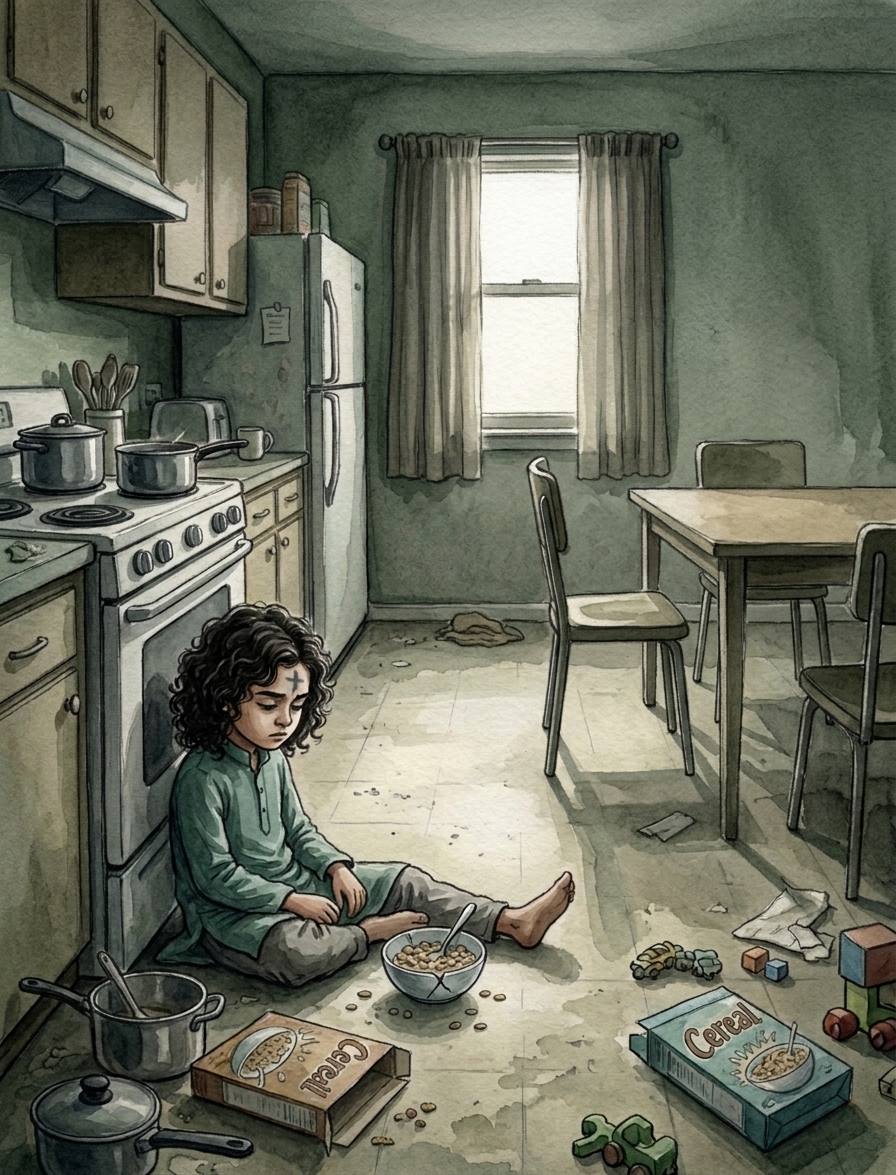
The year was 1995. I was in kindergarten. I had missed several days of school and needed a note for my teacher. So I took my school diary to my mother and asked her to write one. To this day, I do not know what she wrote. The beating, however, I have not forgotten.
I stopped taking school-related problems to her after that. A bully, a teacher’s wrath, anything I did not know how to manage—I handled it myself. There is a version of this story where someone calls that independence. I was in kindergarten. It seems worth mentioning.
What is uninvolved parenting?
Uninvolved parenting describes a recurring pattern of limited emotional responsiveness and limited guidance or oversight. In the classic parenting framework, it is low in both warmth and demandingness: little connection, and little consistent support around what the child needs to learn or do. The American Psychological Association describes uninvolved parents as unresponsive and unavailable. APA guide to parenting styles
It is sometimes called neglectful parenting, although a parenting-style description is not, by itself, a legal finding of neglect. It also does not mean a parent who needs a break, works long hours, or cannot attend every school event. The question is what support is available across the relationship. Does somebody notice when the child is struggling? Can the child bring a problem to an adult? Is there help with things the child cannot reasonably manage alone? In my case, the difficulty was not simply that my mother failed to write a satisfactory school note. I brought her a problem. The response made me stop bringing her problems.
Where is it most common? Was it a generational thing?
I wanted an answer to this too. Was it particularly common somewhere? Was it something our parents’ generation did? I could not find a reliable basis for naming one country or generation as the world leader in uninvolved parenting. Studies examine different populations and use different measures; a finding from one group cannot become a ranking of everybody’s parents. An OECD review of parenting research emphasises the importance of context, including culture, family circumstances, health and available support. So, yes, one label alone does not explain why a pattern develops. OECD research review There is research on generational differences. One study involving three generations of Spanish families found increases in reported warmth and decreases in several strict disciplinary practices across generations. But that does not tell us which generation was most uninvolved worldwide, or establish what happened in Bangladeshi families. Three-generation study
So I can speak about the childhood I remember. I cannot promote it to the official childhood of an entire generation. And in the Dhaka circles I knew in the 1990s, I remember boarding school becoming quite the idea. Not the entire world, obviously. Dhaka was not issuing global parenting instructions. :P
Send them away. They will learn discipline.
My father thought sending us to a boarding school where we would be properly disciplined was a good idea. A lot of other parents around us appeared to think so too. My sister was twelve. I was six. We were sent to Darjeeling—Kurseong, to be exact—to a school I remember as Don Bosco Boarding School. So there we were: a pair of siblings, neither of us speaking English. I am severely dyslexic, and at that age I struggled with communication more broadly. Even in a familiar setting, explaining myself was not my strongest skill. Then I was in a school where I did not speak the language. The wider connection between Bangladeshi families and schooling in Darjeeling was real. A 2009 BSS report, published by The Financial Express, described the established practice of sending Bangladeshi children to schools in Darjeeling and neighbouring areas, including for English-medium education. That later reporting provides context; it does not measure the particular 1990s craze I remember. BSS report in The Financial Express I do not know what life was like in all those other schools. I know about the one where I lived. It was a missionary school. We sang hymns. We prayed to Jesus, regardless of what one’s religion was. We ate with cutlery. We exercised. We studied. We were punished too. Punishments ranged from writing assignments to being beaten with a belt. There were good elements. There were also things that should never have happened to children. Both belong in the account.
Some things really were better
We ate at regular times. For children coming from homes like mine, where we could go without several meals, that was a significant improvement. There was allotted time and space for exercise. There was a routine. Life revolved around school activities, without much distraction. I do not want to pretend those things meant nothing because other things were harmful. Regular meals mattered. Predictability mattered. Having time to move mattered. But the benefits do not require me to call everything around them good.
We also had constant competition, physical punishment, and the absence of parents and family affection. There was sexual abuse too. I am mentioning it because leaving it out would make the setting sound safer than I remember it. I am not going into those experiences in this piece. This article is about the support a child could—or could not—reach.
A school full of children, each with a different reason for being there
I remember children from about three to sixteen. We knew one another. We also knew something about the family circumstances that had brought different children there. Some had divorced parents. Some had lost a parent. Some were being supported financially by an aunt or uncle who did not want, or was not able, to keep them at home. Looking back, it felt like a place where adults could wash their hands of the daily work of having a child. That is how it felt to me. It is not something I can establish about every family’s intentions. Bereavement is not abandonment. Divorce is not a parenting style. A relative paying for school may be trying to provide care in circumstances I did not understand as a child. Still, those distinctions do not erase the loneliness.
My sister and I were among the children whose parents were still together. Our family had not separated. That did not mean we arrived from a home where emotional support had been readily available. I often did not feel like talking when my parents called. Honestly, I felt I had nothing to say. I am not going to turn that into a diagnosis or claim I now understand every reason for it. I remember the distance. A phone call did not automatically give us a conversation. In that sense, boarding school and home were not as different as they might have looked. The setting changed. The experience of dealing with things myself did not.
Boarding school is not the same thing as uninvolved parenting
Sending a child to boarding school does not, by itself, establish uninvolved parenting. A parent can remain attentive, communicate meaningfully, investigate concerns, and advocate for a child living elsewhere. A parent can also live in the same house and offer very little of that. Someone can arrange admission, pay fees, choose a school known for discipline, and feel that they have made a major investment in a child’s future. The child can still need someone to ask:
Are you eating enough?
Do you understand what people are saying?
Who helps when you are frightened?
What happens when you make a mistake?
Can you tell me something difficult without being punished for telling me?
An institution can provide a timetable. That does not automatically provide a trusted relationship. And the absence of that relationship did not begin with the journey to Darjeeling. It was already there when I took my kindergarten diary to my mother. It was there in other situations at home too.
The shirt had a wrinkle. My hand had burns.
I was perhaps nine when my father asked me to iron his clothes. Usually, my sister did the ironing. That day she was still at school, and I was available. So I was given his shirt, trousers and underwear. I remember finding the iron extremely heavy. But I was the good girl. I wanted to do the job properly. I wanted to make my father proud. He did not show me how to do it. I tried anyway. I burnt myself more than once that day. My father did not know I had burnt my hand. He did know that his shirt had a wrinkle. For that, I heard about how incapable I was. He had seen daughters give their lives for their fathers, and I could not even iron a shirt properly. Quite the performance review for a nine-year-old.
I had been given a task involving something hot and heavy, without being shown how to use it. When I failed to produce the expected result, the problem became my inadequacy as a daughter. What would have helped was an adult asking whether I could safely manage the task, showing me what to do, and paying attention while I learnt. What I received was a comparison with daughters apparently prepared to die for their fathers. I was trying to iron his underwear. The distance between those two expectations was considerable. There was plenty of attention to the result. There was very little attention to what I needed to achieve it safely. That distinction matters when I think about parental involvement. Watching for mistakes is not the same as teaching.
Apparently, helping with homework would make us dependent
Around that same week, my sister asked my father for help with her schoolwork. It was something to do with accounting. A balance sheet, perhaps. I am not an accounting person, and I do not remember the exact task. What I remember is that she asked her father for help. He gave her a lecture about how helping her would make her “disabled,” because she would learn to lean on him. That was his language. Disability is not a moral failure, and needing help with schoolwork does not mean a child is incapable of learning. But the idea underneath his response was clear enough: helping would create dependence, so withholding help would teach independence.
I disagree.
Teaching someone how to do something is not the same as doing it for them. He could have asked her to show him where she was stuck. He could have worked through one example and let her try the next. If he did not know the answer, he could have helped her identify someone who did. Even “I don’t understand this either; let’s work out who can help” would have acknowledged that she had brought him a real problem. Instead, asking for support became something she needed a lecture about.
I think parents are there to nourish children and help them flourish—to help them grow into people who can navigate their lives. I do not expect a parent to know every subject. I do expect there to be a difference between not knowing how to help and deciding that help itself is bad for the child.
But there was criticism and punishment. Doesn’t that make it authoritarian?
The beating in the diary incident was a harsh, punitive response. My father’s criticism over the ironing also involved expectations enforced through shame. Those fit the controlling and punitive patterns discussed in the authoritarian-parenting article. The absence of guidance, practical help and dependable emotional support points towards uninvolvement. These observations can coexist.
The classic styles describe broad patterns; they are not four perfectly separate households. A parent may be disengaged from a child’s daily needs and then become intensely controlling when a problem reaches them. A sudden punishment does not establish that there was attentive guidance beforehand. A high expectation does not establish that the child was taught how to meet it. My father expected an ironed shirt. That did not mean he had helped me learn to iron. My sister was expected to manage her schoolwork. That did not mean she had the support to understand it. And I was expected to deal with school. That did not mean I could safely bring school problems home.
No single incident lets me classify an entire childhood. Together, these memories describe a pattern: responsibility was handed to us, while asking for help could bring punishment, criticism or a lecture about why we should not need it.
The same situations, with a sufficiently involved parent
I am deliberately saying sufficiently involved. Not a parent who has read every book, never loses patience, and can explain accounting while producing a wrinkle-free shirt. Just an adult who recognises that a child learning something may need teaching, protection and help.
The alternatives below are imagined responses, not additional memories.
For the diary, the first response could have been ordinary.
“Let me see. We’ll write the note.”
If she was busy:
“I’m doing something right now. Leave it here, and we’ll do it after dinner.”
Then actually returning to it.
For my sister’s schoolwork:
“Show me what you’ve tried.”
For me, struggling with the iron:
“Let’s stop. This is too heavy for you to manage safely.”
None of those sentences requires a flawless parent.
They require noticing the child as well as the task.
Independence, or having nobody to ask?
I did learn to handle things. I do not want to deny my resourcefulness. I found ways through situations. I made decisions. I managed problems that arrived whether I was ready or not. But the skills I developed do not prove that the absence of help was useful. I also grew up to be an extremely anxious adult who is severely burnt out.
Supported independence might look like a parent helping me work out what to say to a teacher, letting me try, and remaining available if it went badly. What I describe is not taking the problem to my parent because I remembered what happened when I did. From the outside, both children might appear to be handling the conversation themselves. Only one knows there is someone to go back to.
The same applies to learning practical skills. A child can be given responsibility in stages, with instruction and opportunities to practise. Help can change as the child becomes more capable. Refusing to teach does not automatically speed that process up. Sometimes it leaves a child holding a heavy iron, trying to prove she is a good daughter.
What I want to carry into my own parenting
I do not want my child’s silence to become my evidence that everything is fine. I know how much can sit behind a child apparently managing. That does not mean I need to take over every difficulty or be available every second. I have limits. Some things can wait. Some things he can practise doing himself. But I want asking me for help to remain an option. If he brings me a school problem, I want to understand it before deciding what it means. If I ask him to do something, I want to consider whether he knows how, whether he can manage it safely, and what support he needs. If he is living or learning somewhere else, I want to know more than whether the fees are paid and the institution has a reputation for discipline. I want to know how he is being treated.
At boarding school, regular meals were an improvement. The routine had value. I can acknowledge that without pretending that either replaced affection, safety, or an adult who would listen. At home, we had parents who expected things from us. That did not always mean we had parents who helped us learn how to do them. I want my son to become capable. I also want him to know that needing an explanation, a demonstration or another attempt does not make him less capable of learning. Teaching him is part of my responsibility. He does not have to arrive already knowing.
About this series: The Parenting Playbook examines parenting philosophies through lived experience and research. This account describes my childhood, not every boarding school, Bangladeshi family, or generation. Family separation, bereavement, disability, poverty, and working away from home do not themselves establish uninvolved parenting. The question is how a child’s needs are noticed and met—and who remains available when help is needed.