A bedtime idea · a morning mystery
Hypnagogia — The Idea That Escaped Me by Morning
A bedtime idea felt like a whole article. By morning, only its emotional fingerprint remained—a personal essay about hypnagogia, creativity, memory, and finding a way to leave morning-me a breadcrumb.
- Published
- Last reviewed
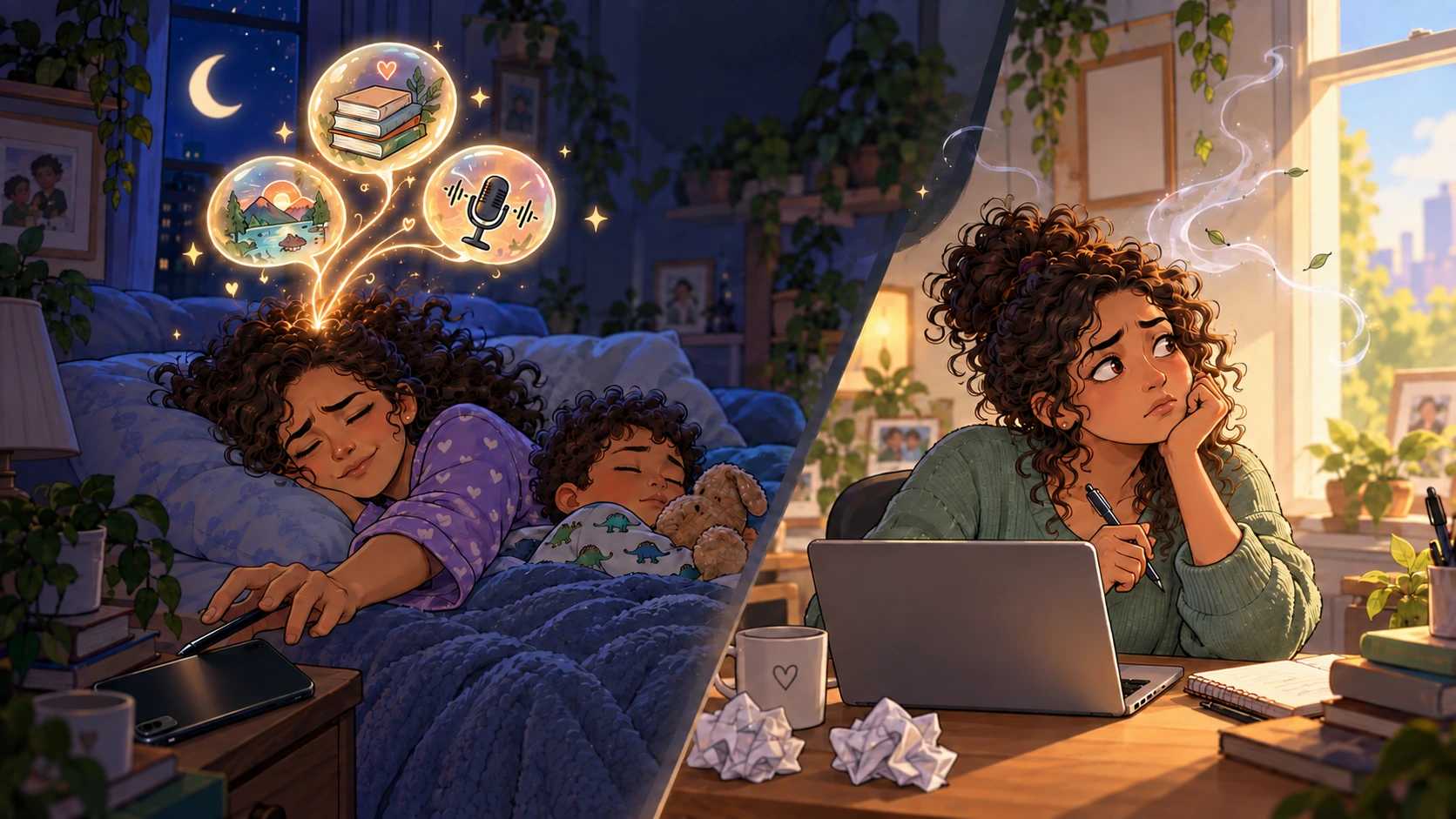
Last night, right before sleep, I had an idea.
Not just a tiny “oh, that could be interesting” idea. It felt like a whole article had arrived. I remember knowing it was about a personal experience. I remember feeling deeply about it. I remember thinking of related things, connections, examples, little side-roads my brain wanted to walk down. It had weight. It had emotion. It had that very annoying glow of yes, this is something I need to write.
And then morning came.
Gone.
Not completely gone in the peaceful way, where you wake up and think, eh, probably wasn’t that important. No. This was worse. I could still feel the shape of it. I knew there had been something there. I knew it mattered to me. I knew I had a lot to say.
But the actual idea? Nowhere to be found.
The more I tried to remember, the more it slipped away. I would get close to a corner of it, and then even that corner would dissolve. It was like trying to hold fog in my fist.
The annoying part is that this is not the first time. A lot of my writing ideas come right when I am about to sleep. Stories, articles, reflections, jokes, titles, arguments, emotional observations — all of them apparently have a secret meeting time, and that time is when I am least able to do anything about it.
During the day? I can sit with a blank page like a dumbass. At night, when I am half gone, trapped under exhaustion, maybe putting my son to sleep, suddenly my brain becomes a TED Talk with feelings.
There is a name for this in-between state: hypnagogia. It is the transition between wakefulness and sleep, when you are not fully awake but not fully asleep yet. Research on sleep onset suggests that this early stage of sleep can sometimes be unusually good for creative connections. In one study of insight into a hidden problem-solving rule, participants who spent a brief period in N1 sleep — that drowsy sleep-onset zone — were more likely to discover the rule than participants who stayed awake. That does not prove every bedtime idea is a work of genius, but I do feel personally vindicated.
Which makes sense to me. At bedtime, the world finally shuts up a little. There are fewer demands. Fewer messages. Fewer chores staring at me with judgmental eyes. My brain is no longer spending all its energy on logistics, work, masking, remembering who needs what. So of course the ideas come then.
The daytime brain is tired AF, while the bedtime brain is like a poet with no respect for office hours.
But here is the catch: that same sleepiness that makes the idea appear also makes it terrible at being saved. Sleep-onset experiences can be vivid and meaningful, but memory around sleep onset can be fragile. In a study of memory loss at sleep onset, even very light N1 sleep was associated with forgetting on a memory task. The researchers were not studying writers losing article ideas, but the finding makes my morning vanishing act feel less mysterious.
So basically, the brain says:
Here is a beautiful idea.
Then immediately:
Would be a shame if someone failed to encode it into long-term memory.
Thank you, brain. Excellent teamwork.
I have tried to fight this. I do sometimes write things down. I have my Samsung Galaxy S23 and the S Pen, which should theoretically make me a very advanced modern woman with a proper capture system. Sometimes I open my notes app and write one line. Not a full article. Not even a proper paragraph. Just enough to leave a breadcrumb for morning-me.
Something like: birthday / unseen child / treasure box or panic / Dobby / checklist.
Ugly little half-asleep notes that look like they were written by a kindergartener.
And when I do this, it helps. Morning-me does not need the whole article. Morning-me just needs enough hint to grab the whole idea. But I do not — sorry, cannot — always do it.
Because sometimes the idea arrives when I am trying to put my son to sleep. And if you have ever tried to put a child to sleep, you know there is a sacred, terrifying moment when they are almost there. Almost asleep. Breathing slows down. Body softens. You can see the finish line.
That is not the moment to suddenly become Shakespeare with a phone.
One wrong movement, one screen glow, one S Pen click, one tiny shift in mattress pressure, and the whole bedtime operation may reset. So I think, I’ll write it down after he sleeps.
Guess what? That doesn’t happen.
After he sleeps, I am either asleep too, half-dead, or convinced I will definitely remember it because it felt so important. But by morning, the idea is gone, and all that remains is the emotional fingerprint. I know it was personal. I know it mattered. I know I had things to say. But the thing itself escaped me by morning.
I also wonder whether this is connected to neurodivergence, though I want to be careful here. I do not want to slap an ADHD/autism sticker on every brain annoyance and call it science. Research reviews on autism and ADHD describe sleep and circadian differences, though much of that research focuses on children and adolescents. It certainly does not prove “autistic women get article ideas at bedtime and lose them by morning.” That would be a very specific study, and sadly nobody has yet given me a grant to investigate my own midnight nonsense.
Still, personally, it makes sense that my brain gets louder when the world gets quieter. When the sensory load drops, when the demands pause, when I am no longer actively performing the day, ideas finally get room to come forward. The problem is that they come forward at the exact time my memory is packing up for the night.
So now I am trying to make the system smaller.
Not “write the article.” Not “draft the whole thing.” Not “capture the perfect sentence.”
Just a few words. One ugly line. A title. Anything. Anything small enough that I do not need to fully wake up, but specific enough that morning-me has a rope to pull.
Because “I’ll remember this tomorrow” is not a plan. It is bedtime propaganda.
And maybe some ideas are just lost. Maybe they come from that soft borderland between waking and dreaming, and not all of them are meant to survive daylight. That sounds poetic, but also deeply irritating. I would prefer poetry with autosave.
A tiny note on hypnagogia
The word hypnagogia sounds like something only sleep scientists and haunted Victorian poets should be saying, but it simply refers to the drowsy transition into sleep. Hypnagogic means something that happens in “the period of drowsiness immediately preceding sleep.” The word comes from Greek roots: hypnos, meaning sleep, and agōgos, meaning leading or bringing on — so basically, leading into sleep. Very fancy way of saying: the doorway where your brain starts taking off its daytime bra. Merriam-Webster traces the word’s meaning and roots.
Everyone who falls asleep passes through some version of this doorway, but not everyone notices dramatic ideas, images, sounds, or sensations there. Some people may only feel sleepy and gone. Others may get flashes of images, strange thoughts, snippets of sound, falling sensations, or fully formed little creative gifts that vanish like they were never legally yours. Some sensory experiences at sleep onset are called hypnagogic hallucinations; having a passing idea is not the same thing. Cleveland Clinic says these brief experiences are common and usually not something to worry about. They can be visual, physical, or auditory.
So no, having thoughts or images in that half-asleep state does not automatically mean something is wrong. It is often just the brain crossing from waking mode into sleep mode. The annoying part is that this state can be creative and slippery at the same time. Harvard Medicine Magazine describes hypnagogia as a possible “sweet spot” for creativity, and artists, writers, and scientists have long been interested in that in-between place where the brain makes unusual connections.
But there is a difference between hypnagogia and a problem. If the experiences are frequent, frightening, affecting sleep, happening when you are fully awake, or coming with major daytime sleepiness or sleep paralysis, then it is worth mentioning to a healthcare provider. But for the occasional “I had the most brilliant idea at midnight and by morning it had escaped with no forwarding address” situation? That may simply be hypnagogia doing what hypnagogia does: opening the creative door right when memory is packing up for the night.