Notice the message · widen the choices · let the child decide
How Gender Stereotypes Shape Children
How everyday gender messages can shape children’s play, friendships, confidence, learning, and future possibilities—and how adults can widen the choices again.
- Published
- Last reviewed
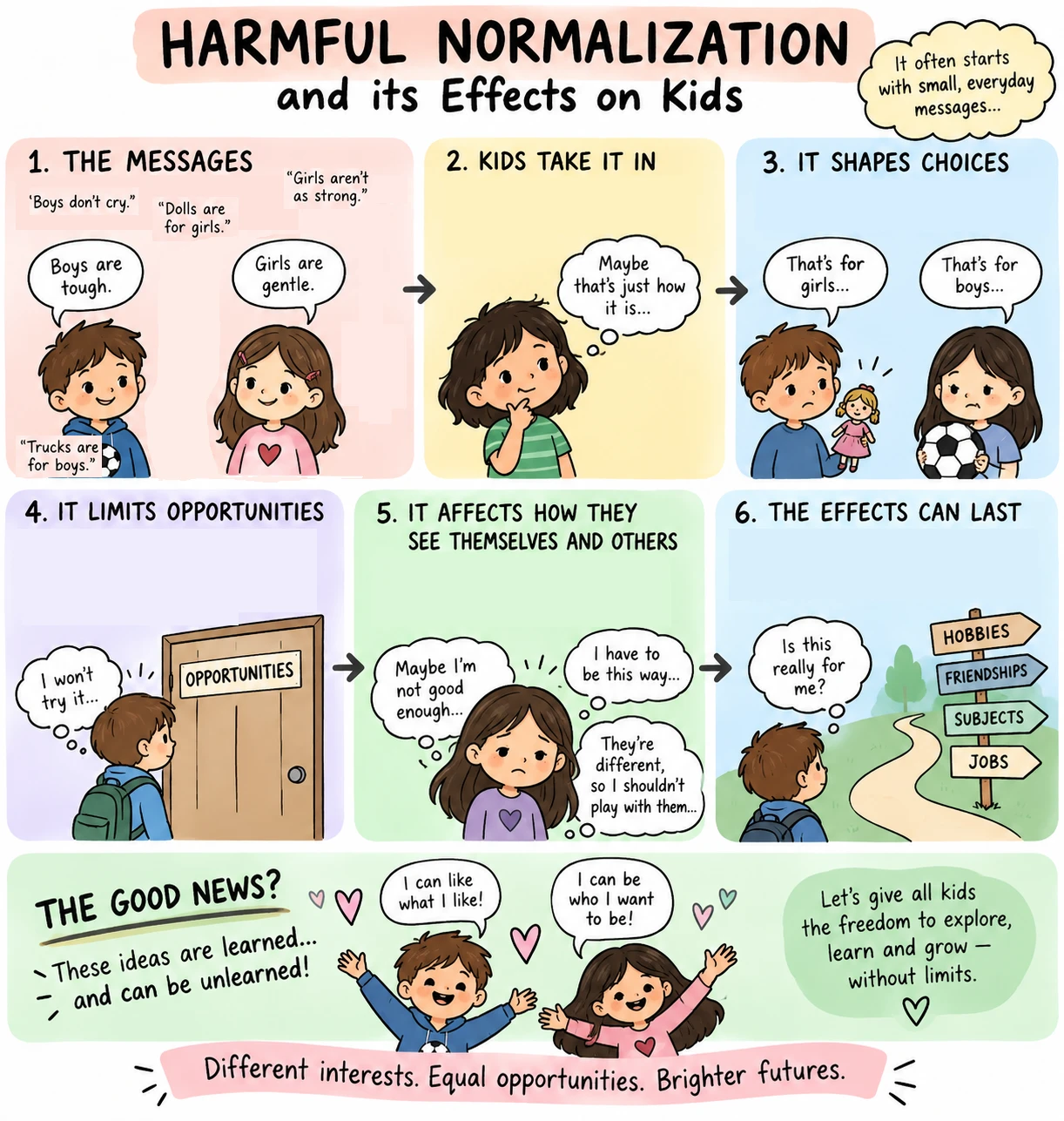
Gender stereotypes often start small. A blue onesie. A pink toy aisle. “Strong boys.” “Gentle girls.” “Don’t cry, you’re a boy.” “That’s not for girls.” “Why is he playing with dolls?”
These things can look harmless from the outside—tiny comments, family jokes, culture, tradition, background noise. But children do not always hear background noise as background noise. Sometimes they hear instructions.
At its simplest, a gender stereotype is the habit of using “boy” or “girl” as a shortcut for what a child should like, how they should behave, what they should be good at, and what kind of person they are allowed to become. The UN Human Rights Office’s working definition describes a gender stereotype as a generalized view or preconception about the characteristics people ought to possess or the roles they ought to perform.
For children, that becomes rules: boys are tough, girls are gentle; boys don’t cry, girls aren’t as strong; trucks are for boys, dolls are for girls; boys are better at maths, girls are better at reading; mums care for children, dads earn money.
The problem is not that a girl likes pink or a boy likes trucks. Let the child love pink. Let the child love trucks. Let the child love glittery monster trucks if that is where their tiny heart lives.
The harm begins when adults turn gender into a shortcut for the individual child: “She is a girl, so she probably won’t like this,” or “He is a boy, so he shouldn’t do that.” That is when “boys and girls can be different” quietly becomes “boys and girls have to be different.”
I Do Not Want the World to Shrink Him
This is not theoretical for me. I have a son. I want him to be able to explore and become whatever fits his actual little heart and brain—dancing, ballet, astronomy, music, sports, science, art, whatever. I do not want the world to shrink him before he even gets to find out who he is.
I do not want him to hear “Are you a girl?” as an insult. I do not want him to grow up around “boys are better than girls” or “girls are better than boys” nonsense either. Superiority is not confidence. Inferiority is not humility. Both are useless baggage.
Research suggests children learn these gender rules very early. One longitudinal Child Development study followed 229 children from ages three to five and found that gender-typed behaviour was already visible in preschool, with many of the behaviours measured becoming more rigid—especially between ages three and four.
Another Child Development study followed 246 children at ages four and five. On average, the children reported positive attitudes toward their own gender and negative attitudes toward the other gender, and their attitudes toward the other gender predicted gender-biased behaviour at age five.
So stereotypes do not only tell children, “This is what you should be.” They also tell children, “This is who belongs with you.” That is how “boys and girls are different” can slowly turn into “I should play with children like me,” or “That child does not belong in this game.” Suddenly, gender is not just a category. It becomes a tiny passport system.
A Toy Can Become Permission—or a Warning
That is why “it’s just a toy” is not always just a toy. A doll can offer practice in nurturing, language, imagination, caregiving, and social play. Blocks and construction toys can offer practice in spatial reasoning, planning, and problem-solving. Art toys invite creativity and fine motor skills. Outdoor play invites risk-taking, coordination, strength, and confidence.
Different toys open different kinds of practice. So when children learn, “That is not for people like me,” they may stop exploring before they even discover whether they enjoy something or are good at it.
There is direct evidence that children make choices for others based on gender stereotypes. In one toy-choice experiment involving children aged four to seven, researchers asked a control group of 36 children to choose a toy for another child. Twenty-eight chose the gender-stereotypical toy, five chose the counter-stereotypical toy, and three chose the neutral toy. The difference was statistically significant. That is the sneaky part: the children were not choosing based on what that specific child liked. They were choosing based on what they thought a boy or girl was supposed to like. You can read the full toy-preference and counterstereotyping study.
Even the label can change children’s interest. In experiments with preschoolers, researchers used unfamiliar objects so children did not already know whether they were supposed to be “boy toys” or “girl toys.” Then the researchers changed the gender labels and colours. The same basic object became more or less appealing depending on whether it was labelled or presented as “for boys” or “for girls.” The study on toy labels, colours, and preschoolers’ preferences found that gender labels had a powerful effect on children’s stereotypes and interests.
Same child. Same object. Add a gender label, and suddenly the object carries permission or warning. Toy না, tiny visa application.
This is how stereotypes can create the very differences people later use to justify the stereotype. The chain is simple:
“That’s for boys” → “I won’t try it” → “I’ve never really done that” → “See, girls aren’t interested in that.”
Or the other way:
“That’s for girls” → “I won’t try it” → “I don’t know how to do that” → “See, boys aren’t nurturing.”
This is not magic. This is rehearsal. Children become good at what they are allowed, encouraged, and expected to practise.
The Theft Is Possibility
The effects can reach far beyond toys. A Swedish study asked 1,832 children aged five to thirteen from 28 schools to draw their dream jobs. Only three occupations—footballer, doctor, and police officer—appeared in the ten most popular choices for both girls and boys. Girls were more likely to choose occupations involving people or animals, while boys were more likely to choose occupations involving things.
Research with older children also finds links between gender stereotypes, motivation, and the futures children imagine. A study of 172 parent-child pairs found that parents’ gender stereotypes about language ability were associated with adolescents’ motivation and career aspirations. For girls, language stereotypes were linked with greater language motivation in a way that nudged aspirations away from STEM. For boys, traditional gender-role beliefs were linked with less interest in language arts.
So “that’s not for girls” or “that’s not for boys” can eventually become “that’s not for me.” That is the real theft. Not one toy, not one colour, not one comment. The theft is possibility.
Boys Get Boxed In Too
Sometimes we talk about gender stereotypes only as something that limits girls. And yes, girls are absolutely limited by being told to be smaller, softer, prettier, quieter, more agreeable, less bossy, less loud, less “too much.”
But boys also get boxed in. Boys are told not to cry, not to be scared, not to be gentle, not to like “girl things,” not to need comfort, not to ask for help, not to show softness unless approved by the masculinity committee, which apparently meets daily inside society’s head.
I do not want toxic masculinity for my son. I also do not want him to feel inferior for being a boy. I want him to be confident in who he is without needing to dominate anyone else. I want him to be comfortable saying what he wants to say without fearing that someone will call him weak, whipped, cuck, girly, soft, or whatever new insult insecure people are throwing around that week.
I also do not want him to hold back because he is scared he is being too masculine or not masculine enough. That is also a trap. The goal is not to make boys afraid of being boys. The goal is to let them be whole human beings.
A boy who wants to play with a doll may be practising care, or just playing for fun. A boy who loves language, music, art, dance, ballet, astronomy, football, dinosaurs, cooking, emotional storytelling, or all of the above should not have to pass through a security checkpoint labelled “masculine enough.” A boy who cries is not broken. He is a child with a nervous system, not a tiny unpaid soldier.
Even small classroom habits can reinforce the box. “Boys line up here, girls line up there.” “Boys versus girls.” “Girls are neater.” “Boys are louder.” “Let the boys carry the heavy things.”
Not every mention of gender is automatically harmful, but when adults repeatedly use gender as the main way to organize children, children learn that gender is one of the most important things about them. In one classroom experiment, teachers’ functional use of gender categories over four weeks increased children’s gender stereotyping, especially among children with less advanced classification skills.
Children are very good at learning the rules adults pretend they are not teaching.
These Rules Can Be Interrupted
The good news is that these rules can be interrupted. Children are not permanently ruined because someone bought them a pink tutu or a blue truck. Their beliefs are flexible.
In experiments with 373 children aged four to seven, children were shown simple counter-stereotypical messages, such as boys can like dolls and girls can like trucks. Afterward, the children made more counter-stereotypical and fewer stereotypical predictions about what other children would like. In one experiment, the intervention also changed the toys children selected for peers. The researchers describe the approach and its limitations in Counterstereotyping Can Change Children’s Thinking About Boys’ and Girls’ Toy Preferences.
That is important because the intervention was not some 900-page policy document or a government-funded gender-neutral spaceship. It was simply information that contradicted the rule.
So what do we do? We do not need to panic and throw every pink item into the sea. We do not need to ban trucks, dolls, princesses, dinosaurs, glitter, football, kitchen sets, ballet shoes, science kits, or toy swords. We need to stop treating them like destiny.
Offer the doll and the truck. Offer the blocks and the art supplies. Offer the science kit and the pretend kitchen. Offer the dance class and the telescope. Let children explore before adults start narrating who they are supposed to become.
Instead of saying, “You’re such a strong boy,” we can say, “You worked hard carrying that.”
Instead of saying, “Girls are so caring,” we can say, “That was kind of you.”
Instead of saying, “That’s for boys,” we can say, “Do you want to try it?”
Instead of saying, “That’s for girls,” we can say, “That is a great choice.”
Growing up and finding yourself is hard enough. Being a good human is already a full-time job. Taking care of people around you, taking care of nature, learning how to be kind, brave, responsible, curious, and honest—that is enough to keep a child busy every day.
Toxic masculinity and toxic femininity have no room in the lives of our children. They already have enough to learn without carrying the rusty chains of gender roles around their ankles.
Let Preference Be a Choice
The goal is not to stop girls from liking pink. The goal is to make sure pink is a choice, not an assignment.
The goal is not to stop boys from liking trucks. The goal is to make sure trucks are an option, not a citizenship requirement.
And the goal is not to force children into some perfectly neutral beige childhood where nobody is allowed to enjoy anything because the adults are overcorrecting and now even the teddy bear needs a committee review.
The goal is freedom.
A child who loves princesses should be allowed to love princesses. A child who loves construction trucks should be allowed to love construction trucks. A child who loves both should not be treated like a confusing software update. A child who loves neither should not be dragged into the gender aisle like it is a legal obligation.
Children deserve room to discover themselves before the world starts handing them scripts. Harmful gender normalization is not “a girl wore pink once” or “a boy liked cars.” It is the constant message that gender should decide personality, ability, emotion, play, friendship, and future.
“Boys and girls can be different” is fine.
But “boys and girls have to be different”?
That is not childhood.
That is a box with glitter on it.
Sources and Further Reading
- Gender stereotyping as a human-rights issue — UN Human Rights Office
- Why gender inequality often starts at home — Plan International Canada
- Rigidity in gender-typed behaviours in early childhood — Child Development
- Gender attitudes in early childhood — Child Development
- Pink gives girls permission: toy labels, colours, and preschoolers’ preferences — Journal of Applied Developmental Psychology
- Counterstereotyping can change children’s thinking about toy preferences — Journal of Experimental Child Psychology
- Functional use of gender in the classroom — Child Development
- Drawing the future: children’s occupational aspirations in Sweden — Frontiers in Education
- How parents’ stereotypical beliefs relate to students’ motivation and career aspirations — Frontiers in Psychology