Name it clearly · notice the pattern
Why Is Everything Still a Struggle? Demand Avoidance in a Pinch
When knowing the toileting steps is not the same as being able to do them: one mother’s questions about stool withholding, sensory discomfort, fear and demand avoidance.
- Published
- Last reviewed
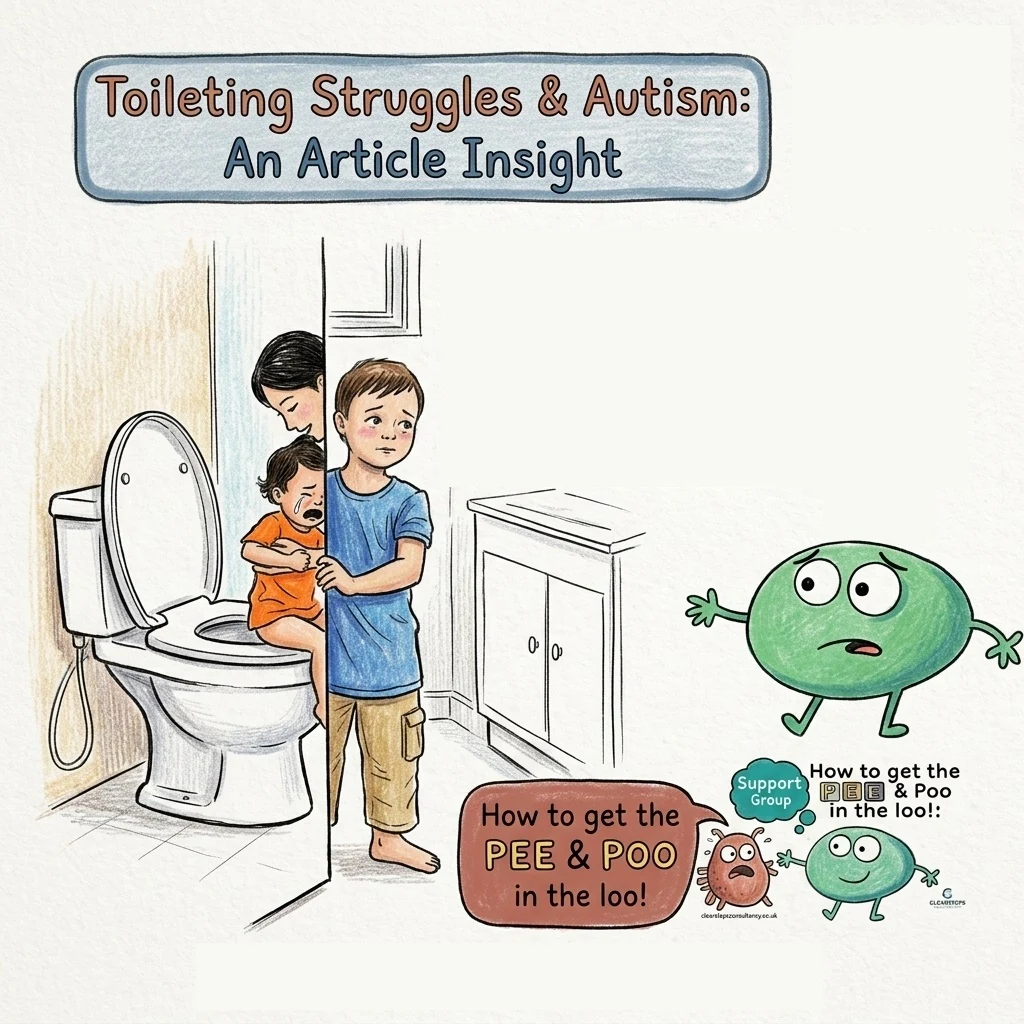
My six-year-old son knows how to use the toilet. He recognises when he needs to poo. He tells us he feels the pressure. And then he asks us to help him hold it.
What do I do with that?
I asked his paediatrician for help, and they suggested consulting an applied behaviour analysis (ABA) therapist. But as I considered possible explanations, I kept coming back to the details that made this less straightforward.
We use pictures showing the steps of handwashing. Those work. We use pictures for toothbrushing. Those work when he wants to brush. When he doesn’t, the pictures remain perfectly informative pictures beside a child who does not want a toothbrush in his mouth. We also use pictures for cleaning himself after pooing. He has learnt the sequence, but he firmly resists doing it.
So my question is: if he knows how, why won’t he?
Could knowing the steps and being comfortable doing them be two different things? That does not tell me exactly what is happening with him, but it gives me a better starting point than wondering whether I have explained the instructions enough times.
Both Entering and Leaving Become Wars
Getting him to the toilet is usually a fight. Getting him to sit is another. Sometimes he wants to get up immediately and runs away at the first opportunity. Other times, he stays for hours, provided he has a device to occupy him, of course.
Somehow, both entering and leaving the same bathroom have become separate wars.
I wondered whether he was avoiding pain when pooing. But then he also resists going for a pee. That can happen after waking up, while he is doing something during the day, or right before bed. So I cannot assume that one explanation accounts for everything.
His school has scheduled toilet breaks at 11 a.m. and 1 p.m., but I do not yet know what happens during them. Does he go willingly? Does he refuse? Does he sit without actually doing anything? Honestly, I am afraid to ask. I find myself hoping that masking, or simply going along with the group, makes it easier for his teachers. But that is a hope, not an observation. I do not yet know whether it is easier for him.
“Resistance” Is an Observation, Not an Explanation
The question shifted when I stopped treating “resistance” as a complete explanation.
Resistance describes what I see. It does not explain what he experiences.
Could pooing hurt? Could he remember a painful poo even if the next one would not hurt? Does the sensation itself frighten him? Is wiping the part he dreads? Does being asked to stop an activity make the whole bathroom routine harder? Could several of these things be happening together?
Children can become caught in a withholding cycle: they avoid passing stool because it hurts or feels frightening; holding it can lead to constipation; the next bowel movement becomes more uncomfortable. Being able to hold it does not establish that everything is physically fine. ERIC
Sensory differences can also make toileting difficult. Noise, smells, the feel of toilet paper, the seat or difficulty balancing can all matter. We already have a stool supporting his feet while he sits. That is one practical support in place, but it does not rule out the other difficulties. Children and Family Health Devon
Today, I stopped and wondered whether his request for help holding it means more than I have been hearing. Could he be saying that he notices something happening in his body and wants help preventing what comes next? If so, I need to understand what “next” means to him.
Demand Avoidance Gives Me a Question, Not a Diagnosis
I have also just come across a term for the broader pattern I am trying to understand: demand avoidance. It means resisting requests, expectations or everyday tasks. But it describes what happens, not necessarily why. Giving the struggle a name does not automatically explain it. National Autistic Society
There is also PDA—Pathological Demand Avoidance, sometimes called Persistent Drive for Autonomy. Some clinicians and families use “PDA profile” to describe pervasive demand avoidance associated with anxiety and a need for control. But it is a debated concept, not a standalone diagnosis in the main diagnostic manuals, and there is no standardised diagnostic assessment.
I do not know whether that profile fits my son.
Finding a description that sounds familiar is not the same as establishing that it explains him. National Autistic Society
For now, I need to separate the things I am seeing. Actively preventing poo from coming out is stool withholding. Avoiding entering, sitting on or using the toilet can be described as toileting refusal, and fear may be involved. Resistance across different activities is a broader pattern to investigate.
I do not want to put everything in one box just because it all looks like “no” from where I am standing.
So I have more questions. Does he do something spontaneously but resist when prompted? Does that happen with things he enjoys too? Is it worse around bodily care, transitions, uncertainty or particular sensations? Does less pressure and more say in the process help?
These are things I need to observe, not answers I already have.
And none of this replaces checking for pain or constipation. Withholding can follow a painful bowel movement and become tangled up with fear. A broader label would not make that discomfort any less real or any less important to treat. ERIC
I do not want “he is demand avoidant” to become another version of “he just won’t.” I want the terminology to help me ask better questions—not stop asking them.
I am planning to try a predictable poo opportunity again at 7:30 p.m. each day. I want to coordinate with the school around its 11 a.m. and 1 p.m. toilet breaks and find out whether they are helping. We already have 9 p.m. toothbrushing followed by a pee before bed.
But I need to be clear about what those times mean.
They are anchors, not deadlines for his body.
Seven-thirty will mean a predictable opportunity to try, with a brief, supported visit. It will not mean sitting until he produces a poo. If he feels the urge earlier, he should not have to wait until 7:30. Guidance recommends offering toilet time after meals, so I will also look at how that fits our evening rather than assuming the clock alone will solve this. National Institute of Diabetes and Digestive and Kidney Diseases
What I Need to Change
There are a few other things I need to do.
Keep a simple record and ask school to do the same. When does he actually pee or poo? What is the stool like? Is there pain, straining, soiling or distress? What happened just before the refusal? I need observations that help us recognise a pattern, rather than guesses about what might be happening.
Make telling me about pressure safe. He is already communicating something useful. I want to respond with, “Thank you for telling me. I’ll help you,” rather than immediately turning that information into a struggle.
Right now, what often happens is that he runs around screaming, “Mum, help! I don’t want to poo!” I run after him and try to get him to the potty. Usually, I try to reason with him using words. Sometimes, I physically take him there despite his resistance.
That is not the way I want us to handle this, and it is not sustainable. I need help finding a calmer approach rather than repeating a struggle that is not working.
Then there is the worry underneath all of it: what happens if something happens to me tomorrow? How will he manage? I want to help him build skills—and a support system—that do not depend entirely on me.
Reduce the demands around cleanup. He knows the wiping sequence, but right now I am going to offer help. Independent wiping has become another battle attached to every bowel movement, and it is not the one I want to fight at this moment.
Practise manageable bathroom steps when he is calm. A small amount of comfortable practice may be more useful than introducing a lesson when he is already clenching and upset. NHS guidance describes gradually building tolerance for sitting, praising attempts even when no pee or poo happens, and adapting the approach when a child is anxious about the toilet. Leicestershire Partnership NHS Trust
There Is No One Guaranteed Method
The internet has no shortage of people whose one successful strategy becomes advice for everybody else. But the research does not give me that certainty.
A systematic review of 26 autism toilet-training studies identified limitations including small samples, weaker study designs and inconsistent reporting of outcomes. That does not mean nothing helps. It means I cannot treat one method as a guaranteed answer for my child. Northumbria University Research Portal
A small clinical trial involving 20 autistic children with encopresis, or stool soiling, found promising preliminary results from coordinated medical and behavioural treatment. But that was a specific clinical programme for a problem I have not established my son has. It is not a ready-made plan for us to copy. PubMed
So this is where I am: questions for school, a routine to discuss and try, and work on my own response- he already is suffering from anxiety, he doesn’t need me to add to it.
I want to offer him a predictable place and enough support to try. I want to learn what makes it difficult. And when he tells me he feels the pressure, I want him to be able to trust what I say next.