Name it clearly · notice the pattern
Get Ready for School: More Than One Instruction
A personal reflection on why getting ready for school can involve many transitions and tasks, and how smaller steps, visual supports and dependable help may make mornings more manageable.
- Published
- Last reviewed
At 8:30 in the morning, I can be trying to wake Kabbo without knowing which version of the next half-hour we are about to have. Some mornings, he gets ready and willingly climbs into his school van. On others, thirty minutes after we started, we find ourselves still struggling through a meltdown. The destination is the same, and the things we need to do are broadly the same, yet getting from bed to the front door can feel completely different. I have not quite worked out what makes the difference.
I do understand the negotiations, though. Five more minutes, followed by another five. I conduct a very similar conversation with myself most mornings, so I cannot pretend that wanting to remain in bed is a character flaw unique to my child. Unfortunately, the school van does not participate in these negotiations. I understand that waking up and changing activities can be hard for him, and I also need us to get somewhere on time. I want school to be an established part of our day, without every morning becoming a battle over whether we are going.
Then I heard Zara at The Therapy Shed explain something that helped me look at the problem differently: what sounds like one instruction to a parent can contain a whole sequence of tasks for a child. “Wake up and get ready” is a short sentence, but quite a large assignment. Waking is already a transition. Then Kabbo has to take in what I am saying, understand what I mean, remember what needs to happen, begin doing it and move through the steps in a useful order—all while managing how his body feels and whatever emotions the morning brings.
Even “get dressed” contains several jobs: finding the clothes, working out which way they go, putting them on, dealing with a sleeve that turns inside out and continuing when something else catches his attention. I have compressed all of that into two words. Some of the skills involved are called executive functions: the skills that help us hold information in mind, manage distractions, organise our actions and shift our attention. They develop throughout childhood and beyond, and they do not all develop at the same pace. Knowing what a task means is therefore different from being able to organise yourself to complete it. Harvard’s Center on the Developing Child explains these skills.
There can be physical difficulties alongside the organisational ones. Dressing involves balance, coordination and planning movements, while a scratchy label, tight waistband or sock seam may feel intensely uncomfortable to a child with sensory sensitivities. Those difficulties do not disappear because the clothes look comfortable to an adult. This does not tell me exactly what happens for Kabbo on every difficult morning, but it gives me more useful possibilities to consider than assuming he has heard the instruction and simply decided to make the next thirty minutes difficult. Humber’s NHS sensory service explains the demands involved in getting dressed.
It also helps explain why yesterday’s smooth morning cannot guarantee today’s. The routine may look identical from my side while his experience of it changes. Anxiety, sensory discomfort, communication difficulties and unexpected changes can all contribute to overwhelm. A successful morning shows me what he managed under those conditions; it does not prove that he will need exactly the same amount of help tomorrow. The National Autistic Society describes common contributors to meltdowns.
Sleep belongs in this conversation, too. Before treating difficulty waking as a problem with cooperation, it is worth considering whether a child is getting enough good-quality sleep. The Canadian Paediatric Society emphasises that sleep problems are common among children with neurodevelopmental disabilities and can affect attention, mood and family life. Persistent difficulty waking, substantial daytime tiredness, snoring or disrupted sleep deserve a conversation with a healthcare professional. A more organised morning cannot compensate for an untreated sleep problem. AASM sleep-duration guidance; Canadian Paediatric Society guidance.
I also need to be careful about assigning a particular explanation to that meltdown half an hour into our morning. The timing alone cannot tell me that Kabbo has been masking or experiencing an adrenaline crash. After-school restraint collapse is an informal term for the emotional release some children experience after managing the demands of a school day; it is not a medical diagnosis or an automatic explanation for distress before school. For us, the more useful question is what happened during those thirty minutes: where did things become harder, and what might have helped at that point? PCIT International explains the term and its limits.
The practical advice I found starts with making the morning require less organising in the first place. Choosing comfortable clothes, putting them within reach, packing the school bag and deciding on breakfast ahead of time can remove several decisions from the following morning. The Child Mind Institute recommends preparing these items ahead of time and using clear checklists to support children who struggle with executive functions. This appeals to me because I am also part of this morning. A plan that depends on me being fully alert, endlessly patient and able to remember everything at 8:30 is asking rather a lot of both of us. Its guide to building organisational skills offers practical suggestions.
Once we are awake, I can make the immediate instruction smaller. “Get ready for school” might become “It’s time to sit up.” “Get dressed” could become “Your trousers are here. Let’s start with those.” Instead of asking him to gather everything, I could point to his lunch bag and ask him to put it in his backpack. The aim is to make the next action clear, then leave him time to respond before adding more words. Sometimes showing him the item or offering help may be more useful than another sentence. If he gets sidetracked telling me something, I can acknowledge him while gently returning to the task: “I’m listening. Here’s your sock.”
These smaller steps also create opportunities to see where help is needed. Is beginning the task difficult? Is the clothing uncomfortable? Does he need help working out which way something goes? NHS guidance recommends breaking dressing into manageable steps and allowing time to practise them. That practice does not all have to happen in the rushed minutes before transport arrives. We can work on independence at calmer times while leaving more support available during the morning itself. Practical support for dressing.
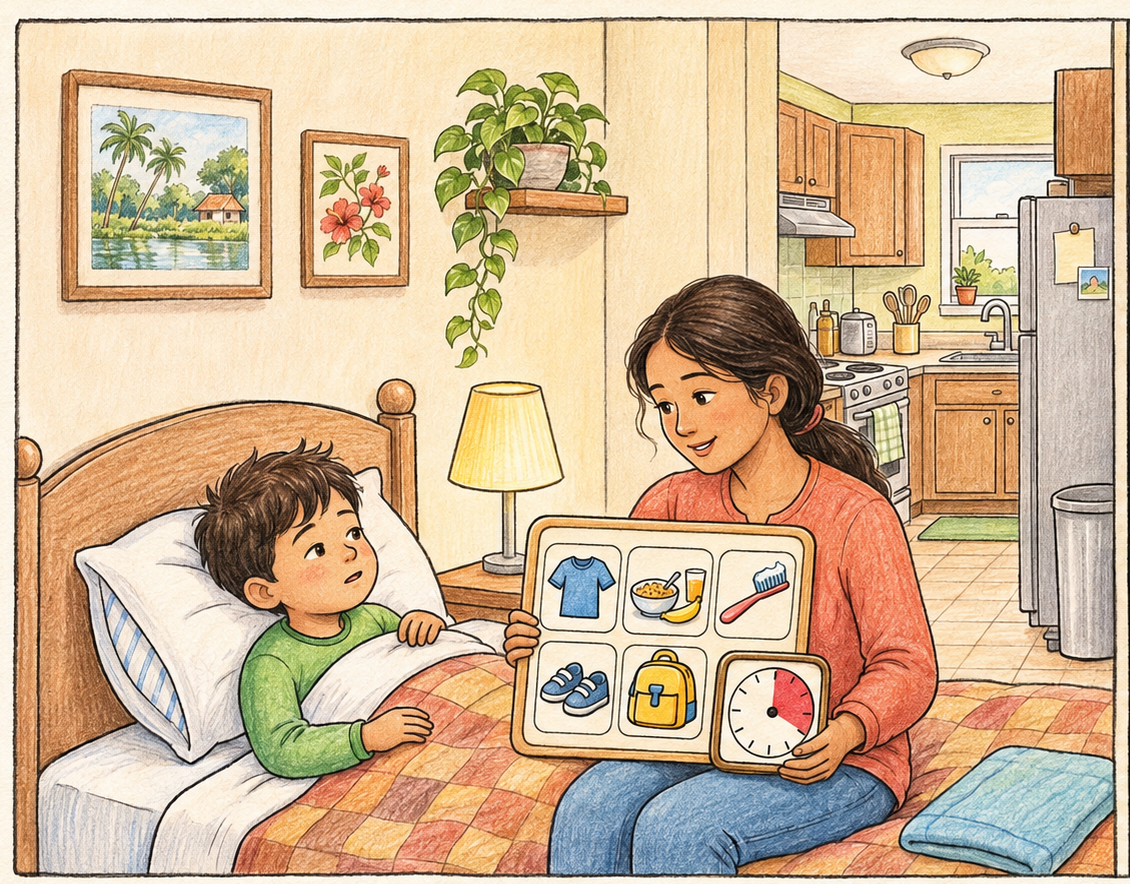
A visual routine can make the sequence easier to follow without requiring me to keep repeating it. Pictures, photographs, objects or written words can show what happens next, and they remain available after a spoken instruction has finished. Raising Children Network notes that visual supports can help even after a routine has been learned, particularly when a child is stressed, distracted or unwell. For us, that might mean a short sequence showing the bathroom, clothes, breakfast, teeth, shoes and van, arranged in the order that works for our family. If the whole sequence is too much, we could show just the current step and the next one. The important part is that Kabbo understands it and finds it useful. The chart can hold the sequence for both of us, so I do not have to become a walking announcement system. We already use this magnetic morning, bedtime and daily routine chart (Amazon.ca affiliate link) with him. Raising Children Network explains how visual schedules and supports can help.
The first transition of the day deserves some room, too. I would like to build in a gentler start: a familiar greeting, a little time to become properly awake and a predictable first step. Some children welcome quiet music or a cuddle; others need less sound or space from touch. A planned few minutes of waking time could give our “five more minutes” negotiations a clearer shape, with an agreed next step afterwards. A visual timer might help with that transition if Kabbo finds it reassuring; if a countdown makes him more anxious, we would need another approach. And that pause has to fit the actual morning. If waking at 8:30 leaves no room for difficulty, I need to look at the whole schedule, including bedtime, rather than simply taking more time away from sleep.
We also have this visual schedule and planning board with a timer (Amazon.ca affiliate link). For other tasks, we use an analogue sixty-minute visual timer, which works well for us. Before that, we used these glass hourglass timers (Amazon.ca affiliate link). The idea worked really well, but ours broke very easily, and the breakages became another reason for a meltdown. I eventually removed them from Kabbo’s sight. A tool can make sense in principle and still turn out to be a poor fit for the child and household actually using it.
If a meltdown has already begun, the immediate priority changes. Safety, less noise and fewer words become more useful than a detailed explanation of why we are late. Familiar comfort may help if it is wanted; space may be preferable. Questions about what happened can wait until he has recovered. The van’s timetable still exists, which is why, on a difficult morning, I let the transport team know and we arrange something else.
Through all of this, I still want a clear expectation: on school days, we go to school unless illness or another exceptional circumstance means we cannot. I want that expectation to come with dependable help: “Today is a school day. I’ll help you get ready. First, let’s put your clothes on.” There can be manageable choices within the routine—which of two comfortable tops to wear, or whether he wants to try a step himself or have my help—without making the entire morning an open-ended negotiation.
For now, I want to observe our mornings more closely without turning them into another exhausting project.
The Amazon.ca links in this article are affiliate links. If you buy through them, I may earn a commission at no extra cost to you. As an Amazon Associate I earn from qualifying purchases.