Name the stuck point · examine the evidence · build a balanced thought
CPT — COGNITIVE PROCESSING THERAPY
Helping your brain get unstuck after something scary or painful happens.
- Published
- Last reviewed
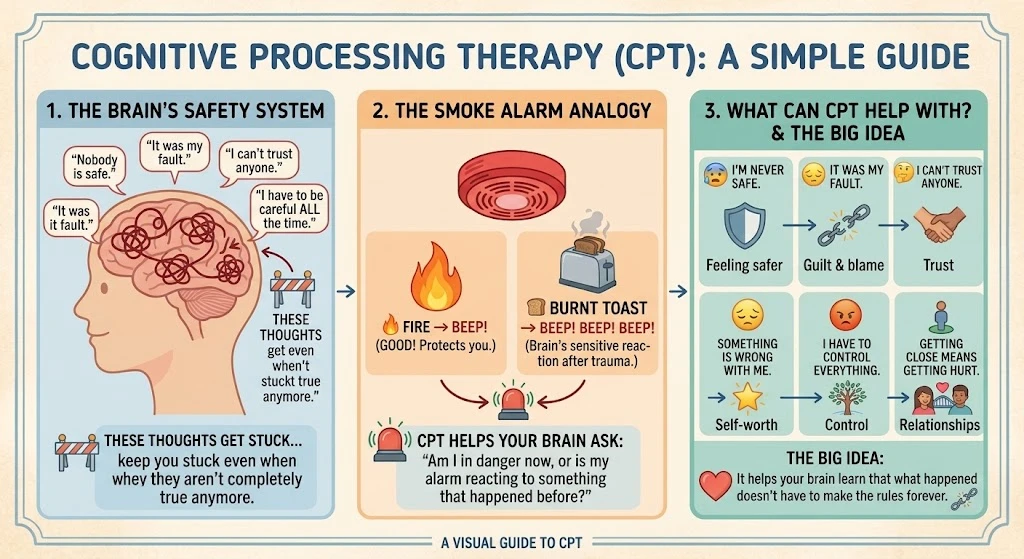
Helping your brain get unstuck after something scary or painful happens
Cognitive Processing Therapy (CPT) is an evidence-based, trauma-focused psychotherapy for PTSD. The VA’s National Center for PTSD explains that CPT helps people notice and examine trauma-related thoughts called “stuck points” and develop more balanced ways of understanding what happened, themselves, other people, and the world.
🧠 Your Brain Learns Rules
After something really upsetting happens, your brain tries hard to protect you.
Sometimes it learns rules like:
“Nobody is safe.”
“It was my fault.”
“I can’t trust anyone.”
“I have to be careful ALL the time.”
These thoughts can get stuck, even when they are not completely true anymore.
🚨 Think of It Like a Smoke Alarm
A smoke alarm is supposed to warn you about fire.
🔥 Fire → BEEP!
Good! It is protecting you.
But imagine it becomes so sensitive that…
🍞 Burnt toast → BEEP! BEEP! BEEP!
Your brain can do something similar after trauma.
CPT helps you ask:
“Am I in danger now, or is my alarm reacting to something that happened before?”
🔎 Become a Thought Detective
CPT teaches you not to automatically believe every scary thought your brain gives you.
Instead, investigate:
🔎 What actually happened?
🔎 What evidence do I have?
🔎 Am I missing part of the story?
🔎 Is this a feeling or a fact?
Then build a thought that fits the whole story.
🌱 What Can CPT Help With?
😨 “I’m never safe.” → Feeling safer
😔 “It was my fault.” → Guilt and blame
🤔 “I can’t trust anyone.” → Trust
😞 “Something is wrong with me.” → Self-worth
😠 “I have to control everything.” → Control
🧍 “Getting close means getting hurt.” → Relationships
CPT often examines how trauma has affected beliefs about safety, trust, power and control, esteem, and intimacy. These are the five themes described by the VA’s National Center for PTSD.
The Big Idea
CPT can’t change what happened.
❤️ It helps your brain learn that what happened doesn’t have to make the rules forever.
A Note About Support
This page is a simplified introduction, not instructions for processing trauma on your own. CPT is a structured psychotherapy for PTSD. A qualified mental-health professional can help you decide whether it fits your needs and provide support while you work through painful material.