Name it clearly · notice the pattern
CBT can help everyone
A practical introduction to how CBT connects thoughts, feelings, and behaviours—and how its everyday tools can help us notice patterns, question assumptions, and respond with more choice.
- Published
- Last reviewed
Seven-part visual guide
CBT: what it is and how it can help
Use the arrows, numbered buttons, keyboard arrow keys, or swipe to move through the seven cards.

1 / 7CBT: what it is and how it can help
If you have ever found yourself trapped in an endless loop of overthinking, carrying a sudden heavy weight of unexplained guilt, or jumping straight to the absolute worst-case scenario after a simple text message, you are not alone.
When many people hear the term Cognitive Behavioural Therapy (CBT), they assume it is a heavy clinical treatment meant strictly for hospitals, formal diagnoses, or severe mental-health crises. CBT is a psychological treatment, but many of the ideas and exercises used within it are also practical tools for understanding how our minds process the world.
You do not need a formal diagnosis to learn from basic CBT-informed self-help techniques. Whether you are unlearning childhood conditioning, navigating the stress that can accompany neurodivergence, or simply trying to stop your brain from spiralling at 2:00 a.m., these tools may help you create more room between a thought and your response. Formal CBT is still a treatment, however, and some people and conditions benefit from—or require—support from a properly trained professional.
What Does CBT Mean?
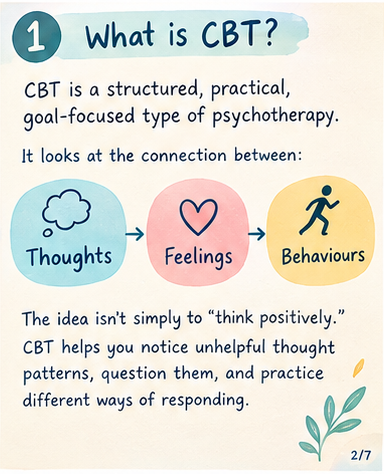
CBT stands for Cognitive Behavioural Therapy. It is a structured, practical, and goal-focused approach that looks at the relationship among three core elements:
- Thoughts: The internal monologue and immediate assumptions running through your head.
- Feelings: The emotional and physical reactions that follow, such as anxiety, dread, anger, sadness, or a sinking feeling in your stomach.
- Behaviours: The actions you take in response, such as avoiding a task, withdrawing from people, people-pleasing, or seeking repeated reassurance.
The NHS overview of CBT describes the way situations can affect how we think, feel, and act—and how CBT can help us approach those situations differently.
A common misconception is that CBT is about “forced positivity”: tricking yourself into thinking everything is sunshine and rainbows. It is not. CBT does not ask you to ignore reality. It helps you notice patterns that may be keeping you stuck, examine whether your first interpretation is accurate or useful, and practise other ways of responding.
The Automatic Cycle
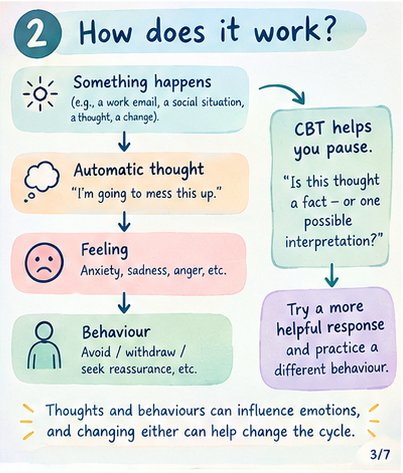
To understand how CBT can work in everyday life, it helps to break down a chain reaction that may happen in our minds many times a day:
- The trigger—an event: Something happens in your environment: a work email, a sudden change in schedule, or a subtle shift in someone’s tone.
- The automatic thought: Your brain instantly creates a story about the event, often influenced by past experience: “I am going to mess this up,” “They are upset with me,” or “I am failing at this.”
- The emotion: That thought is followed by a physical and emotional response. Anxiety may spike, your stomach may drop, or guilt may settle in.
- The behaviour: To escape the discomfort, you may react from habit by procrastinating, shutting down, over-explaining yourself, withdrawing, or repeatedly seeking reassurance.
CBT helps insert a pause between the automatic thought and what you do next.
Instead of letting the first thought dictate your next move, you can step back and ask:
“Is this thought a factual guarantee, or is it one possible interpretation?”
The goal is not to pretend that a painful interpretation is impossible. It is to check the evidence before treating that interpretation as the only truth. By catching a thought before it drives your behaviour, you may begin to change the cycle.
What Can CBT Help With?
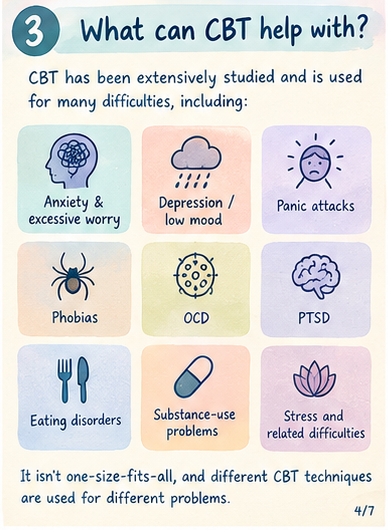
CBT is widely researched and is used in tailored forms for a range of mental-health difficulties, including depression, anxiety disorders, panic, phobias, OCD, PTSD, and eating disorders. Different problems call for different techniques; for example, treatment for OCD or an eating disorder should not be reduced to a generic “think differently” exercise. The American Psychological Association and the NHS both describe the evidence for CBT across a range of problems.
CBT-informed skills may also be useful for everyday psychological stress, including:
- Chronic overthinking and worry: Constantly playing out catastrophic scenarios in your head.
- Unlearning childhood guilt: Disentangling your self-worth from productivity, perfectionism, or the need to please everyone.
- Perfectionism and burnout: Challenging the belief that if something is not done perfectly, it is a complete failure.
- Social situations and daily transitions: Managing anxiety around unfamiliar routines, changes, or interactions.
The NHS also offers self-help CBT techniques for recognising unhelpful cycles, reframing thoughts, managing worries, solving problems, and gradually facing fears. Self-help can be a useful starting point, but it is not a replacement for individual assessment when distress is severe, persistent, or interfering with daily life.
What Do You Learn?
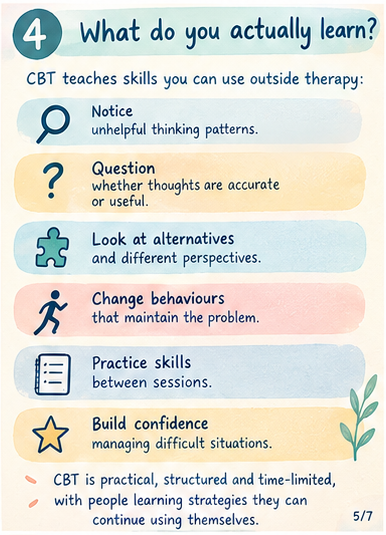
CBT is not simply sitting on a couch and talking endlessly about childhood, although understanding your history can be valuable. It is an active skill-building approach. In CBT, you may learn to:
- Notice: Become an observer of your own mind and catch automatic patterns as they happen.
- Question: Test the evidence. What supports this thought? What contradicts it? Is there information you do not yet have?
- Reframe: Develop alternative, realistic perspectives that account for the facts without automatically catastrophising.
- Change: Practise behaviours that reduce avoidance or interrupt a cycle instead of maintaining it.
- Practise: Try skills between sessions or in ordinary life so they become easier to use when stress is high.
- Build confidence: Develop trust in your ability to handle difficult emotions and uncertain situations.
These are skills, not moral tests. Struggling to use them does not mean you are failing at therapy or at life. Sometimes a thought pattern is connected to trauma, disability, poverty, discrimination, unsafe circumstances, or a problem that cannot be solved by reframing it. A good CBT approach does not blame you for reality; it helps you distinguish what can be questioned, what can be changed, and what needs support or protection.
The Bigger Picture
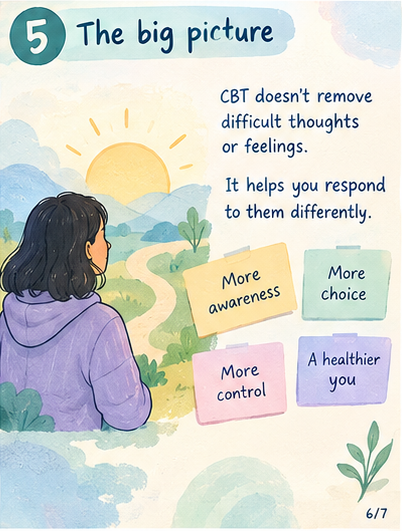
The most liberating truth about CBT may be this: it does not teach you never to have difficult thoughts or feelings again.
Minds generate thoughts, and life will continue to bring stressful situations. CBT can change your relationship with some of those thoughts. Instead of treating every anxious impulse as absolute truth, you can learn to view it as mental weather—something you can acknowledge and observe before choosing how to respond.
CBT is not one-size-fits-all, and it will not be the right or sufficient approach for every person or every situation. But you do not need a medical label before you are allowed to become curious about your own patterns. If you recognize yourself in cycles of anxiety, self-doubt, or old conditioning, CBT-informed tools can offer a practical and compassionate place to begin—one thought at a time.
A Note About Support
This article offers general education about CBT-informed skills. It is not a diagnosis, an individual treatment plan, or a promise that CBT will work for everyone in the same way. If difficult thoughts or feelings are intense, persistent, connected to trauma, or interfering with daily life, a qualified mental-health professional can help you decide what kind of support fits your needs.