Don’t Humiliate a Sensitive Child—It May Leave a Deeper Scar Than You Can Imagine
A personal reflection on childhood humiliation, the shame it can leave behind, and the gentler kind of parenting sensitive children deserve.
It Was Just a Joke—Until I Stopped Playing
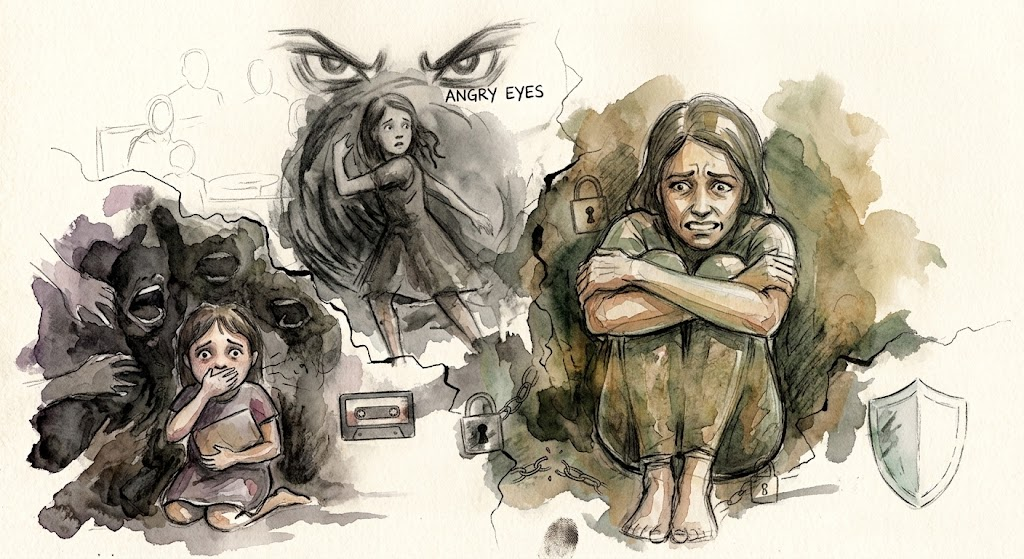
I was six when I learned that something joyful and private could be turned into public evidence against me. We had a cassette recorder at home. I wanted to know what my voice sounded like, so I pressed Record and began pretending to be two different women having a conversation about their husbands. I changed my voice for each character and acted out both sides of the conversation. That was it. I was not making a statement about marriage. I was not doing anything inappropriate. I was six years old, borrowing the voices and subjects I had heard around me and using them to create a story. I know now that this was pretend play—a completely normal and healthy part of childhood. I did not know that then.
My mother found the cassette. Then she played it for everyone. And I mean everyone. We lived in a joint family. Looking back, perhaps it was not an enormous crowd. But to six-year-old me, those people were my entire world. I do not remember every face or exactly how each person reacted. I remember being watched. I remember knowing that something I had created privately was now being presented for everyone’s amusement. I remember wanting to disappear.
What an adult may have considered a funny little performance felt like the public execution of my trust. I had not volunteered to perform. I had not handed anyone the cassette. I had not agreed to let a roomful of people enter the tiny imaginary world I had created for myself. After that day, I never pretend-played like that again. I stopped experimenting with characters. I stopped playing with different voices. Even singing freely became difficult because I had learned to monitor the sound coming out of me before anyone else could hear it and decide that it was ridiculous.
I cannot prove that I would have become an actor or voice actor. Nobody can prove the life they might have lived under different circumstances. But I now believe I had some talent in that area. What I can say with certainty is that my willingness to explore it ended that day. The talent may or may not have become a career. The shame made sure I never found out.
Then I Stopped Dancing
Something similar happened when I was twelve. I was dancing to Kaanta Laga, which was extremely popular at the time. I was not putting on a show. I was not dancing in front of strangers. I made one little move because I liked the song.
My mother saw me and gave me the angry eyes. If you grew up with those eyes, you know exactly what I mean. No words were necessary. The whole judgment arrived in one look: Vulgar. That was enough. I never danced for fun again.
One look took something that had felt playful and turned it into evidence that there was something shameful about my body. Dance stopped being movement. It became exposure. It became the possibility of being watched, judged, and found morally wrong. This is how a child learns shame. Not always through a long lecture. Sometimes joy is simply paired with humiliation often enough that the child’s nervous system understands the rule: Do not perform. Do not dance. Do not attract attention. Do not let anyone see you enjoying your own body or imagination. So I stopped.
What I Was Doing Was Normal
The hardest part for me to accept was that I had not done anything wrong. Pretend play is not useless silliness. The American Academy of Pediatrics describes play—including pretend play—as important to children’s language, social-emotional development, self-regulation, executive functioning, and ability to manage stress. Play gives children a safe place to experiment with roles, relationships, emotions, and the world they observe around them. The Power of Play, American Academy of Pediatrics
That cassette was not proof that I was ridiculous. It was proof that I was playing. It was evidence of imagination, observation, storytelling, and performance. I was practising dialogue. I was distinguishing between characters. I was testing what my voice could do. I did not need to be corrected. I certainly did not need an audience assembled without my consent.
At twelve, dancing one move to a popular song was not evidence that I was vulgar either. I was a child moving to music. My body had not committed a moral offence by existing rhythmically for several seconds. These were ordinary childhood acts. The response taught me to experience them as crimes.
When a Parent Makes the Child the Punchline
Not every embarrassing family story causes PTSD. Not every clumsy joke is emotional abuse. Parents are human. They misjudge situations, laugh at the wrong moment, misunderstand their children, and sometimes cause hurt without intending to. But intention does not decide impact by itself.
A parent can make a mistake, notice the child’s distress, stop, apologize, and repair the damage. The danger grows when humiliation becomes a pattern, when a child’s pain becomes part of the entertainment, or when shame is repeatedly used to control behaviour.
The World Health Organization includes ridicule and denigration among forms of psychological or emotional violence against children when those actions harm—or are likely to harm—a child’s development. The CDC similarly lists shaming and name-calling as examples of emotional abuse. Professional guidance on psychological maltreatment specifically identifies ridiculing a child and humiliating them in public as forms of spurning. WHO: Violence Against Children, CDC: About Child Abuse and Neglect, APSAC definitions of psychological maltreatment
That does not mean every unfortunate joke should immediately be assigned the most severe possible label. It means we need to stop pretending that humiliation becomes harmless simply because the person doing it is a parent or because other adults found it funny. A child is not family entertainment. A child’s diary, recording, crush, mistake, body, fear, performance, or private experiment does not automatically become community property because an adult discovered it. Turning a child’s vulnerability into a spectacle is not cute. It is cruel.
Why Would a Mother Do That?
This is the question people inevitably ask, and I have asked it too. Why would my mother play the cassette for everyone? Why did so many ordinary things we did have to become spectacles? Why did she use an angry look to turn a twelve-year-old child’s dancing into something dirty? Why did femininity, performance, beauty, or self-expression appear to make her so uncomfortable?
I do not know. Maybe she genuinely thought the recording was funny and did not consider that I had a private inner life. Maybe she grew up in a world where children belonged to the family and privacy was treated as secrecy or disobedience. Maybe public embarrassment was the form of discipline she knew. Maybe she feared how other people would judge her daughters, so she tried to control us before the world could. Maybe she had been taught that femininity was dangerous, frivolous, or shameful and passed that lesson on without questioning it. Maybe making a spectacle of us gave her control inside a family system where she otherwise felt powerless.
I can consider those possibilities. I cannot diagnose her from my memories, and I do not need to call her a narcissist to make what happened serious. What I can say is that, in those moments, my dignity mattered less than the room’s reaction. My privacy mattered less than the story she wanted to tell. My freedom mattered less than her ability to control how I behaved and how other people saw me. Whatever her reasons were, that is what her actions communicated.
Understanding that she may have had her own conditioning does not require me to sanitize what she did. An explanation is not an absolution. Generational trauma can explain why someone reaches for the weapon. It does not make it acceptable for them to use it on a child.
The Shame Followed Me Into Adulthood
The cassette disappeared a long time ago. The audience went home. The humiliation stayed. It stayed through school, adulthood, and even marriage. It lived in the way I avoided performing, singing, dancing, or drawing too much attention to myself. It lived in the split second of panic that appeared whenever I felt observed.
This is how those experiences became part of my PTSD. They did not remain neatly stored as unpleasant childhood memories. They became rules inside my body: Being seen is dangerous. Self-expression leads to humiliation. If you enjoy yourself too openly, someone will use it against you.
The effects were not limited to acting or dancing. When I felt that my life was slipping beyond my control, I chopped off my hair. I did not understand the connection at the time. I only knew that cutting it gave me a brief sense that I had done something. I had made one decision about my own body when everything else felt impossible to control.
My mother used to grab our hair and roughly chop it off. Sometimes she did it because she thought we were spending too much time looking in the mirror. The lesson was never only about hair. The lesson was that our bodies were available for correction whenever she disapproved of how we were using them.
Years later, I repeated the same action on myself—but with one important difference. This time, the scissors were in my hand. I was doing to myself what had once been done to me, while also trying to reclaim control over it. I am not claiming that everyone who cuts their hair during a difficult period is responding to trauma. I am explaining what the act came to mean in my own life. The body remembers patterns long before the conscious mind understands them.
What Therapy Helped Me Unlearn
It took CBT and later Cognitive Processing Therapy—CPT—for me to accept something that should have been obvious all along: Six-year-old me had done nothing wrong. Twelve-year-old me had done nothing wrong.
CPT is a trauma-focused treatment for PTSD that helps people identify and challenge “stuck points”—beliefs involving shame, self-blame, safety, trust, power, control, esteem, and intimacy. It does not erase what happened. It helps separate what happened from the conclusions the traumatized mind built around it. The U.S. National Center for PTSD identifies CPT as one of the most strongly recommended and extensively studied PTSD treatments. National Center for PTSD: Cognitive Processing Therapy
My stuck point was not simply, “My mother embarrassed me.” It was: There must have been something embarrassing about me. Therapy helped me pull those two ideas apart. The first describes what someone did. The second blames the child for having been available to hurt.
I had spent years treating the humiliation as proof that my performance was shameful. Only much later could I see that the shame belonged to the act of exposing a child—not to the child who was playing.
Research cannot tell me exactly why one particular memory stayed inside me for decades. But broader evidence supports the connection between childhood emotional maltreatment and later mental-health difficulties. A systematic review and meta-analysis covering 90 studies found associations between childhood emotional abuse or neglect and adult depression, anxiety, substance misuse, suicidal thoughts or attempts, eating disorders, and other psychological symptoms. Association is not destiny, and children do not all respond in the same way. But emotional harm does not become imaginary simply because it leaves no bruise. Systematic review and meta-analysis of childhood psychological maltreatment
Research has also found a meaningful association between shame and PTSD symptoms. Shame is not merely remembering, “Something bad happened.” Shame whispers, “Something bad happened because there is something wrong with me.” Meta-analysis of shame and PTSD
That was the belief I carried. Not that someone had failed to protect my vulnerability. That I had been foolish for having any vulnerability to protect.
Sensitive Children Do Not Need Thicker Skin
Calling a child “too sensitive” is often an adult’s way of avoiding a more uncomfortable question: Why was I so careless with something this child trusted me with?
Children differ in temperament. Some recover quickly from embarrassment. Some feel social exposure with enormous intensity. Some remember a roomful of laughter or one disgusted look for years. The adult’s job is not to determine whether the child has earned the right to feel hurt. The adult’s job is to notice the hurt and respond responsibly.
A sensitive child does not need to be mocked until they become less sensitive. That does not create resilience. It can create avoidance. The child does not necessarily learn, “Other people’s opinions cannot hurt me.” They may learn: Never give anyone anything real enough to hurt.
Research on parental verbal aggression suggests that ridicule, disdain, and humiliation can be associated with lasting psychological difficulties and are not necessarily cancelled out by affection or praise at other times. Kindness on Tuesday does not automatically erase humiliation on Monday. Study on parental verbal affection and verbal aggression
This does not mean parents must protect children from every uncomfortable feeling. Children need correction, limits, frustration, feedback, and opportunities to recover from mistakes. Humiliation is not the same as guidance. Guidance addresses what a child did. Shame tells the child what they are.
What These Memories Have Taught Me as a Mother
Now I am the mother of a sensitive child. My son feels things deeply. A tone of voice, a disappointed look, a joke that goes slightly too far—things that appear small to other people can become enormous inside him. I understand that part of him because it exists inside me too.
That does not mean I always respond perfectly. I do not. Sometimes I become impatient. Sometimes I misunderstand what he needs. Sometimes my own exhaustion speaks before the mother I want to be has time to catch up. But these memories have given me a very clear list of things I never want to do to him.
I will not take something he created privately and turn it into entertainment for the family. I will not tell stories about his fears, meltdowns, mistakes, unusual phrases, private interests, or vulnerable moments simply because other adults might find them funny. I will not mock his voice, his body, his movements, his stims, his tears, or the things that bring him joy.
I will not use the angry eyes and leave him to guess what terrible thing he has done. If something needs to stop, I want to use words. I want to explain the behaviour, the reason, and what he can do differently. I do not want one disgusted look from me to turn singing, dancing, or playing into something shameful for the rest of his life.
I will not tell him that he is “too sensitive” when what I really mean is that his feelings are inconvenient for the adults around him. His feelings being real does not mean every request must be granted. He still needs boundaries. He still needs correction, guidance, and opportunities to learn how his behaviour affects other people. But boundaries do not require humiliation. I can correct what he did without convincing him that there is something wrong with who he is.
I also will not expect him to laugh when someone makes a joke at his expense. A child should not have to participate in his own humiliation to prove that he is polite, easygoing, or capable of “taking a joke.” If someone continues after he asks them to stop, I want him to know that I will stand beside him—not beside the adults who think their amusement matters more than his dignity.
Before sharing a recording, photograph, private story, performance, or embarrassing moment from his life, I want to ask myself whether that moment belongs to me to share. Being his mother does not make every part of his life my property.
And if I embarrass him, I want to notice. If I hurt him publicly, I want to repair it publicly. I do not want to whisper an apology later while everyone else is allowed to keep believing that what happened was acceptable. I want to be able to say: “I shared something private without asking you. I saw that it embarrassed you. I should not have done that. I am sorry.” Then I want my behaviour to change.
I am not trying to raise my son inside a bubble where he never feels discomfort, criticism, rejection, or embarrassment. That would be impossible, and it would not prepare him for life. I am trying not to become his first bully.
I am trying to make home the place where he does not have to protect every soft part of himself. I want him to know that his sensitivity is not a defect that must be mocked out of him before the world gets the chance. Because sensitivity is not only pain. It is also empathy. Imagination. Attention. Creativity. The ability to notice what other people miss. I do not want him to become less sensitive just so that he can survive the people who are supposed to love him.
I know I cannot promise that my child will grow up without scars. No parent is given that promise. I will make mistakes. I will sometimes speak too sharply, misunderstand him, or respond from my own exhaustion and conditioning. Breaking the cycle does not mean becoming a perfect mother. It means refusing to defend the harm simply because I did not intend it. It means noticing, apologizing, repairing, and trying differently the next time.
Maybe I cannot leave my son with no scars. But I can refuse to carve them deliberately and call it discipline. I can refuse to turn his pain into a joke and call it affection. I can refuse to humiliate him and then make his sensitivity the problem. Maybe I can leave impressions that do not have to become wounds.
In that sense, my mother taught me something about parenting—although I wish the lesson had cost me less. She taught me, with painful clarity, what I never want to do to my own child.
I want my son to keep playing after someone walks into the room. I want him to sing without first checking everyone’s face. I want him to dance because he hears music and his body wants to move. I want him to create strange characters, make ridiculous voices, and explore every harmless version of himself without wondering who might use it against him later.
I cannot return the cassette to the six-year-old girl I was. But I can make sure my son never has to hide his.
What I Know Now
I do not know whether I would have become an actor. I do not know whether I would have tried voice acting, sung confidently, or danced badly and happily at weddings. Those alternate lives are impossible to measure. What I know is that the choice should have been mine.
The cassette did not capture a ridiculous little girl. It captured a creative child discovering what her voice could do. The dance move did not reveal a vulgar child. It revealed a twelve-year-old who heard music and wanted to move. My hair was not someone else’s instrument of discipline. My body was not a family project. My private joy was not public property.
I cannot go back and protect the child holding that cassette. I cannot stop my mother from pressing Play. But after CBT and CPT, I can finally sit beside that child in my memory and tell her what an adult should have said then: That was really creative. You made both voices yourself? Would you like me to listen—or would you rather keep it private?
And if she says it is private, I will protect it. I can protect that same privacy in my son. I can make home a place where he does not need to shrink his voice, hide his imagination, or study my face before allowing himself to feel joy.
Because sensitive children do not need thicker skin. They need adults with gentler hands, quieter mouths, and enough self-control not to turn a child’s vulnerability into entertainment.
The joke may last thirty seconds. The child may stop playing for thirty years.