Name it clearly · notice the pattern
So Tired of Walking on Eggshells Around You!
How gaslighting can turn disagreement into self-doubt, why some autistic adults may miss the pattern, and how to listen and repair without erasing someone else.
- Published
- Last reviewed
I have been told way too many times by siblings, parents, and friends that I am too sensitive, or that my memory is faulty because I describe things differently from the way someone else remembers them.
“Everyone knows you remember things wrong.”
That sentence is particularly effective. Because what are you supposed to do when several people apparently agree that your memory is wrong? You begin to doubt yourself. Maybe I did misunderstand. Maybe I remembered it incorrectly. Maybe I exaggerated it inside my head. Maybe I am blaming someone for a situation I created entirely on my own. And before I know it, I am apologizing.
What Gaslighting Actually Is
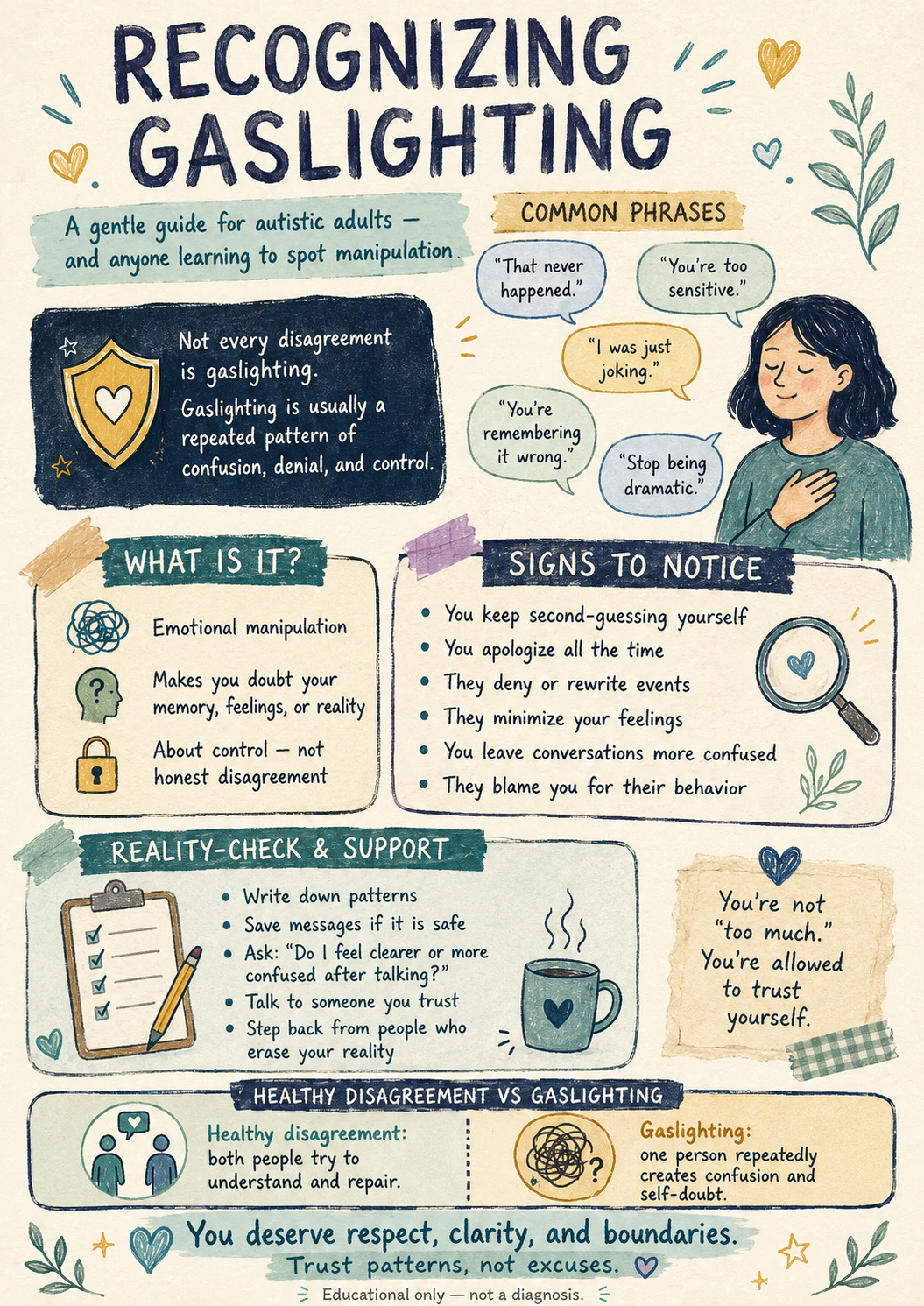
Gaslighting is another one of those words that has become so common that it is in danger of meaning everything—and therefore nothing. Someone remembers an event differently? Gaslighting. Someone disagrees with you? Gaslighting. Someone becomes defensive or says something insensitive? Gaslighting. But not every disagreement, faulty memory, defensive response, or dismissive sentence is gaslighting. That distinction matters—not because we need to protect people who cause harm, but because we need to understand the harm clearly. Gaslighting is a repeated pattern of emotional manipulation in which one person denies, minimizes, distorts, or rewrites another person’s experiences until that person begins to distrust their own memory, feelings, judgment, or perception of reality. It is not simply:
“I remember it differently.”
It becomes something closer to:
“That never happened. You always remember things wrong. You’re too sensitive. Everyone else agrees with me.”
The goal—or, at the very least, the function—of this pattern is power. One person gradually becomes the authority on what is real, while the other person becomes increasingly dependent on that version of reality. The National Domestic Violence Hotline describes gaslighting as a form of emotional abuse that can cause someone to question their feelings, instincts, and sanity. Over time, the person experiencing it may become confused, anxious, isolated, and increasingly reliant on the abusive person to define what happened. That is what makes gaslighting so damaging. It does not only challenge what you remember. It teaches you that you are not qualified to remember your own life.
What Gaslighting Can Sound Like
Some phrases frequently associated with gaslighting include:
- “That never happened.”
- “You’re imagining things.”
- “You always remember everything wrong.”
- “Everyone else remembers it the way I do.”
- “You’re too sensitive.”
- “You’re being dramatic.”
- “I was only joking. Can’t you take a joke?”
- “Nobody else has a problem with me.”
- “You’re trying to make me look like the bad person.”
- “You’re confused again.”
- “It’s all in your head.”
But the words alone are not proof. Someone saying, “I don’t remember that,” once is not automatically gaslighting. Two people can honestly remember the same event differently. Human memory is imperfect—including mine. A person can also say something dismissive, recognize the harm, apologize, and change their behaviour without establishing a pattern of manipulation. The important questions are:
- Does this keep happening?
- Are the facts rewritten only when accountability becomes uncomfortable?
- Are other people’s opinions brought in to outvote your memory?
- Are your feelings used as evidence that you are irrational?
- Does the person show curiosity, or only certainty?
- Can they accept responsibility?
- Do you leave the conversation understanding more—or trusting yourself less?
What It Did to Me
I often felt guilty for blaming someone else. Then I felt angry at myself for creating the entire situation inside my own head. I apologized too much, sometimes without fully understanding what I was apologizing for. That becomes particularly difficult when someone is accusing you of something you cannot remember—or when you remember the same event differently. How do you defend yourself against an incident you cannot retrieve clearly? How do you remain confident when someone else appears completely certain? I checked and rechecked old conversations. I reread messages, trying to understand how my words could have been interpreted differently. I searched for the point where my thinking had gone wrong.
There is nothing inherently wrong with examining your behaviour. We should all be willing to ask whether we have misunderstood or hurt someone. But I was not checking only to understand. I was checking because I had stopped trusting myself. The original issue would disappear. Instead of discussing what someone else had done, I would end up defending whether I was reasonable enough, calm enough, intelligent enough, or mentally reliable enough to speak about it. And if I could not prove every detail perfectly, I assumed that I must be the problem.
The Moment I Recognized the Pattern
It took somewhere around my thirtieth session with my current therapist before I began to see it. This was not happening randomly. Certain people used the same strategy repeatedly—and usually when they felt cornered in an argument. When the conversation approached something they did not want to acknowledge, the subject changed. Suddenly, we were no longer discussing what they had said or done. We were discussing my memory. My tone. My sensitivity. My tendency to misunderstand. The argument was no longer about their behaviour. The argument was about whether I was mentally qualified to have an argument at all. Once I saw the pattern, I could not unsee it.
That did not mean every disagreement with those people was gaslighting. It did not mean my memory became perfect or that I could never be wrong. It meant I finally understood that my uncertainty was being used as an exit door. Whenever accountability entered the room, someone escaped through my self-doubt.
Why Some Autistic Adults May Miss Gaslighting
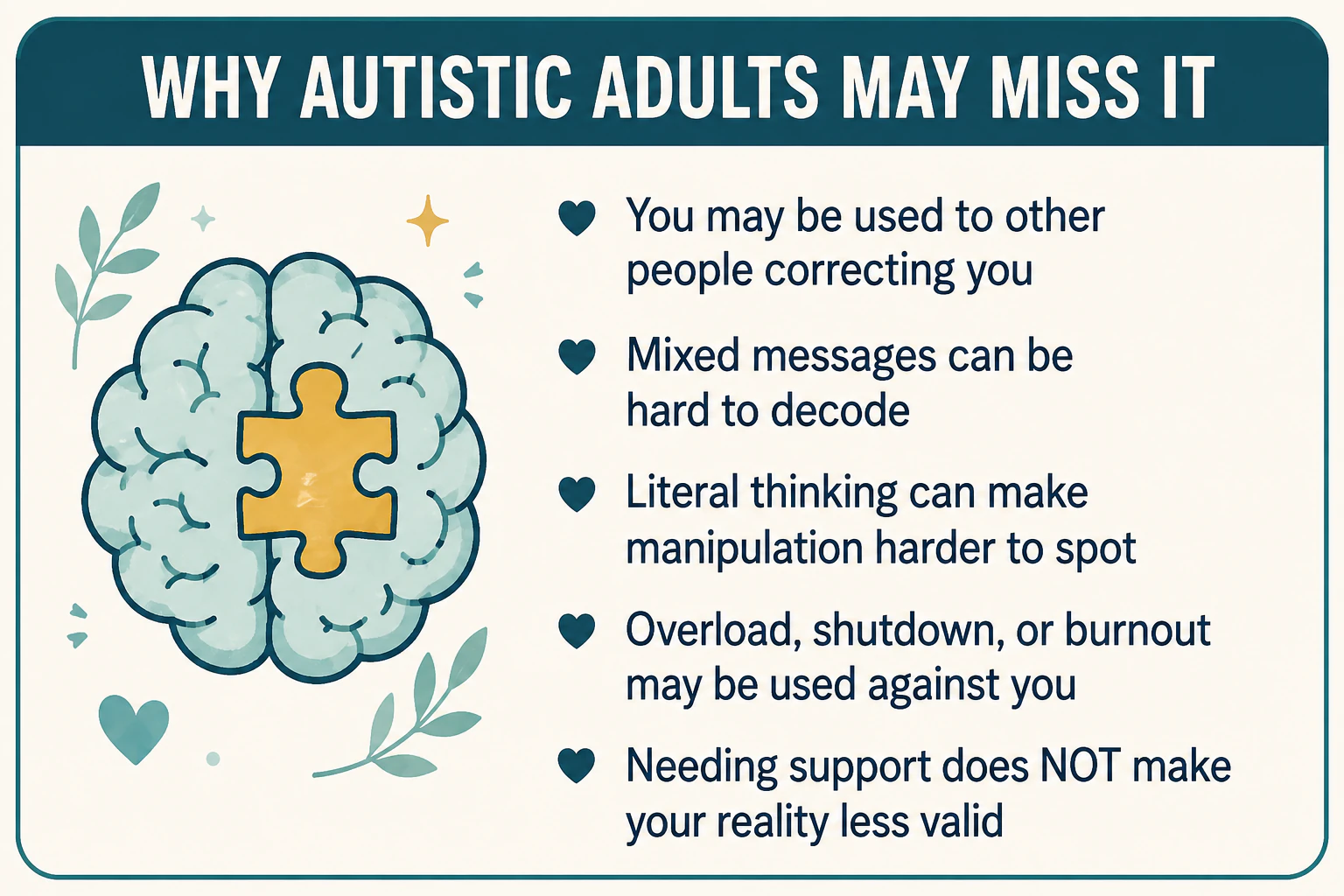
Autistic people are not inherently naïve, incapable, or unable to understand relationships. The problem is not that an autistic person’s mind is defective. The problem is that manipulative people may exploit differences in communication, processing, support needs, and social experience. Many autistic adults—particularly those who were diagnosed late or remain undiagnosed—have spent a lifetime being corrected. You misunderstood the joke. You reacted too strongly. You took that too literally. That noise is not painful. That fabric does not hurt. Stop making a scene. Everyone else is fine. When someone has repeatedly been told that their interpretation of their own experiences is wrong, it may become difficult to recognize when “correction” has crossed into control.
Mixed messages and hidden intentions may also be difficult to decode. If you tend to assume that people mean what they say, it may not occur to you that someone is deliberately changing their story, denying a pattern, or using your trust against you. Overload, shutdown, burnout, or difficulty communicating under pressure may create another opening for manipulation. Someone might say:
“You were too emotional to remember.”
“You shut down, so clearly you agreed.”
None of those statements makes the autistic person’s reality less valid. Research based on autistic adults’ own accounts has found that some participants had difficulty identifying manipulative intentions, recognizing unhealthy boundaries, or refusing unreasonable demands. Many described doubting their judgment after repeated interpersonal victimization. These findings do not mean autistic people are responsible for being harmed. They demonstrate why accessible information, supported self-advocacy, and clear examples of healthy relationships matter. Read the Autism in Adulthood study.
Research has also found higher reported rates of several forms of violence and repeated victimization among autistic adults than among non-autistic comparison groups. The lesson is not that autistic people are “easy targets.” The lesson is that abusers, inaccessible systems, stigma, isolation, and the dismissal of autistic communication can create dangerous conditions. Read the cross-sectional victimization study. Needing support does not make your memory disposable. Processing something differently does not make your experience imaginary. Communicating slowly does not give someone else ownership of your reality.
Disagreement Is Not Gaslighting
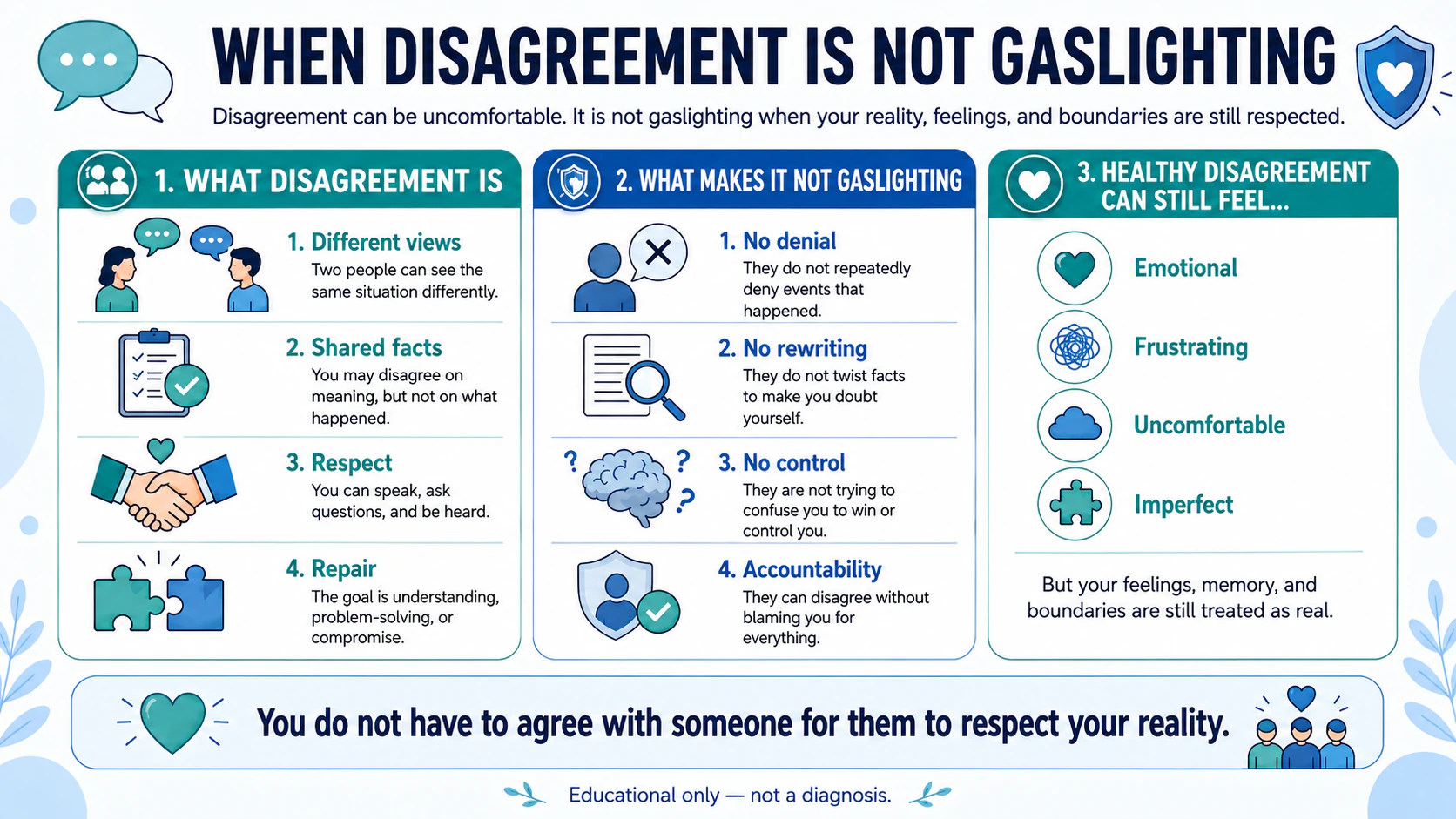
I have disagreed with my husband and still felt safe. I have disagreed with a few close friends and still felt respected. Those conversations may be uncomfortable. Sometimes one of us becomes frustrated. Sometimes we need time before we can speak clearly. But disagreement does not automatically become disrespect. That is the difference. Two people can experience the same situation differently. They may agree on what happened but disagree about why it happened, what it meant, or what should happen next. In a healthy disagreement, both people are still allowed into the room. One person might say:
“I remember you raising your voice.”
The other might respond:
“I remember speaking firmly, but I didn’t realize it sounded like shouting. I believe that it felt frightening to you.”
They have not agreed on every detail. But neither person has been erased. Healthy disagreement usually leaves room for:
- Different interpretations.
- Shared or verifiable facts.
- Questions and clarification.
- Respect for emotional impact.
- Accountability.
- Compromise, problem-solving, or repair.
Gaslighting does something different. It repeatedly denies events, rewrites facts, shifts blame, attacks credibility, or creates confusion to avoid accountability and maintain control. A healthy disagreement may still feel awful. You may cry. You may become angry. You may need time apart. Discomfort by itself does not prove gaslighting. The difference is not whether the conversation feels good. The difference is whether you are still permitted to exist inside it. Your feelings do not prove every factual claim you make. But factual disagreement does not make your feelings unreal. You do not have to agree with someone to respect their reality.
The Uncomfortable Part: I Can Do Harm Too
I do not want to write this as if gaslighting is something only other people do. I have caught myself minimizing the effort my husband puts into connecting with my family. Once I recognized what I was doing, I tried to remedy it. There have been other occasions when I realized I was being rude or mean. I tried to repair those situations too. That is the person I want to be—not someone who never causes harm, because that person does not exist, but someone willing to recognize harm and do something about it. I have also caught myself saying things like:
“Are you crazy?”
Sometimes it comes out through habit. It is one of those expressions many of us learned to throw around without thinking about what it actually communicates. But imagine trying to explain that something hurt you and hearing, “Are you crazy?” What happens to the conversation then? Your experience is no longer the subject. Your mental stability is. I do not want to reproduce the same behaviour I am learning to recognize in others. That is partly why I am writing this—for people like me. People who do not want to fall victim to gaslighting but also do not want to make someone else its victim.
Recognizing gaslighting cannot only be a weapon we point outward. Sometimes it needs to be a mirror.
How Not to Gaslight Someone—Even Unknowingly
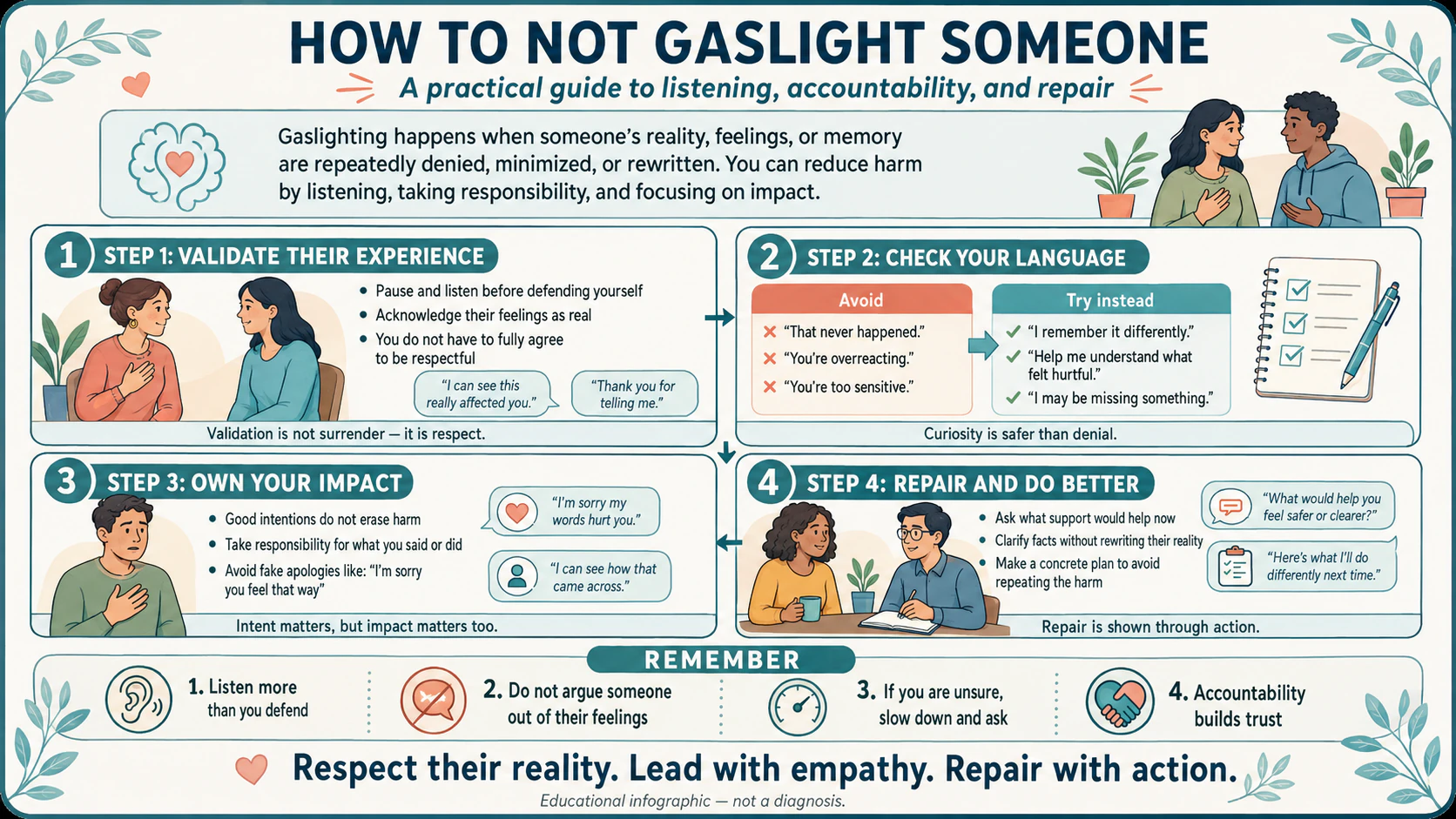
It is possible to invalidate someone without deliberately planning to manipulate them. Most of us have become defensive. Most of us have minimized another person’s feelings because accepting their pain would require us to confront something uncomfortable about ourselves. One harmful sentence does not automatically make someone a gaslighter. But refusing to examine the sentence, repeating it, and using it to establish yourself as the only reliable person in the relationship can become a dangerous pattern.
Pause before defending yourself
If someone tells you that your words or actions hurt them, listen for the experience underneath the accusation. You do not have to formulate your entire defence while they are still speaking.
Replace certainty with honesty
Instead of:
“That never happened.”
Try:
“I remember it differently, but my memory may be incomplete. Tell me what you remember.”
You are not required to confess to something you genuinely do not remember. You are being asked to leave room for the possibility that your memory is not the only memory.
Validate feelings without pretending to agree on everything
Validation is not surrender. You can say:
“I can see that this affected you deeply.”
“I believe that you are hurt.”
“Thank you for telling me.”
None of those statements requires you to abandon your perspective. They simply acknowledge that the other person has an inner life that does not require your permission to be real.
Stop using personality as an escape route
Avoid turning the conversation into a judgment about who the person is.
“You’re too sensitive.”
“You always overreact.”
“You’re impossible to talk to.”
“Are you crazy?”
These statements do not resolve the issue. They make the person’s character or mental state the problem so that your behaviour no longer has to be examined. Ask instead:
“What part of what I said felt dismissive?”
“What am I missing?”
“What would help you feel heard?”
Own your impact, not only your intention
“I didn’t mean to hurt you” may be useful context. It is not a complete apology. Good intentions do not erase harmful effects. If you step on someone’s foot accidentally, their foot still hurts. Try:
“I did not intend to dismiss you, but I can see that I did. I’m sorry.”
Avoid:
“I’m sorry you feel that way.”
The first takes responsibility. The second quietly returns the problem to the injured person.
Never weaponize someone’s diagnosis or emotions
Do not use autism, ADHD, anxiety, trauma, depression, memory problems, or emotional overwhelm as automatic proof that someone’s account is unreliable. A person can be anxious and correct. A person can be overwhelmed and correct. A person can struggle to communicate and still know that something harmed them. Address the issue. Do not put their entire mind on trial.
Repair through action
An apology matters. Changed behaviour matters more. Ask what would help. Clarify what you will do differently. Then do it. If the same harm continues while the apologies become increasingly polished, that is not repair. Repair has evidence.
If You Think You Are Being Gaslit
Pay attention to patterns rather than isolated phrases. If it is safe, keep dated notes, screenshots, or records of important conversations. Store them somewhere the other person cannot access. Documentation is not about winning an argument. It can help anchor you when your memory is repeatedly challenged. Talk to someone you trust. A friend, therapist, advocate, or support worker may help you identify patterns that are difficult to see from inside the relationship. Set boundaries where it is safe:
“I will not continue this conversation while my feelings are being mocked.”
“I know what I experienced.”
“We remember this differently. I will not debate whether I am mentally competent to discuss it.”
You are also allowed to disengage. You do not have to remain in an endless argument with someone committed to misunderstanding you. If confronting the person could put you in danger, prioritize safety rather than proving your point. Contact a local domestic-abuse organization or qualified professional for confidential safety planning.
Finding support: In Canada, the Government of Canada’s Get help now page lists provincial and territorial crisis lines, shelters, and other services. Call 911 if there is immediate danger in Canada. In the United States, the National Domestic Violence Hotline offers phone, text, and chat support. Elsewhere, use the emergency and domestic-abuse services for your location.
The Question I Keep Returning To
Maybe the most useful question is not:
“Did this person use one of the official gaslighting phrases?”
Maybe it is:
“What happens to my sense of self when I am around this person?”
Do I leave disagreements feeling heard, even when we do not agree? Can this person admit uncertainty? Can they apologize without making me responsible for the apology? Can I say no? Can I remember something differently without having my sanity questioned? Do our conversations move toward clarity and repair—or toward confusion and control? And I need to ask myself the same questions from the other direction. Do I listen before defending myself? Do I dismiss someone because their reaction makes me uncomfortable? Do I hide behind my intention instead of addressing my impact? When I cause harm, do I repair it? A healthy relationship does not require two people to share one mind.
It makes room for two memories, two emotional experiences, and two people making a sincere effort to find the truth between them. Gaslighting does not make that room. It slowly removes one person from it. I am writing this because I do not want to be removed from my own reality again. I am also writing it because I never want to erase someone else from theirs.
Sources and Further Reading
- What is gaslighting? — The National Domestic Violence Hotline
- “This Was Just How This Friendship Worked”: Experiences of Interpersonal Victimization Among Autistic Adults — Autism in Adulthood
- The Extent and Nature of Autistic People’s Violence Experiences During Adulthood: A Cross-sectional Study of Victimisation — Journal of Autism and Developmental Disorders
- Get help now — Women and Gender Equality Canada