He Said He Would Sell Us: Like We Were Debts, Not Daughters
A personal reflection on threats of abandonment, parentification, misogyny, and learning that daughters are children—not debts, servants, or obstacles.
Content note: emotional abuse, threats of abandonment, parentification, and misogyny.
My father used to threaten to sell us.
It was not something he said every day. But it was not something he said only once, either. That distinction matters. It happened enough times that the possibility had somewhere to live inside my childhood.
I do not know whether he ever seriously intended to do it. I do not think that question matters as much as adults may want it to. A child does not hear a threat like that and carefully evaluate its legal or practical likelihood. A child hears: My place here is not secure. My father can give me away. My body and my future are his to bargain with.
That is a terrifying thing to put inside a little girl’s head.
He also liked to remind us that other daughters would give their lives for their fathers, while we were ungrateful. Apparently, being his daughters was not enough. We had to prove our devotion through service, sacrifice, obedience, and praise—and even then, the standard could move.
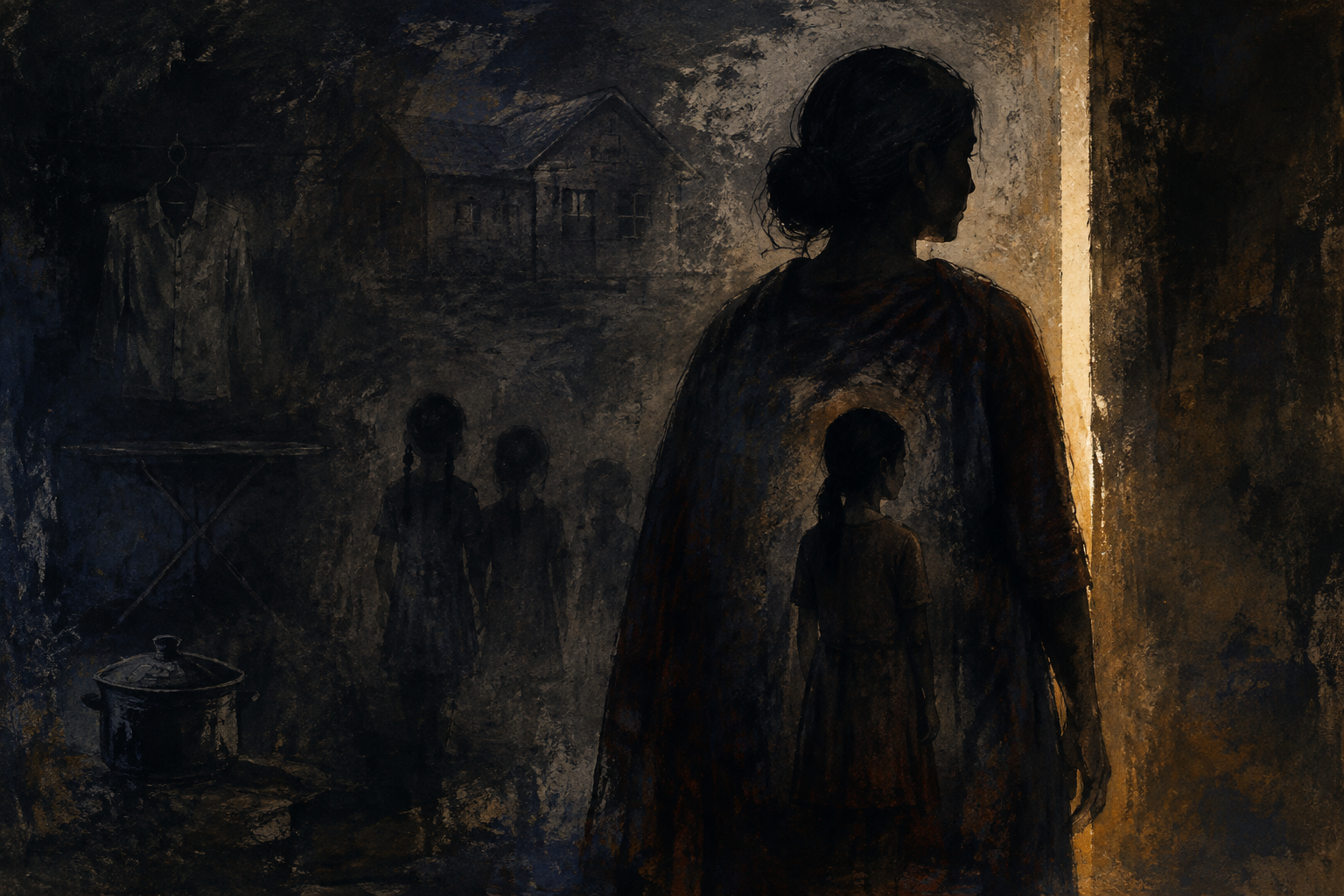
We cooked. We cleaned. We ironed his shirts and pants. The earliest I remember doing these things regularly, I was seven or eight years old. Nobody properly taught us how. We were simply expected to know. Then, when something was not cleaned well enough or a shirt was not ironed properly, he taunted us for failing him.
Ironing a shirt was not just a chore. It became an examination in devotion.
Children helping around the house is not automatically harmful. Learning to prepare food, fold clothes, or clean up after yourself can be a healthy part of childhood when the work is age-appropriate, taught patiently, shared fairly, and not connected to a child’s right to receive love or safety. What we experienced was different. We were expected to take responsibility for an adult man’s comfort before we were old enough to understand why his comfort had become our job.
Research describes parentification as a reversal or distortion of family roles in which a child takes on developmentally inappropriate responsibilities for a parent or family. It can be practical—such as excessive cooking, cleaning, or household management—or emotional, when a child is expected to protect a parent’s feelings, maintain family harmony, provide companionship, or support the parent’s self-esteem. The difference between learning responsibility and being parentified is not simply whether a child performs chores. It is the child’s age, the weight and frequency of the responsibility, the pressure attached to it, and what happens when the child cannot carry it. (Systematic review in the International Journal of Environmental Research and Public Health)
We were not only expected to cook, clean, and iron. We were also supposed to talk to him, listen to him, and praise him properly. We had to help maintain not only his home but also his idea of himself. A seven-year-old can help around the house. A seven-year-old should not be made responsible for an adult man’s clothes, comfort, ego, and sense of greatness.
Whenever he spoke to us at length, the conversation often became a list of our mother’s failures. We heard how imperfect she was and how glaring her flaws were. We were placed in the position of listening to one parent tear apart the other, as though we were his confidantes, judges, or witnesses for the prosecution rather than their children. Meanwhile, we were made to feel like thorns in his eyes and weights tied to his legs—the reasons he had not achieved whatever greatness he imagined should have been his.
That is an extraordinary burden to place on children. We had not created his circumstances. We had not made his decisions. We had not prevented him from pursuing his ambitions. We were children he had brought into the world, yet he spoke as if our existence were something we had done to him.
One memory, in particular, contains this entire family system in miniature.
I had been told since childhood that my father was an art major. At some point, while studying Jean Rhys’s Wide Sargasso Sea, I approached him for help. I was trying to understand a tormented woman. I wanted to examine what had happened to her and why she had gradually lost her mental stability.
In Wide Sargasso Sea, Rhys reimagines the life of the woman whom Jane Eyre reduces to “the madwoman in the attic.” She gives Antoinette Cosway a childhood, a history, and a voice. Antoinette’s deterioration cannot honestly be reduced to one neat cause. It is tied to colonial displacement, racial alienation, family trauma, patriarchal control, an increasingly destructive marriage, the loss of autonomy and identity, and eventually isolation and confinement. The novel is widely studied as a postcolonial and feminist rewriting of Jane Eyre—one that allows a previously silenced woman to tell part of her own story. (University of Cádiz research repository)
I brought my father a complicated question about the psychological unravelling of a woman whose identity and freedom were being stripped away.
He read what I had written and calmly told me that she felt guilty because she had failed to be satisfactory to her husband. Then he walked away. I was disgusted. I am still disgusted.
The question I brought him was literary. His answer was domestic doctrine.
A woman’s suffering, in his explanation, was not evidence that something terrible had been done to her. It was the consequence of her failure to satisfy a man. Her pain became guilt. Her destruction became inadequacy. The husband remained the standard against which her entire mind and life had to be measured.
I cannot know exactly what my father told himself when he gave me that answer. I cannot prove whether he deliberately twisted the novel, misunderstood it, or simply interpreted it through the only worldview he was willing to consider. I do know what his answer revealed to me: when presented with a tormented woman, his first instinct was to ask how she had failed her husband.
It was also the rule governing our home.
Our mother’s flaws were always available for discussion. His disappointments were blamed on his daughters. A woman’s value was measured through her usefulness to a man, and her suffering could be interpreted as evidence that she had not served him well enough.
We were expected to anticipate his needs without being taught. If we failed, we were ungrateful. If we did the work, it was merely what daughters were supposed to do. If his life was not what he wanted, our existence could be offered as an explanation.
And hanging above all of it was the threat that he could sell us.
The World Health Organization includes threats, intimidation, ridicule, rejection, denigration, and other hostile treatment within psychological or emotional violence against children. These are not harmless words simply because they leave no visible bruise. They can damage a child’s sense of safety, identity, and worth. (World Health Organization: Violence against children)
When a parent repeatedly connects a child’s safety to obedience and usefulness, the child can begin to understand love as a transaction. You earn your place by working. You earn protection by being pleasing. You prevent abandonment by staying useful. Rest feels selfish. Mistakes feel dangerous. Receiving anything can feel like taking on a debt you will eventually have to repay.
That is not gratitude. It is fear wearing the clothes of gratitude.
Naming what happened does not require me to diagnose my father. I do not need to decide what disorder he did or did not have, and I do not need to prove what existed inside his mind. I only need to describe what he repeatedly said, what he required of us, and what those demands did to the children living under them.
Nor do I need to pretend that every household chore was abuse. That would flatten the truth. The problem was not that I ever held an iron or helped prepare food. The problem was that adult responsibility was imposed without teaching, kindness, choice, or room for failure. The problem was that service became proof of love. The problem was that our father’s emotional and practical care was treated as his young daughters’ obligation.
We were daughters, not unpaid wives-in-training. We were children, not obstacles standing between a man and greatness.
I should not have been expected to know instinctively how to iron an adult man’s clothes at seven or eight. I should have been taught patiently if I was going to help. I should not have been responsible for praising a grown man enough to keep his ego intact. I should not have had to listen while he dismantled my mother’s character. I should never have been told that other daughters would die for their fathers, as though a child’s willingness to disappear were the highest proof of love. And I certainly should not have been made to wonder whether my father could sell me if I disappointed him.
For years, he presented us as the burdens in his story. But children are not responsible for rescuing a parent from the life that parent built. Daughters do not owe their fathers domestic service, constant admiration, emotional caretaking, or death as proof of devotion.
I was not ungrateful. I was a child. My sisters were children.
We were not thorns. We were not weights. We were not debts that had to justify their cost. We were little girls who deserved to be protected, taught, listened to, and loved without having to earn our place in the family.
When I remember Wide Sargasso Sea now, I still remember the disgust I felt when my father reduced a tormented woman’s destruction to her inability to satisfy her husband. But I can finally name why that answer affected me so deeply. He was not merely interpreting a character.
He was repeating the story he had already written for every woman in our home.
I simply refuse to live inside that story anymore.