Kids’ Birthday Parties, Modern Parenting, and My Tiny RSVP Panic Spiral
A child’s birthday party, a mother’s RSVP spiral, and the line between creating opportunities with love and trying to panic-proof an entire childhood.
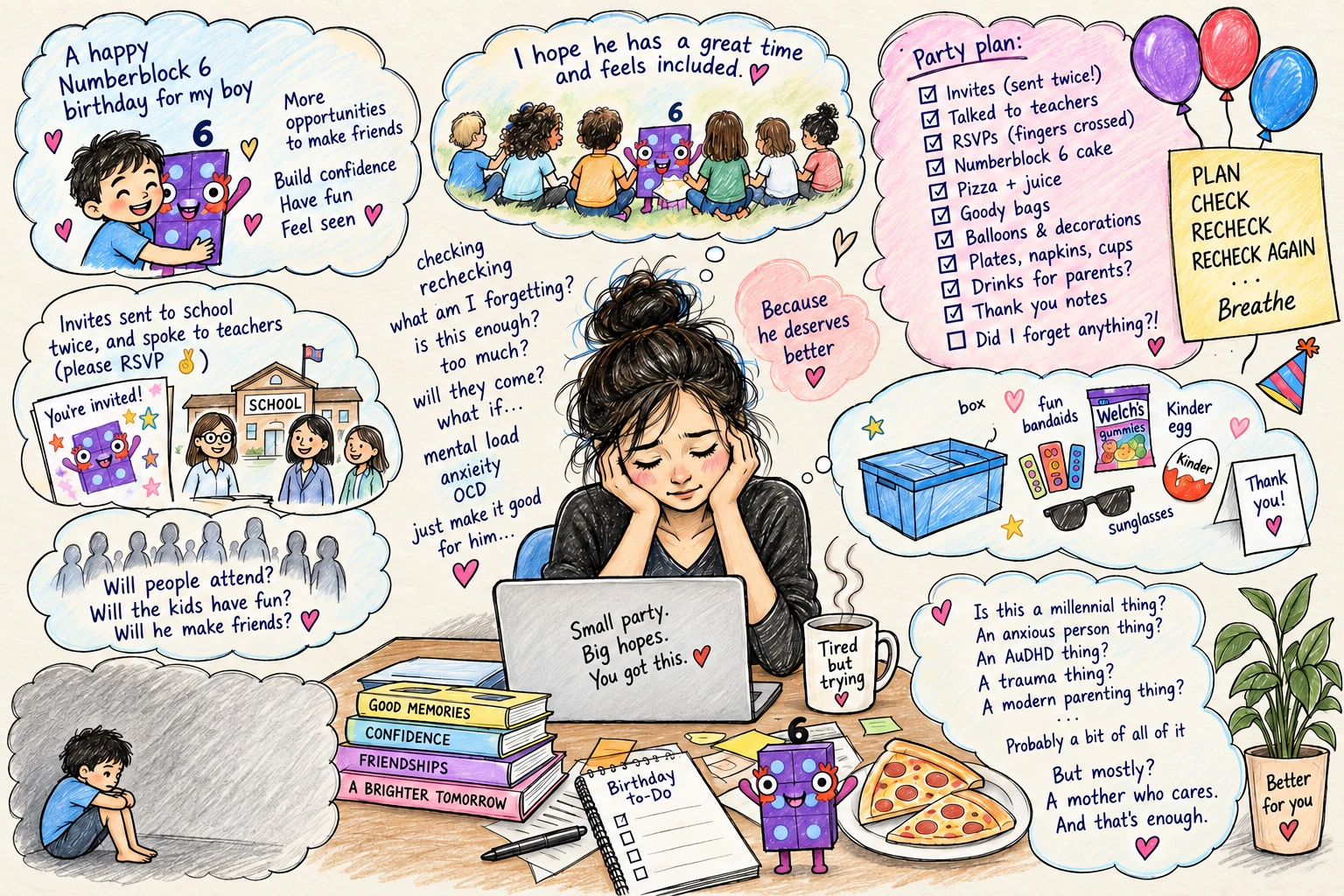
There is a very specific kind of anxiety that comes with planning a child’s birthday party now.
It starts with something innocent: a theme, a guest list, a cake. Maybe pizza, juice, balloons, drinks for the parents, goody bags, not goody bags.
Maybe I am losing my mind over a six-year-old’s birthday party, which, to be fair, I slightly am.
I have planned themed invites. I sent the invites to his school twice. I spoke to his teachers so they could help make sure the invitations actually reached parents and hopefully got RSVPs. I ordered a themed cake. I planned pizza and juice. I am working on goody bags that will be useful and not be immediately discarded.
Basically, I am one step away from standing at the school gate with a clipboard like, “Hello, have you considered attending my child’s social development opportunity disguised as a birthday party?”
And the thing is, I know how this sounds.
It sounds like I am trying to make my child popular. And maybe there is a little truth there, but not in the shallow movie-villain-mom way. I do not want fake friends for him. I do not want popularity as a personality replacement. I do not want him to become the CEO of kindergarten.
But my son is on the spectrum, and initiating play does not always come easily to him. Friendships do not always happen through magic. Some children can walk into a playground, say “wanna play?” and boom, full social merger. My child sometimes needs more structure, more chances, more bridges built toward him.
That part is not just my anxiety talking. Autism can involve differences in social communication and interaction, including the skills used to start, build, and maintain friendships. Some children on the spectrum may need more support, practice, and real-life opportunities to build those relationships. The National Autistic Society’s guidance for parents and carers includes structured, tangible practice and support from schools among its suggestions.
So yes, I am trying. Not because I think a goody bag will manufacture love. Not because I think Kinder eggs are a friendship intervention—though honestly, Kinder eggs have done more diplomacy than some governments.
I am trying because I want to create openings. I want him to have a good day. I want other kids to see him in a happy, fun, familiar setting. I want him to have memories where he was not hovering at the edge of the room, waiting for someone else to notice him.
And maybe that part hits harder because I remember what it felt like to be a child who was not centred.
I did not grow up with birthday parties where we, the children, were the sun and everyone orbited around us. We were not the heart of the house. We were footnotes. Barely present. There because we had nowhere else to be. Discarded and tolerated. We slept on the floor, or wherever. Ate or did not eat. Nobody fussed over whether we felt special. The maid servant was at least asked if she had eaten.
So when I am planning my son’s party and rechecking the list for the thirty-seventh time, it is not only about balloons. It is not only about cake. It is not only about whether I bought enough juice boxes.
It is also this weird ache of wanting my child to never wonder whether he mattered.
And this is where I start asking myself: is this a millennial thing? An anxious person thing? An AuDHD thing? A mother thing? A trauma thing? A “modern parenting” thing?
Probably yes. Probably all of it.
Trying to Raise Them Differently
Modern parenting does seem to come with a heavier mental load. Pew Research Center found that mothers are more likely than fathers to say parenting is stressful and tiring, to feel judged by others, and to manage children’s schedules and activities. Its survey also found that mothers are more likely than fathers to say they are trying to raise their children differently from how they were raised.
That sentence landed in my ribs a little: trying to raise them differently.
Because that is exactly what it feels like sometimes. Not just parenting. Counter-parenting. Repair-parenting. Parenting while looking at your own childhood and saying, “Nope. Not this. This one stops here.”
There is also a name for the style of parenting many of us have been pulled into: intensive parenting or intensive mothering. It is the idea that good parenting means constant investment, planning, emotional availability, development support, enrichment, safety, stimulation, memory-making, and also somehow remembering which child likes Paw Patrol and which one is gluten-free. A Penn Today explanation of intensive mothering describes this modern style as heavily child-focused and demanding of mothers’ time, attention, and planning.
And the hard part is, some of it comes from love. Some of it is beautiful.
I do want to be thoughtful. I do want to know my child. I do want to make him feel celebrated. I do want to help him connect with other children. I do want to be the kind of parent who notices.
But intensive parenting can also become a pressure cooker. Research available through PubMed Central links intensive parenting beliefs with maternal stress, exhaustion, anxiety, guilt, and self-blame when mothers feel they are failing the impossible “ideal mother” standard.
Am I Loving My Child, or Trying to Panic-Proof His Whole Life?
So maybe the question is not: Am I a good parent or a bad parent?
Maybe the better question is: am I loving my child, or am I trying to panic-proof his whole life? Because those are not the same thing.
Planning a thoughtful party? Good. Making sure the invitation reaches families? Reasonable. Choosing goody bag items that are fun and useful? Cute. Checking the list once or twice? Normal.
But checking and rechecking until my brain becomes a browser with 47 tabs open and one of them is playing birthday music but I cannot find which one? That is probably my anxiety, and I need to be honest about that too.
The mental load of parenting is not just doing the task. It is remembering, anticipating, planning, checking, tracking, worrying, and holding the emotional outcome of the whole event in your head. A systematic review of mental labour describes this kind of invisible family work as involving planning, monitoring, anticipating needs, remembering, managing, and self-regulation—and found that women often carry more of this load.
That is exactly what birthday party planning can become.
Not “buy balloons.”
More like:
Buy balloons.
But not too many.
But enough.
Will balloons scare anyone?
Do we need extra plates?
What if parents stay?
What if parents leave?
Should I have coffee?
Will the cake arrive on time?
Will my son be overwhelmed?
No wonder my brain is tired. It is running a full event management office with one unpaid employee and too many tabs.
So what helps? For me, I think it is separating love from panic.
The loving part says:
“I want my child to feel celebrated.”
The panic part says:
“If anything goes wrong, I have failed as a mother.”
The loving part says:
“I want to give him chances to connect.”
The panic part says:
“If enough kids don’t come, this means something terrible about his future.”
So maybe the goal is not to stop caring. I do not want to become careless. I know what careless felt like as a child, and I am not interested in passing that down like family silverware nobody asked for.
The goal is to care without making every detail a referendum on my worth as a parent.
The Party Is Not an Exam
My son does not need a perfect party. He needs to feel wanted, feel seen.
And he needs a mother who is present enough to enjoy the party too, not just a sweaty logistics goblin hiding behind the pizza boxes checking whether the thank-you notes are emotionally optimized.
So yes, I will probably still check the list again: cake, pizza, juice, goody bags, balloons, plates, parent drinks, thank-you notes, child’s joy, and mother’s nervous system, if we can fit it in the budget.
But I am trying to remember this: the party is not an exam. The RSVP count is not a prophecy. The goody bag is not a moral document.
And giving my child opportunities does not mean I have to engineer his entire childhood like a military operation with gummies.
It means I am trying. Not good parent. Not bad parent. Not millennial anxious disaster mother.
Just a mother who remembers what it felt like to be uncared for, and is trying very, very hard to make sure her child never has to translate love from absence.