Safe Food
Why my son’s grilled cheese needs that brown bread, why repetition is not entitlement, and why expanding a restricted diet should not mean taking away what already works.
A note before we begin: This is our family’s experience and general information, not medical or dietary advice. A highly restricted diet deserves individual guidance from a doctor and registered dietitian.
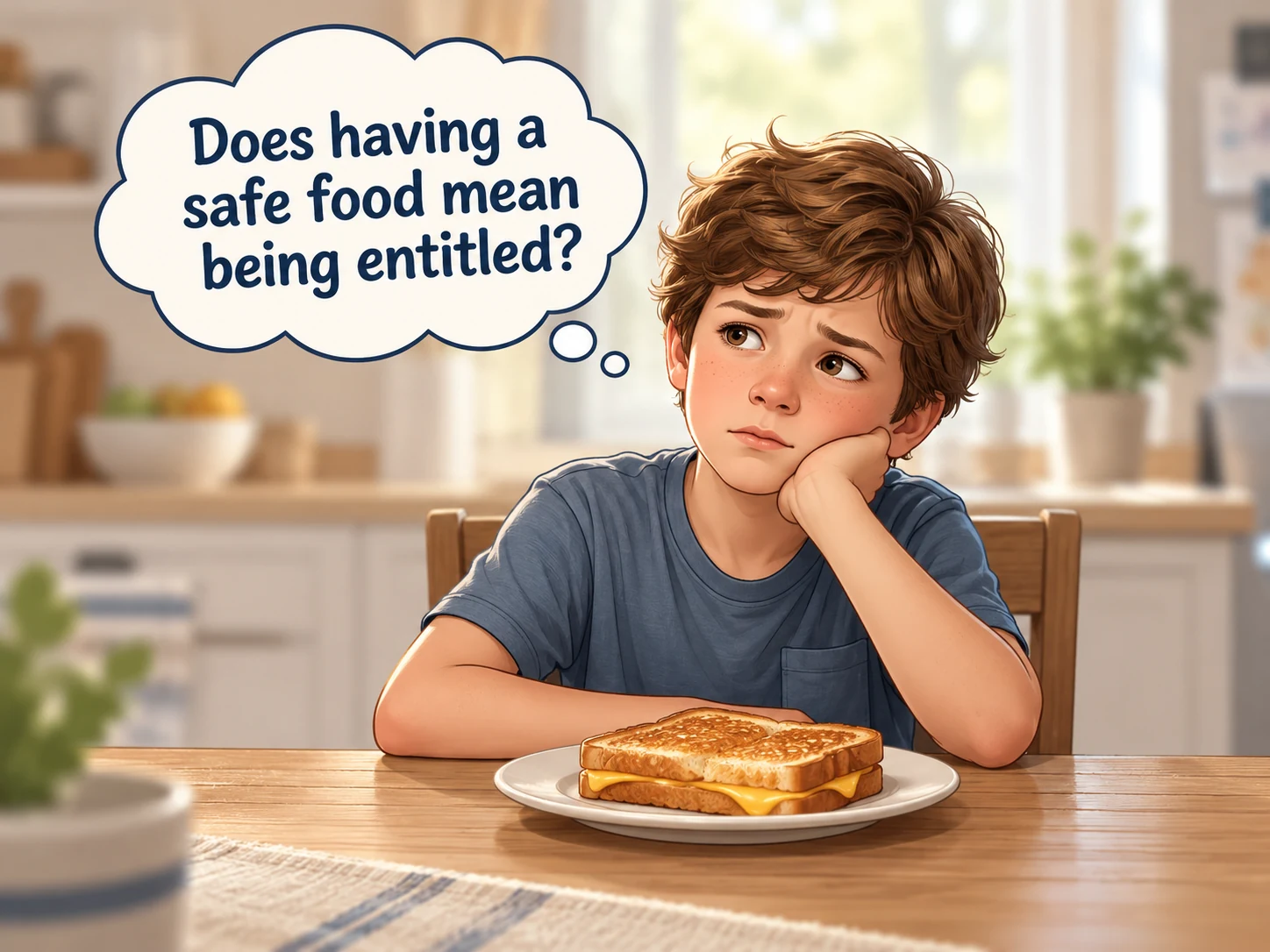
My son eats grilled cheese. Sounds straightforward until I explain that it has to be made a very specific way, with a very specific brown bread. Butter chicken? Yes, he eats that too. But again, there is a formula. We are not casually improvising dinner here.
The rest of the list includes naan, butter, certain chips—IKEA, Lay’s, Doritos, Cheetos—Bear Paws, Fruit Roll-Ups and some jelly. Multivitamin pills are also part of the picture. This is not a menu I put together because I thought, you know what would be fun? Extremely limited options. These are the foods I can actually get him to eat.
And then there is school. His school is nut-free, which reduces my choices even further. Feeding him is already a matter of working within a small selection. Packing something he can eat at school makes that selection smaller again.
This is what I mean when I talk about safe foods.
It Is Not Always “I Really Like This Food”
In this context, a safe food is something a person finds reliably manageable to eat. Familiar taste, texture, smell or preparation can make it feel predictable rather than overwhelming. Johns Hopkins All Children’s describes this preference for consistency in autistic children: the familiarity of a food can matter as much as the food itself. Johns Hopkins Medicine
You may also hear people call repetitive eating food hyperfixation. An Inflow article describes becoming intensely focused on a particular food, wanting it repeatedly and sometimes eventually losing interest in it. That can overlap with relying on safe foods, but I would not use the terms as though they mean exactly the same thing. Inflow
“I want this all the time” is not necessarily the same as “this is one of the few things I can manage eating.” Research often uses the term food selectivity for a restricted range of accepted foods and food refusal. A person does not have to be enthusiastically obsessed with a sandwich for that sandwich to be one of their reliable options. Journal of Pediatrics study via PubMed Central
That distinction matters to me. It changes the question from “Why won’t you just eat something else?” to “What makes this one possible?”
Same Ingredients Does Not Mean the Same Experience
Eating involves much more than deciding whether something tastes nice. For some autistic people, texture, temperature, smell, appearance and presentation can affect whether a food is tolerable. Some prefer mild flavours; others enjoy strong ones. There is no single autistic menu that everyone follows. National Autistic Society
And this is not just parents imagining things. A study comparing 53 autistic children with 58 non-autistic children found more atypical sensory processing in the autistic group. Among the autistic children, greater oral sensory sensitivity was associated with refusing more foods and eating fewer vegetables. That does not explain every child, but it supports taking sensory differences seriously. Sensory Sensitivity and Food Selectivity study
Predictability also helps explain why some packaged foods become reliable favourites. A familiar product is generally more consistent than fresh produce, where one piece can be firm and sweet and the next soft or sour. That variation may seem insignificant to someone else, but it can matter to a sensory-sensitive eater. Johns Hopkins Medicine
So when I say specific brown bread, that is not an unnecessary detail. It is part of the description of the food he accepts. Likewise, “he eats butter chicken” does not mean every restaurant’s butter chicken or every slightly modified version of mine has automatically made the list.
I cannot tell you exactly which detail matters most to him every time. But I can tell you that “basically the same thing” is not a particularly useful cooking instruction in our house.
Then Try Packing a School Lunch
The nut-free rule adds another restriction to an already restricted menu. I am not arguing against the rule. I am explaining why something that might be a straightforward substitution for another family is not necessarily straightforward for us.
The foods my son accepts and the foods I can send to school are not automatically the same list. Suggesting a replacement is easy. Getting that replacement onto his accepted-food list is the difficult part.
That is the bit I want people to understand when they see a repetitive lunch. The repetition does not tell you how little thought went into it. Sometimes it tells you how carefully the parent has worked out what the child will actually eat.
Understanding His Needs Does Not Mean Ignoring Nutrition
When I say we are basically getting by on a handful of foods and multivitamins, I am describing our struggle—not recommending a meal plan.
Multivitamins can help fill some vitamin and mineral gaps, but they do not turn a restricted diet into a complete one. They cannot replace the full nutritional contribution of food, including fibre and other components that supplements may not provide. NIH Office of Dietary Supplements
A very limited diet deserves an individual review with a doctor and a registered dietitian, ideally someone familiar with autistic eating differences. Importantly, normal growth does not rule out nutrient deficiencies. The Royal Children’s Hospital specifically highlights this in its guidance on highly restricted diets. That is a reason to get useful support, not a reason to blame parents or panic over every meal. Royal Children’s Hospital
There is also avoidant/restrictive food intake disorder, or ARFID. This is more than having favourite foods: restriction leads to significant nutritional, growth or everyday-functioning difficulties. It can involve sensory sensitivity, fear of choking or vomiting, or little interest in eating, rather than concerns about body shape or weight. Not every autistic selective eater has ARFID, and I am not diagnosing my son from his menu. But it is worth knowing that serious eating difficulties deserve assessment, not dismissal. UCSF Eating Disorders Program
Help Should Not Mean Taking Away What Works
I do not want “respect his safe foods” to become “never help him explore anything else.” But I also do not want exploration to mean making every meal a test he can fail.
Kent Community Health’s guidance advises against withholding accepted foods to make a child hungry enough to eat something else. It also warns against secretly mixing new ingredients into safe foods: the child may notice the change and stop trusting that food altogether. Pressure and threats can increase anxiety around eating. Kent Community Health NHS Foundation Trust
That makes sense to me. When the list is already short, losing something from it is not a small inconvenience.
Gentle exploration can start with looking at, touching or smelling something unfamiliar, without requiring a bite. Changes can be introduced gradually while keeping familiar food available. And discomfort needs attention too: constipation, reflux, dental pain or swallowing difficulties should not simply be written off as “the autism.” National Autistic Society
I want more options for my son. Of course I do. I would love for feeding him to involve less precision and a slightly larger menu. But I also want him to feel understood while we work towards that.
Right now, the naan, the particular snacks, the butter chicken made to its very specific formula and the grilled cheese with that particular brown bread are what we have to work with. They are not the whole answer to nutrition, but they are an important starting point.
I am not trying to win an argument with his plate. I am trying to feed my child, understand what makes eating difficult, and help him have more choices without taking away the few that already work.
And yes, the bread still needs to be that bread.