Visual noise · cognitive load · choosing the format that works
When My Eyes Are Too Loud
Comic Strips, Blurry Vision, and Cognitive Overload
- Published
- Last reviewed
The day before yesterday, we randomly went to Coles, which in my head is also Chapters/Indigo because I do not fully understand Canadian bookstore genealogy. It is just all one big book-family to me.
Anyway, I was surprised to see that our local store had a much bigger collection of graphic novels and manga than I expected. I had seen big manga sections at Imaginaire in Rideau Mall, Ottawa, but I did not expect this much variety locally.
They had The Apothecary Diaries, which I am currently reading. Not only the manga, but also the light novel. My husband saw the graphic novels and immediately said, “Let’s get them,” like a supportive husband in a bookstore should.
Very sweet.
Very dangerous.
Because unbeknownst to him, I cannot read graphic novels.
And I do not mean I dislike them in a casual “not my thing” way. I mean my brain looks at a comic page and says, sorry, what language is this?
This has always been a thing for me. I do not know whether it is a neurodivergent thing, a visual-processing thing, an attention thing, or just a very specific “me and my brain doing nonsense again” thing. But it is real.
Comics and manga are visually distracting for me. Between the characters, backgrounds, speech bubbles, action lines, sound effects, panel order, and all the artwork hullabaloo, I lose the meaning of the words. I spend so much effort locating the next piece of text that by the time I find it, I have lost what I just read. Then I have to go back, then forward, then guess which bubble belongs to whom, and soon my brain is tired, my comprehension is gone, and a headache is forming like it has been personally invited.
Light novels, on the other hand, are fine. Beautiful, even. Just words. One line after another. My eyes know where to go. My brain can stay with the story.
The same story in animation is also fine because the sequence is handled for me. The show moves forward. I do not have to decode the page structure like I am solving a visual escape room.
This is not me saying I hate artwork. I love illustrated books. I love art. I love animation. I can enjoy beautiful visuals. But illustrated books usually keep the text and image in a relationship my brain understands: here is the sentence, here is the picture, thank you very much, everyone stay in your lane.
Comic-style pages feel different. Multiple images per page, dialogue floating around, no single obvious reading path, monochrome panels, visual density — suddenly reading becomes labour.
And this has been consistent across everything I have tried. Tintin. Calvin and Hobbes. Peanuts. Marvel. DC. X-Men. Superman. Spider-Man. Even manga like Mushoku Tensei. I always prefer the animated version or the light novel.
It is not even about taste. It is about whether I can actually understand the content without my brain overheating.
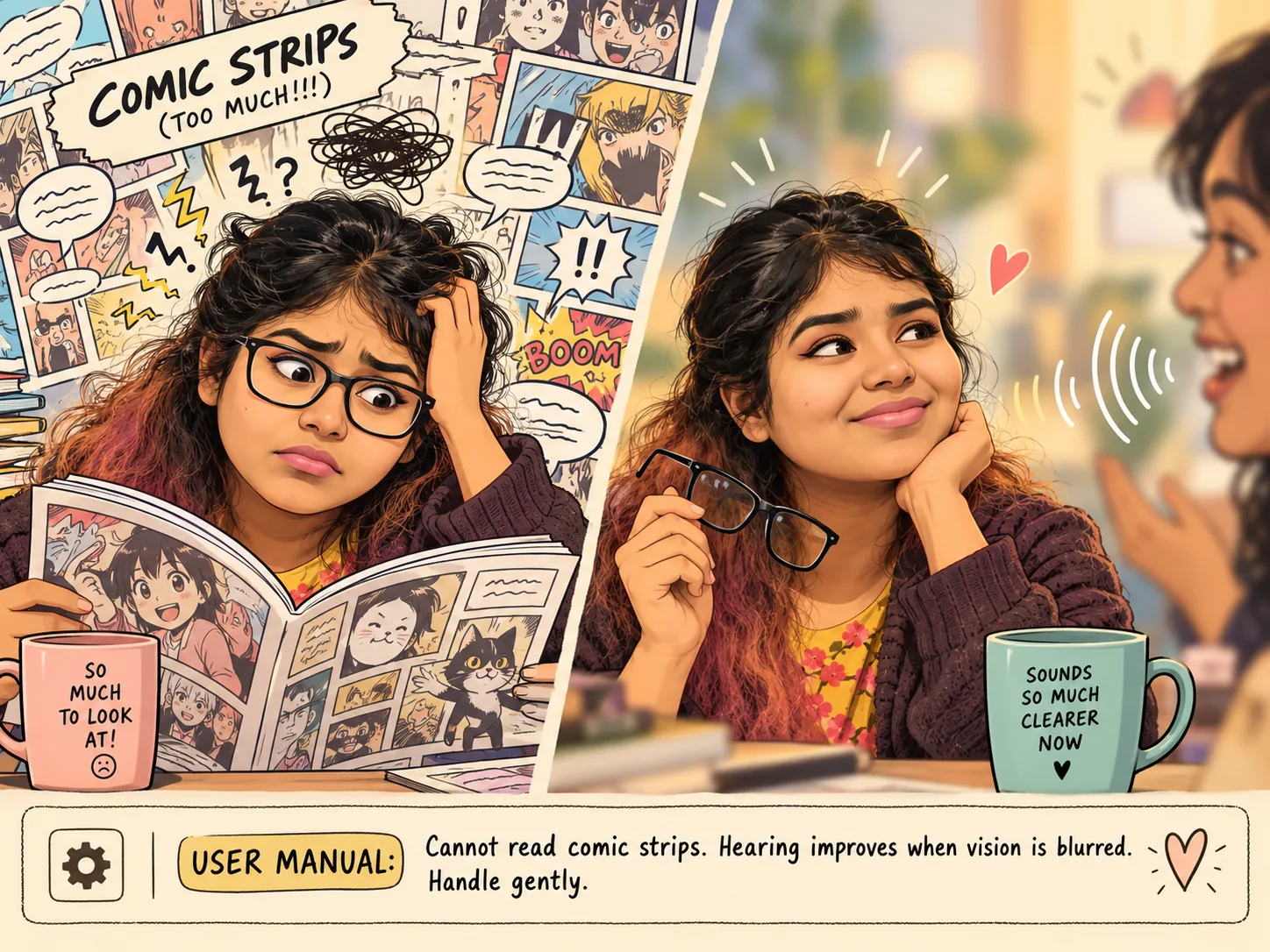
It feels like one of those weird facts about me, like how I feel I can hear better when I take my glasses off. Just a small line in the user manual:
Cannot read comic strips. Hearing improves when vision is blurred. Handle gently.
So I wanted to know: is this completely absurd, or is this a known thing?
Turns out, it is not absurd.
Comics are not just books with pictures
Comics require a different kind of reading. A plain-text novel is mostly linear: line to line, paragraph to paragraph, page to page. A comic or manga asks the brain to decode words, images, spatial layout, sequence, speaker attribution, emotion, action, and often sound effects at the same time.
Researchers who study comics describe visual narratives as having structure — almost like a grammar — where panels have roles in the larger sequence, not just meanings on their own. Cognitive scientist Neil Cohn’s work on visual narrative grammar and comic-page layout argues that understanding sequential images involves narrative structure, page layout, and attentional framing working together.
That made me feel very seen, because yes. That is exactly the problem. My brain is not simply reading words with helpful pictures beside them. It is being asked to read a whole visual grammar.
And apparently, I am not fluent.
There is also research suggesting that experience matters. In an electrophysiology study of visual narrative processing, people who had frequently read manga while growing up processed a manga-common narrative pattern differently from less frequent manga readers. The infrequent readers showed a larger brain response associated with devoting more resources to mental updating.
That is exactly what it feels like. I am not relaxed-reading. I am constantly updating.
Who is speaking? Which panel came first? Is this sound effect part of the action? Did I accidentally skip a bubble? Why is there a tiny text box in the corner? Where did that character come from? Why am I on page three and already tired?
When the page becomes admin work
This is where cognitive load gives me a useful way to think about the problem. Cognitive load is the mental effort required to process information, and working memory can only hold and manipulate so much at once.
Classic split-attention research by Paul Chandler and John Sweller found that learning can become harder when people must keep switching between separated but mutually dependent sources of information — such as text and diagrams — and mentally integrate them.
That study was about instructional materials, not manga. It does not prove that comic pages are badly designed or that every person who finds them tiring is experiencing the same cognitive process. But the framework makes sense of my experience: sometimes pictures help, and sometimes the format asks me to do so much locating, switching, sequencing, and integrating that the story stops feeling like a story and starts feeling like admin work.
And listen. I already have enough admin work.
It also explains why illustrated books are fine for me. The illustration supports the story, but it does not usually demand that I decode sequence, dialogue order, and spatial relationships all at once. A light novel gives me the whole story in a clean line. Animation gives me the sequence, movement, sound, and timing without making me assemble the page myself.
Comics and manga ask me to do more of the assembly work manually, and my brain apparently did not sign that contract.
Is this a neurodivergent thing?
Maybe. Maybe partly.
But I want to be careful here, because I do not want to slap an autism/ADHD sticker on every single brain quirk and call it science. There is no neat evidence saying, “Autistic people cannot read comics” or “ADHD people get headaches from manga.” Many autistic and ADHD people love comics, manga, graphic novels, visual storytelling, and complex art. Some probably find comics easier than prose.
Brains are not IKEA furniture; one label does not tell you how the whole thing is assembled.
What we can say is that sensory-processing differences are very real in autism. The National Autistic Society’s guide to sensory processing explains that autistic people can be much more or less sensitive to sensory input, that the pattern can vary by person and situation, and that visually crowded or cluttered environments can be overwhelming for some people.
Research also suggests that audiovisual multisensory integration — the brain’s use of auditory and visual information together — can differ in autism on average. A systematic review and meta-analysis found an average group difference, but also substantial variation across studies and effects that differed with factors such as age and the type of stimulus.
So for me, it is plausible that visual density, layout uncertainty, attention, and sensory processing all add up to overload. But I would not call it a rule for neurodivergent people. I would call it a pattern in me that happens to make sense through the lenses of sensory processing, attention, and cognitive load.
The glasses thing fits somewhere nearby too, but again, carefully.
I am not saying my glasses objectively turn my ears down like a volume knob. That would be very dramatic, even for me. But I do feel like I hear better when I take my glasses off. My guess is that sharp visual input takes up more of my attention, and when the world becomes visually softer, my brain has less detail to process and can attend to sound more easily.
The broader science supports the general idea that hearing and seeing are not completely separate departments. The original McGurk and MacDonald experiment showed that mismatched lip movements can change what people report hearing. Separate experimental work on speech in noise has found that adults can use visual speech cues to improve detection and discrimination of spoken sounds.
That does not prove my glasses theory.
But it does prove the general point: the senses talk to each other. Sometimes they cooperate. Sometimes they interfere. Sometimes they form a committee and ruin my ability to enjoy Spider-Man in comic form.
Choose the format that lets the story reach you
So do I need a cure?
Honestly, no.
This is not a tragedy. It is not a moral failing. It is not an emergency. I do not need to become a graphic-novel person to be a complete human being. I can read the light novel. I can watch the anime. I can enjoy the artwork separately. I can admire manga as a medium while also admitting that my brain treats the page like an overdecorated wedding invitation with too many fonts.
If I really wanted to train myself, maybe I could try reading comics slowly, using a digital panel-by-panel mode, enlarging pages, reading colour versions instead of dense black-and-white ones, or starting with simpler layouts. Familiarity may help, because visual-narrative fluency appears to matter.
But do I need to force it?
Not really.
Sometimes the answer is not “fix the brain.”
Sometimes the answer is “choose the format that lets the story reach me.”
And that is what light novels do. They give me the same story without making me fight the page. Animation gives me the visual world without making me decode the panel grammar. Illustrated books give me art without turning reading into a Where’s Waldo of dialogue bubbles.
So this is now officially one of my fun facts.
I can hear better when I take my glasses off.
I cannot read comic strips.
Thank you for reading, acknowledging, and understanding my plight.