Name it clearly · notice the pattern
Autism Spectrum
An introduction to autism’s varied profiles, everyday experiences, screening tools and the stories that helped me recognize my own.
- Published
- Last reviewed
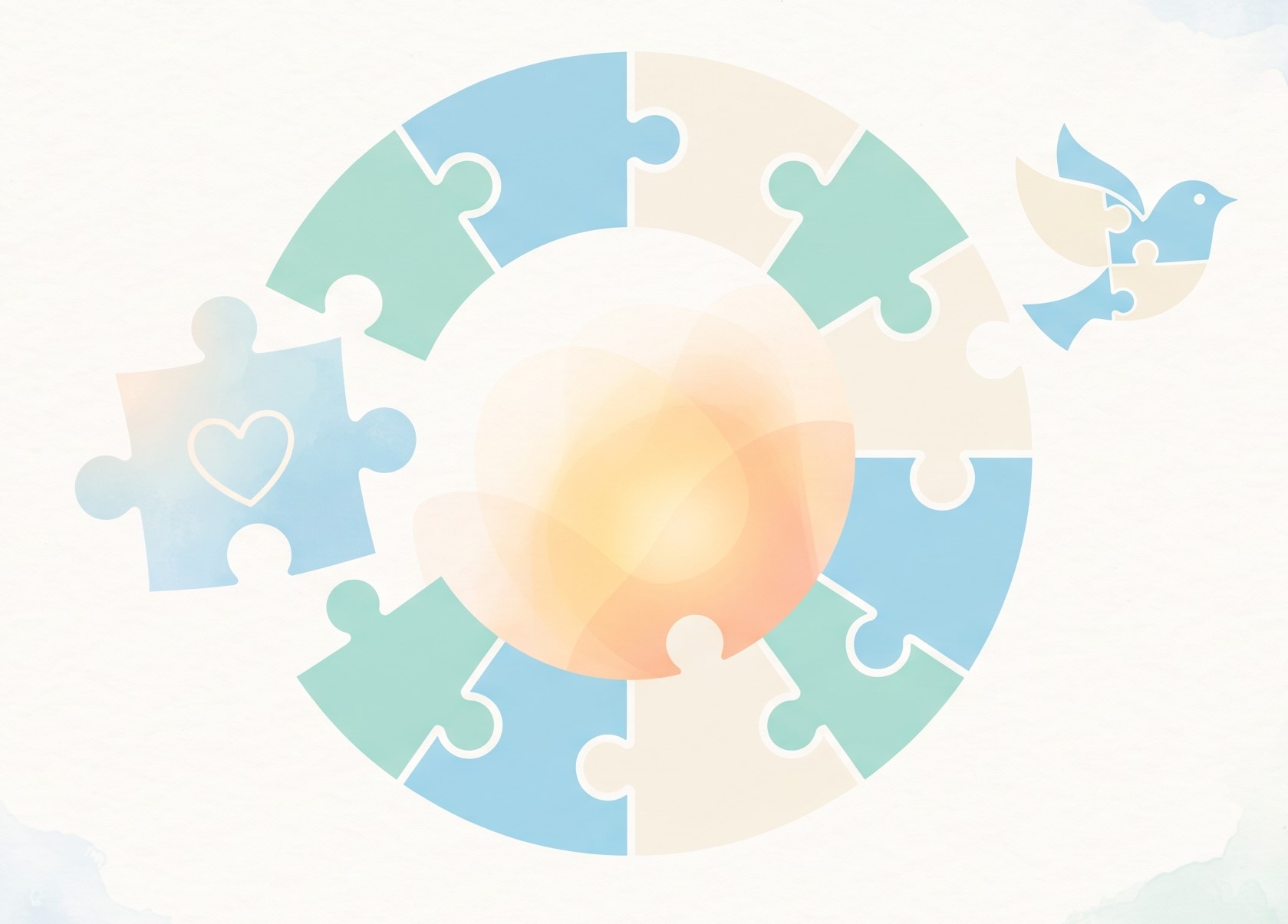
From old boxes to a soundboard
For a long time, autism was described through separate diagnostic labels. Older manuals included categories such as autistic disorder, Asperger’s disorder and pervasive developmental disorder not otherwise specified. The DSM-5 brought several of those diagnoses together under autism spectrum disorder. That history can make it sound as if autism is a straight line from “a little autistic” to “very autistic.” It is not that simple. The American Psychiatric Association’s overview explains the change in diagnostic language.
I find it more helpful to picture a mixing board or a colour wheel. One person might have sound sensitivity turned way up, need lots of time to recover after socializing, and have no particular difficulty with coordination. Another person may have a different combination. These are metaphors for varied experiences, not settings that can explain every autistic person.
When autism and ADHD occur in the same person, many people use the informal word AuDHD. Sometimes it feels to me like two roommates sharing one brain: one wants a predictable schedule and everything in its place, while the other is bored and wants to rearrange the living room at midnight. That image helps me explain a tension I recognize. It is not a rule about everyone who has both.
How autistic people may process the world
There is no single autistic brain profile, and researchers do not have one settled theory that explains everyone’s experience. A few ideas have helped me make sense of patterns people describe.
The details in the room
Many autistic people describe sensory experiences or details that other people may not notice as quickly. Research into predictive processing asks how the brain combines incoming information with expectations. It is an active area of study, not proof that every autistic person takes in “every pixel” or processes the world the same way. A recent review found variation across studies and limited support for one universal predictive-coding explanation.
As a metaphor, though, I understand the feeling of noticing the loose thread on a sweater, the low hum of the fridge and the pattern in a spreadsheet all at once. That attention can be useful. It can also make a noisy grocery store feel like standing in front of twenty blaring televisions. A systematic review of predictive-processing research describes the evidence and its limits.
The theatre spotlight
The autistic-led idea of monotropism describes attention as flowing strongly into a smaller number of interests at a time. I picture a bright theatre spotlight rather than a wide porch light. When it lands on something fascinating, I can stay with it for hours and uncover details I would otherwise miss. When someone suddenly redirects me to a new task, switching can take effort; it can feel like cognitive whiplash. Monotropism is a useful framework for some people, not a complete explanation for every autistic person. Research exploring monotropism and attention discusses both the theory and the limits of the evidence.
The two-way translation gap
For years, social difficulties were often described as if they belonged entirely to autistic people. The double empathy problem offers another way to think about misunderstandings: people with different experiences and communication styles may have trouble understanding one another. Studies have found that autistic people can communicate effectively with other autistic people in some settings. That does not mean every autistic person automatically understands every other autistic person, or that communication never takes work. It does remind me that a mismatch between two styles is not proof that one person is broken. Research on autistic peer-to-peer information transfer is one example.
TV tropes versus real people
If I ask people to picture an autistic person, many may think first of a familiar television character: a socially awkward white man who speaks like a robot, dislikes hugs and can calculate prime numbers in his head. Think Rain Man, The Good Doctor or Sheldon Cooper from The Big Bang Theory. Those characters made autistic traits visible to many viewers, but repeating a narrow story can leave the impression that autism has only one face.
Other shows have made room for different autistic characters and experiences: Quinni in Heartbreak High, Everything’s Gonna Be Okay, Dinosaur and the animated series Carl the Collector. Autistic people can make jokes, want connection, mask exhaustion and come from every background imaginable. No single character can represent all of that, but a wider range of stories gives more people a chance to recognize themselves.
Why missing stories hurt real people
When the world recognizes only a narrow picture of autism, people outside that picture can be overlooked. Women and girls, people of colour, queer and trans adults, non-speaking people and parents who are already carrying a lot may hear, “You can’t be autistic—you make eye contact!” Those words can shut down a conversation before anyone asks what is actually difficult.
Assessment and research have not always represented everyone equally. Research into tools such as the GQ-ASC has explored how autism screening might better capture experiences reported by girls and women, including trans women. That work is useful, and it also has limits: a questionnaire developed for one group cannot automatically speak for every gender, culture or life experience. The study of the GQ-ASC in adult women discusses both its potential and its limitations.
When people never see someone like themselves in a book, on a screen or in a clinic, they may spend years forcing themselves to appear “normal,” being offered other explanations, or blaming their character for what may be a brain trying to cope without the right support. Stories matter because they can give us language. They cannot diagnose us.
What patterns might be worth exploring?
Autism is developmental. Some patterns may be noticeable in childhood; others may become clearer only when life’s demands grow or learned strategies become harder to maintain. Diagnosis involves more than recognizing a few traits: clinicians look at a person’s developmental history and current experiences across contexts. The CDC’s overview of autism assessment explains that symptoms begin in the early developmental period, even when they become more apparent later or are masked.
Maybe you have always felt as if other people received a secret social rulebook at birth while you had to learn by watching from the sidelines. Maybe you become absorbed in a fascinating topic for hours, feel physically rattled by buzzing lights or scratchy clothing tags, and need a quiet room to recover after an ordinary dinner party.
If you also have ADHD, making sense of things can feel like solving a riddle with clues that contradict each other: you build colour-coded routines to keep your brain from freezing, then your restless, novelty-seeking side blows up the very routine three days later.
The clues often show up in ordinary moments—the same behaviours other people may read as “rude,” “cold” or “too sensitive.” Any one of these can have many explanations. The point is not to diagnose yourself from a list, but to notice whether a longer pattern is worth discussing.
- Backing out of plans at the last minute, or leaving early: From the outside, it may look as if you do not care. For some people, uncertainty, crowds, sensory stress or having already rehearsed every conversation can make the outing exhausting before it starts.
- Asking “Why?” about an instruction or rule: It can sound like arguing. For some autistic people, understanding the reason behind a rule makes it easier to remember and follow; asking may be an attempt to understand the system, not to be defiant.
- Answering “How are you?” honestly—or freezing during small talk: A pause or a detailed answer can seem awkward to someone expecting an automatic “Good, you?” Unscripted chit-chat may simply take more thought.
- Feeling rattled when plans change without warning: Someone drops by, the restaurant changes on the drive over or a meeting moves up an hour. A change can mean rebuilding the sequence you had already prepared for yourself.
- Looking away while someone is talking—or concentrating hard on eye contact: Some people find that watching a face while listening adds more sensory or processing demands. Looking away may help them listen; other people experience eye contact differently.
- Noticing a small inconsistency everyone else missed: A typo, a date that does not line up or a gap in a group plan may stand out before the bigger picture does. Mentioning it can be part of how someone makes sense of things, even when it is mistaken for nitpicking.
- Taking hints, idioms or sarcasm at face value: Direct language may be easier to follow than hints. A literal interpretation is not necessarily stubbornness or deliberate difficulty.
- Replaying a short conversation for hours: You may find yourself checking whether your tone sounded flat, whether you interrupted or whether you laughed at the wrong moment. That kind of review can have many causes, including anxiety; it is not a diagnosis by itself.
Noticing three or four of these patterns does not establish autism. If experiences have been present across your life and are affecting you, it may be useful to write down examples and talk them through with a qualified clinician. A screening questionnaire can help organize questions, but it cannot answer the whole question for you.
What screeners can—and cannot—tell you
For many years, autism research and assessment tools gave limited attention to experiences that did not fit the most familiar presentations. Researchers have since developed and studied additional measures for adults and for girls and women. They can be useful prompts, but a score is not a diagnosis.
- RAADS-R (Ritvo Autism Asperger Diagnostic Scale–Revised): This adult self-report questionnaire asks about experiences across development, including sensory experiences, interests, language and social connection. The original study proposed a score of 65 as a cutoff in its sample. A later study of adults referred to an outpatient clinic found that the measure did not reliably distinguish those who did and did not receive an autism diagnosis. A number from the questionnaire should not be treated as proof that someone is autistic—or as proof that they are not. The original validation study and a study in an outpatient clinic sample show why the setting and comparison group matter.
- CAT-Q (Camouflaging Autistic Traits Questionnaire): Developed from autistic adults’ accounts, this self-report measure asks about strategies such as rehearsing, compensating and trying to blend in. It measures reported camouflaging; it is not an autism test. There is no universally established clinical cutoff that diagnoses autism. The often-repeated claim that a score above 100 confirms heavy masking should not be used as a diagnostic rule. The CAT-Q development paper and later research on the measure explain what it does and does not measure.
- GQ-ASC (Girls’ Questionnaire for Autism Spectrum Condition): This questionnaire was created for girls and has also been explored as a screening measure with adult cisgender and transgender women. It is still a research and screening measure, not a stand-alone diagnosis, and its findings should not be assumed to apply to everyone. The adult-women study sets out its scope.
A screening tool can be a relief if it gives language to patterns you had mistaken for personal flaws. It can also be confusing. Trauma, anxiety, ADHD and other experiences can overlap with some questionnaire items; wording may not fit your life; and masking can make it harder to recognize what you have learned to hide. A clinician considers a broader history and context. Children need age-appropriate assessment, not adult questionnaires.
Researchers continue to explore how existing tools can better reflect autistic people’s varied experiences. Newer research measures and technology are still being studied; they do not replace a careful conversation with a qualified person who listens. For now, honest reflection and an assessment by someone experienced in autism can help turn scattered questions into a fuller picture.
What it looks like in real life: personal and wider perspectives
For most of my life, autism felt like putting on an endless act—playing the role of the “likable girl.” I carried an internal checklist of rules: listen attentively, yet speak the truth; be intelligent, yet do not ask too many questions; enjoy food, yet never eat too much; be hospitable and kind, and never talk behind anyone’s back; keep secrets, yet know which ones are safe to share; never laugh too loudly, and always know when not to cause trouble. I masked for so many years that when I began unmasking at home after years of therapy I had sought for myself, my husband asked if I was okay—simply because I was no longer performing every second.
That quiet exhaustion appears in ordinary places. Picture someone at home spending forty-five minutes moving through a morning routine in a comforting rhythm, only for an unexpected phone call to knock the sequence off its tracks. They are left staring at the coffee maker, suddenly unable to figure out what comes next. Or imagine someone at work who spots a tiny spreadsheet error everyone else missed, then feels as if their brain has run a marathon after twenty minutes of small talk in a buzzing office. They need a dark, silent room just to reboot. Even walking into a loud restaurant—with clinking forks, overlapping conversations and flickering overhead lights—can push someone past their limit until they need to step outside for air.
Writers, thinkers and advocates have put words to some of these experiences from very different lives.
Naoki Higashida’s The Reason I Jump was written when he was thirteen and first published in Japan in 2007. The publisher describes him as having used an alphabet grid to communicate and compose the book. In its question-and-answer form, he writes about everyday questions people may not know how to ask: why he jumps, repeats questions or finds eye contact uncomfortable. His account challenges me not to assume that someone who does not speak has little to say or feel. It is one person’s account, not a template for every non-speaking person. Hachette’s author page provides the publication background.
Temple Grandin’s Thinking in Pictures, published in 1995, describes her experience of thinking visually. She has written about noticing shadows and other details that affected cattle moving through handling chutes, and applying what she observed to her work designing livestock equipment. Her story stays with me because it shows how a way of noticing that might be treated as “too much detail” can also become expertise in the right environment. Grandin’s own excerpt on visual thinking describes that process.
Katherine May’s The Electricity of Every Living Thing (2018) follows a year in which she was making sense of an autism diagnosis while walking the 630-mile South West Coast Path. She writes about motherhood, sensory overload and a long-standing feeling of being out of step with other people. Her story speaks to parents who have spent years holding everything together for everyone else and are only beginning to see that their own needs also require room. May’s page about the book gives its background.
Devon Price’s Unmasking Autism (2022) explores the work of hiding or compensating for autistic traits and the cost that can have. Price, a social psychologist and autistic author, brings research and personal accounts into a book about people whose experiences do not fit the narrowest stereotypes. The publisher’s book page provides more information.
Reading stories from around the world, I keep recognizing pieces of my own life. Like Katherine May, I am a mother figuring out my own wiring while trying to support my son. In fact, I only began to recognize my own possible place on the spectrum after seeing some familiar traits in him. Like Temple Grandin, my brain locks onto tiny details: one loose thread hanging off the sofa, or every micro-hazard on an icy winter sidewalk. I am so afraid of falling that I weigh every step and its consequences. I avoid going out on ice whenever I can. When I have no choice, I move with such hyper-aware caution that in my entire adult life I have never once slipped.
Living inside a brain that never turns off that radar is like playing a nonstop game of mental chess, replaying the whole match after every move. It is exhausting—there is no other word for it. I ran at a relentless 100 percent from a very young age until I burned out completely in 2023. I stopped enjoying anything, work or leisure, and spent days staring at the ceiling, doing only the bare minimum to cook for my child or attend a meeting I could not miss. Eventually, even the fumes ran out, and I realized I was dangerously close to not being able to do those basic things for my son.
That fear finally pushed me to ask for help. I went to a psychiatrist, was referred to CBT, and began the slow, emotionally taxing work of untangling old trauma, memories and lifelong conditioning while rebuilding my roots from scratch. Learning to show up firmly for my son while honouring my own needs often left me with zero energy coins at the end of the day. I could not have made it through without the steady support of my rock—my husband.
Today, toward the end of 2026, I finally feel as if I have my footing. I know my limits, I set real boundaries, and I can simply love myself and be myself.
If you are sitting where I was a few years ago—staring at the ceiling, running on fumes and wondering how much longer you can keep pretending—my hope for you is simple: find the one anchor that matters enough to make you reach for help. For me, it was the fear of not being able to show up for my son. Whatever your anchor is, let it pull you toward care. You deserve more than just surviving inside your own mind.