A personal reflection
I Was Too Busy Watching Myself to Just Be
On AuDHD, OCD, hyper-self-consciousness and the exhausting business of existing
- Published
- Last reviewed
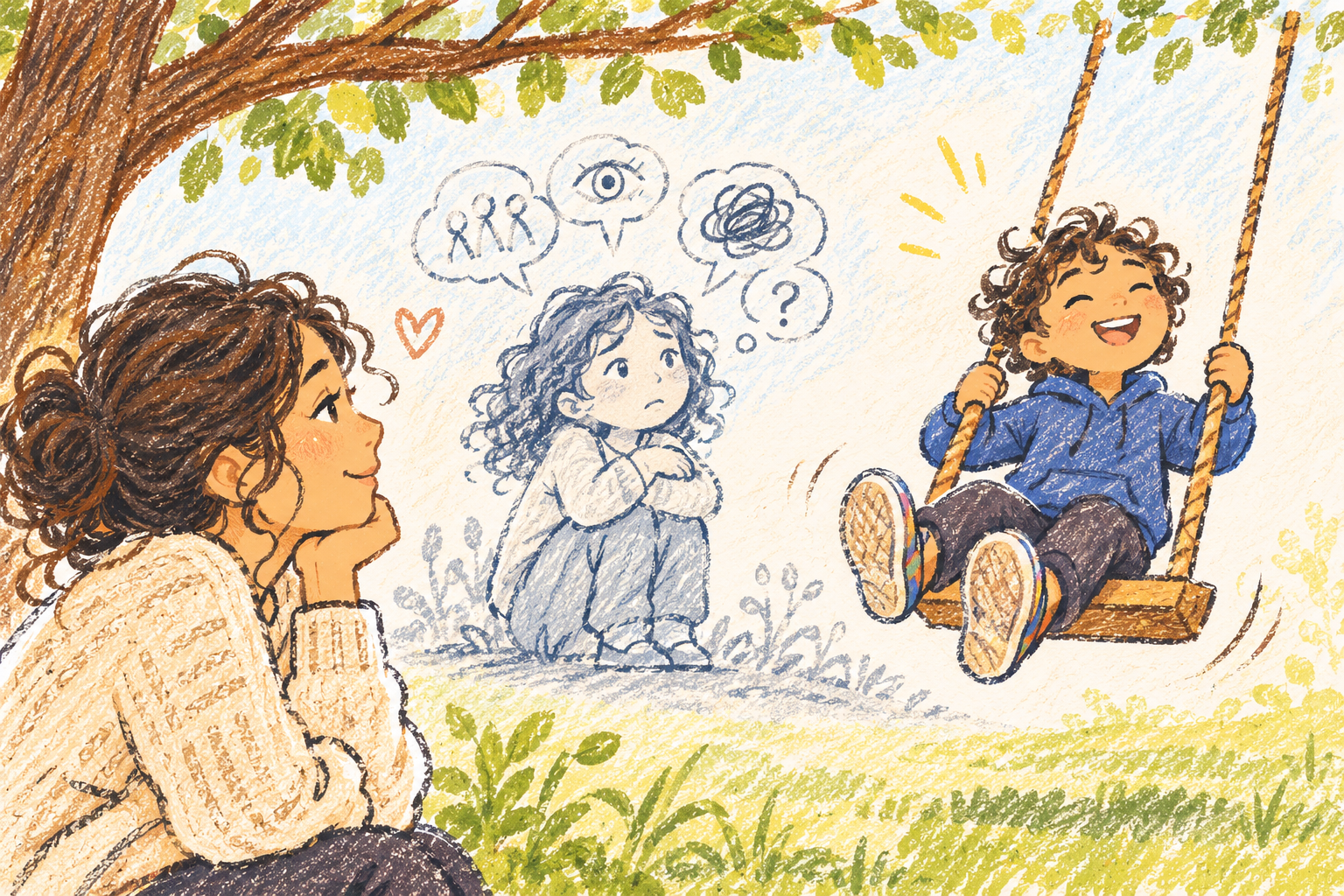
I tell my son to go play. Go on the swing. Chase the ants. Run around. Try something. Fall, get up, try again. Have fun. Fairly straightforward instructions, you would think. Except I don’t remember ever being able to do that myself. I remember getting on a swing and wondering whether I was sitting correctly. What if I fell? What if I looked ridiculous? Were people watching? Did they think I was lame? Was I swinging properly? Even sitting on a swing required a performance review. I was so conscious of how I might be perceived that I rarely got to enjoy whatever I was doing. It wasn’t only about making mistakes or preventing them. I was concerned about how I looked while doing perfectly ordinary things. Walking, talking, laughing, playing, trying something new. Even failing at something required careful consideration of how much of a buffoon I might look like in the process.
I wasn’t being bullied in the way many other children were. I wasn’t regularly beaten up by classmates, dunked in water or tormented by groups of children. The worst nickname I remember was Malinga, because of the curly blonde edges of my hair. Mostly, I was left alone.
I changed schools so frequently that I was perpetually the new kid. I didn’t have a group of familiar friends I could comfortably be ridiculous with. I was the odd one, the backbencher weirdo, sitting somewhere on the perimeter. I don’t know whether I was left alone because I seemed strange, because I kept changing schools, because I struggled to connect, or for a combination of reasons. What I remember is being acutely aware of myself and having very little idea how to stop.
I understood the words. I didn’t always understand what they meant.
Something my son’s therapist explained to us brought back another part of my childhood. When my son was around four, he could say words without necessarily associating them with their meanings. Hearing that explanation reminded me of how confusing language and social interaction had felt to me. I heard people talking. I could speak too, obviously. But looking back, I struggle to remember genuinely understanding many of those conversations, or knowing what my own responses were supposed to accomplish.
It’s difficult to describe. Imagine trying to communicate through sign language with someone who doesn’t understand it. There are gestures, expressions and attempts to communicate, but the connection between what one person means and what the other understands doesn’t quite happen. That is how I remember parts of my childhood. I am not saying my language development was identical to my son’s, or that my memory proves I had the same difficulties. I am describing how the experience felt from inside my own head.
I wish someone had helped me understand things. Not merely told me what to say, or corrected me when I got something wrong. I wish someone had explained why people behaved the way they did, what they meant, and what I could reasonably do in response. Instead, I spent an extraordinary amount of time watching people and trying to work things out. And I was still getting them wrong. During my early days at university, one of my lecturers kept coughing. I got up, went outside, brought her some water, put it on her table and returned to my seat.
At the time, I thought I was being helpful. Looking back, I wonder whether the way I did it came across as passive-aggressive. I didn’t ask whether she wanted water. I didn’t explain myself. I just got up, placed it on her desk and sat down. Was that rude? Was it considerate but awkward? Did she appreciate it? Did she even think about it afterwards? I have no idea.
That is precisely the problem. I can take one ordinary interaction, revisit it years later, and start another round of assessment without having any new information to work with. I wanted to help somebody who was coughing. Somehow, I am still wondering whether I managed to make a fool of myself doing it.
When you are both the performer and the audience
There is a term for part of what I am describing: hyper-self-consciousness, or excessive self-focused attention. Instead of simply experiencing a situation, you keep monitoring how you appear within it. You observe your behaviour, anticipate other people’s judgements and adjust yourself accordingly.
Some self-awareness is useful. We all need to consider how our behaviour affects others. But there is a difference between noticing that someone is uncomfortable and continuously checking whether your face, posture, voice or existence might be making you look ridiculous. For autistic people, this can sometimes overlap with social camouflaging, also called masking. Camouflaging may involve deliberately or habitually changing how one communicates or behaves to fit social expectations, conceal differences or avoid negative attention. A systematic review of autistic camouflaging found associations between greater self-reported camouflaging and poorer mental health, while acknowledging important limitations in the evidence. Another review of people’s lived experiences described how sustained self-monitoring can be mentally demanding.
I recognise aspects of that experience. But I cannot neatly separate what came from my neurodevelopmental differences, what came from growing up under constant criticism, and what came from repeatedly being the new child who didn’t know how to fit in. Perhaps all of those things played a role. Perhaps some mattered more than others. What matters to me is that watching myself became so habitual that it interfered with actually doing things. And this wasn’t something I simply grew out of.
AuDHD, OCD and the committee inside my head
As an adult, I have become increasingly interested in what happens when autism, ADHD, OCD and anxiety-related vigilance overlap. AuDHD is an informal term for the co-occurrence of autism and ADHD. It is not a separate diagnosis, and it does not describe one universal experience. I find it helpful as a way of exploring the different demands my brain seems to be juggling. I can struggle to interpret an interaction, feel overwhelmed by its emotional significance, and then spend hours trying to reach a satisfactory explanation.
OCD adds another important possibility. OCD isn’t limited to visible behaviours such as washing, checking locks or arranging things. Compulsions can also be mental. Repeatedly reviewing conversations, analysing intentions, seeking certainty or trying to resolve an unwanted thought can sometimes become part of an obsessive-compulsive cycle. But not every instance of overthinking is OCD. Rumination can also occur with anxiety, depression, stress and other difficulties. The difference is not established by how long I think about something, but by the pattern, its function and whether it involves compulsive attempts to reduce distress or uncertainty.
The US National Institute of Mental Health explains that OCD may involve persistent unwanted thoughts and repetitive behaviours or mental acts, and identifies exposure and response prevention (ERP) as an evidence-based treatment. What I notice in myself is that an upsetting interaction can turn into a problem I feel compelled to solve immediately.
What did they mean? Was that mistreatment? Am I overreacting? Should I say something? What if I say something and make it worse? What if I say nothing and they think they can keep doing it? And what exactly would be the correct response?
I can spend hours investigating a question for which I have no new evidence. The thinking feels productive because I am trying to understand something important. In reality, I may be replaying the same material and becoming increasingly distressed. It is like holding a committee meeting where every participant is me, nobody has brought new information, and nobody is willing to adjourn.
When one comment takes up an entire day
The night before last, my husband and I were trying to sleep while our son was struggling. Kabbo has been having difficulty settling in his own room. Something about that environment seems to upset him, although we have not yet established what it is. Interestingly, he managed to sleep downstairs in the library without the same difficulty. My husband, who was exhausted, said he hated his life. I heard it, and I couldn’t stop thinking about it.
It took me almost an entire day before I felt able to interact with him normally again. I avoided looking at his face and kept returning to what he had said. Was he blaming me? Was he saying he hated our family situation? Was this another instance of him taking his frustration out on me? Should I confront him? How do I establish a boundary without starting an enormous argument? How do I make sure it doesn’t happen again?
Meanwhile, I was also trying to understand his perspective. He works hard. Our mortgage is a substantial financial responsibility. Parenting can be exhausting. Our son sometimes needs considerable support, and there are nights when nobody gets the rest they need. Those things are very real.
But there is another part of the situation that matters to me. I have spent years learning my own limits after pushing myself far beyond what I could sustainably manage. I know what happened when I tried to keep working at that pace, and I do not want to return to it. So when the conversation turns towards financial contribution, household responsibilities or how difficult our lives have become, there is more at stake for me than a single frustrated sentence.
I do not want to disregard my husband’s exhaustion. I also do not want to become responsible for absorbing every expression of it. And there I was, trying to solve both questions internally for an entire day. The problem is that my need to understand his reaction did not automatically make me better at responding to it. I became distant and preoccupied. From his side, that could have looked like hostility or punishment, even though I was struggling to work out what I should do.
I have experienced similar difficulties during other emotionally intense situations, including an occasion when I was intoxicated and was struggling to sit comfortably and interpret a disagreement. I found myself monitoring his reactions instead of being able to respond clearly. Of course, my perception was affected, as were my anxiety and attention, so I cannot use that experience as evidence of a particular neurodevelopmental mechanism. But it reminded me how disorienting this kind of self-monitoring can feel.
Sometimes I am so occupied with figuring out whether I am being treated badly that I lose track of how I am participating in the interaction. That doesn’t automatically mean my concerns are unfounded. It means I may need a different way to examine them.
What happens when I get stuck?
I am calling these episodes shutdowns, but I want to be careful about the terminology. I experience a kind of stalling. I can keep performing ordinary tasks, but mentally I am occupied with one unresolved issue. I become reluctant to engage, struggle to shift my attention and feel unable to respond naturally. Whether that is best described as shutdown, rumination, emotional overload, a stress response or some combination is a question I cannot settle through an essay. What I do know is that trying harder to think my way out of it often makes things worse.
I might replay the conversation twenty times, searching for a slightly different interpretation. I might monitor the person’s face to see whether they are annoyed. I might mentally rehearse five versions of a confrontation and then reject all five because none guarantees the outcome I want. And that last part matters: I keep looking for a response that will protect me from every possible consequence.
There isn’t one.
I cannot know exactly what another person intended without asking. I cannot guarantee how they will respond to a boundary. I cannot make every interaction perfectly fair, and I certainly cannot analyse my way into a relationship where misunderstandings never happen.
I can, however, decide what I am willing to discuss, what I need from the other person and what I will do if something continues. That is a much more manageable question than trying to establish the complete meaning of another human being.
Three things I am trying instead
After several conversations about this, I realised that I did not particularly want to choose between physical grounding, postponing rumination and communicating a boundary. Why not use all three?
They address different parts of the problem. Movement might help me shift attention. Postponing repetitive analysis gives me room to stop rehearsing the same question. A conversation later allows me to address something that genuinely needs addressing. None of these is a guaranteed treatment or a substitute for professional care. They are practical things I want to try when I notice myself getting stuck.
1. Do something physical before doing more thinking
One possibility was splashing cold water on my face. No, thank you. I hate the feeling of being wet. I am not particularly interested in solving sensory discomfort by introducing another sensory discomfort. Push-ups, though? Those I can do. A few wall push-ups, some stretching or moving around the room might give me something immediate and concrete to pay attention to. The point is not that ten push-ups magically reset my nervous system or cure OCD. It is that I can temporarily redirect my attention towards an activity that doesn’t require interpreting anyone’s intentions. And I can choose movement that actually feels comfortable rather than forcing myself through a supposedly calming technique that I dislike.
2. Stop treating every thought as an urgent assignment
My instinct is to keep analysing until I understand everything. But I am beginning to realise that sometimes the problem isn’t a lack of analysis. It is that I cannot stop analysing. I want to try recognising the difference between a question that requires action and one that is simply repeating itself.
For example:
The question: Did my husband mean that he hates our life together?
What I know: He said something upsetting while exhausted.
What I don’t know: Precisely what he meant or how he would describe it when rested.
What I can do: Ask him later and explain how the comment affected me.
Everything beyond that risks becoming another rehearsal of a conversation I haven’t actually had. So rather than scheduling ten minutes in which I am allowed to ruminate, I would prefer to set aside a time to consider whether there is a practical action to take. If there is, I can take it. If there isn’t, I can practise leaving the uncertainty unresolved for now. This is particularly important if OCD is contributing to the cycle. I don’t want my coping strategy to become another elaborate mental ritual that I feel compelled to complete perfectly.
3. Have the conversation without conducting a trial
This is probably the part I find hardest. I don’t want to pretend a comment didn’t hurt. But I also don’t want to turn one difficult night into a comprehensive examination of our marriage, finances, parenting, previous disagreements and everything else I have ever been upset about. I want to be able to say something like:
“I know you were exhausted the other night. But when you said you hated your life while we were dealing with Kabbo’s sleep, I found it upsetting. I wasn’t sure what you meant, and I spent a long time thinking about it. Can we talk about it now? And if you’re overwhelmed at bedtime, can we try to discuss the bigger issues when we’re both rested?”
That is a conversation I can actually have. It doesn’t require me to establish whether the entire incident qualifies as mistreatment before I am allowed to say it bothered me. It doesn’t require him to have intended harm before I can ask for a change. And it doesn’t require me to agree with every explanation he offers. A boundary can be quite ordinary. We can discuss difficult subjects without doing it just as we are trying to sleep. We can acknowledge financial and parenting stress without making the conversation a competition over who is suffering more. I can also recognise that some disagreements will not be resolved in one conversation. If a pattern continues, the answer may involve further discussion, outside support or decisions about what I can reasonably accept—not endless private analysis.
I don’t want to spend the rest of my life watching myself live
I keep returning to the child on the swing. I wonder what it would have been like to sit there without evaluating my posture. To chase an ant without worrying who was watching. To laugh without checking how my face looked. To ask a question without first rehearsing the acceptable ways to ask it. I wish someone had helped me understand the world instead of leaving me to decipher so much of it by myself. But I also want to be careful about what I am asking of myself now. If I turn overcoming hyper-self-consciousness into another task I must perform correctly, I have merely given the internal committee a new agenda.
I do not need to monitor how successfully I am being spontaneous. I do not need to become an expert at relaxation before I am allowed to enjoy something. And I do not need to understand every social interaction immediately. There will still be difficult conversations. I will still misunderstand people, and people will misunderstand me. Sometimes I will need support. Sometimes I will need to address something uncomfortable rather than simply putting it out of my mind. But perhaps I can learn to separate the actual situation from the hours of internal investigation that follow it.
I want to be able to notice that I am stuck, move my body, leave a question unanswered until I have more information, and then communicate what matters. And occasionally, I would like to just sit on a swing. Without conducting a performance review.