The Rubik’s Cube He Chose on My Birthday
A birthday shopping trip, a child’s collection of Rubik’s Cubes, and a reflection on autistic interests, ownership, childhood deprivation, and learning that joy does not need to be earned.
Today is my birthday.
We went to the Rideau Centre in Ottawa, and my husband made the entire day about me. I bought books: an Avatar Kyoshi collection, four volumes of The Apothecary Diaries light novels, and a hardcover copy of Dawnshard. I got the Dumbledore’s Office LEGO set, a bunch of Medicube skincare products and several other things.
It was not cheap. I am quite sure my husband is now out a large sum of money.
But for once, I think I accepted it without feeling guilty.
Usually, receiving gifts comes with an uncomfortable calculation in my head. Did this cost too much? Do I deserve it? Have I done enough to earn it? Should I have asked for less? This time, however, I let my husband buy things for me because he wanted to. I let the day be about me without immediately trying to make myself smaller.
I think I am slowly unlearning some of the things my parents instilled in me. But that is another piece, another day and, most likely, another headache.
So why am I telling you everything I bought?
Because while I was busy choosing my books, LEGO and skincare products, my son found the Rubik’s Cubes.
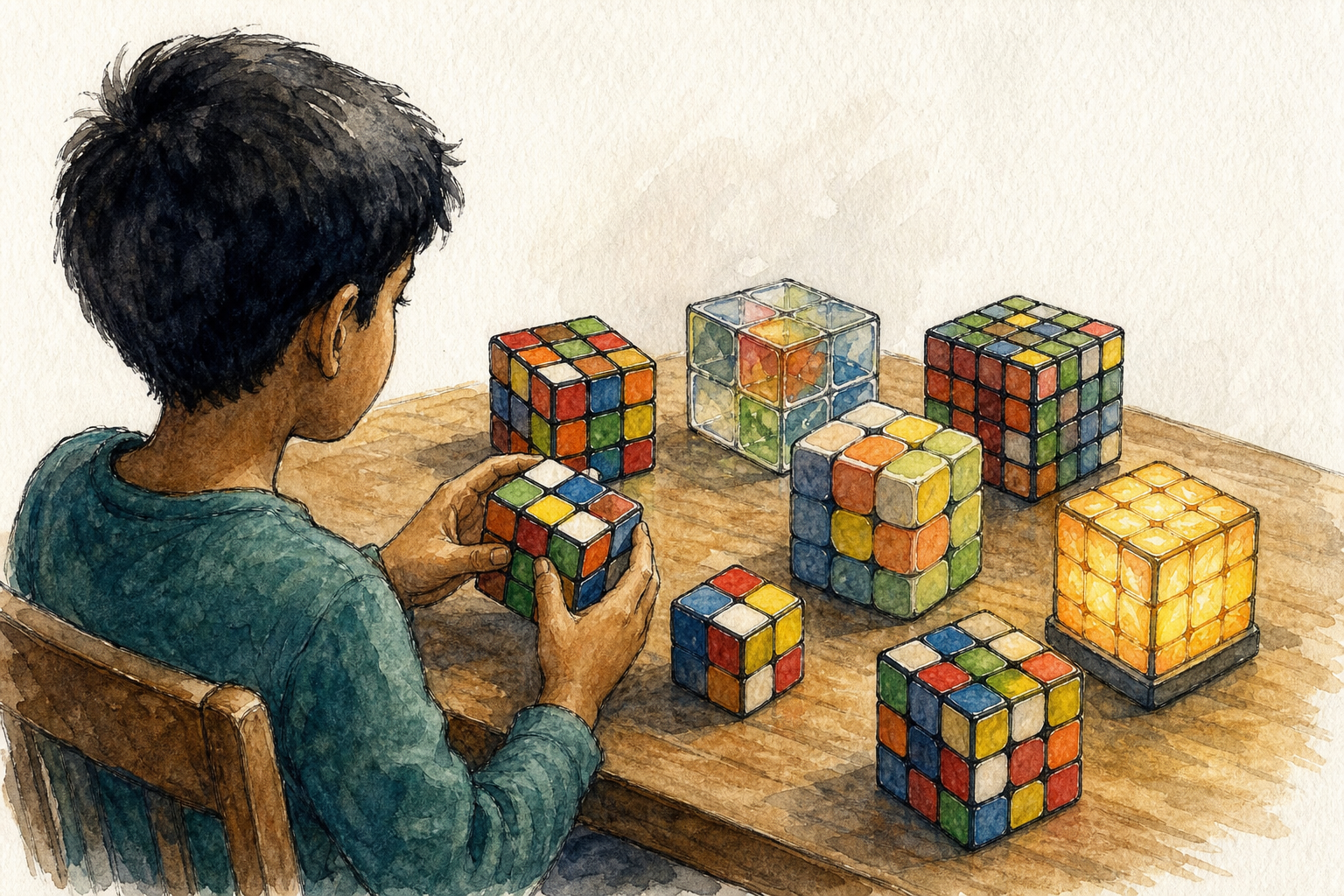
That is what he does. Wherever we go, if there are Rubik’s Cubes, he will find them. He has the regular 3×3 cube, a magnetic one, a light-up one, a spongy one, an easy-spin one, a glass one, a 2×2, a 4×4 and a 5×5. I may even be forgetting a few.
It is not as if he did not want more. There were many other kinds in the store. But that iccha—that desire to find another version of the thing he already loves—was there immediately.
I understand that feeling. I collect books and LEGO. He collects LEGO because he has watched me do it, but Rubik’s Cubes are very much his own thing. He does not simply want the same cube repeatedly. He wants to explore all the ways a cube can be different: the size, texture, movement, resistance, mechanics, colours and even the way it feels in his hands.
Watching him made me wonder: why do we collect things? Is it just a normal human habit, or is it something more common among autistic children and adults? Why does one person collect cubes, another books, another stones and another little bits of paper that look completely meaningless to everyone else?
And why did I not collect anything as a child?
Why Do People Collect Things?
At its simplest, collecting turns many separate objects into one meaningful thing.
One Rubik’s Cube is a puzzle. Nine different Rubik’s Cubes are a collection. Once they are placed together, we begin comparing them: which one is bigger, faster, smoother, harder, stranger or more satisfying? We notice patterns and differences. We arrange them. We learn about them. We begin to understand a small part of the world in greater detail.
Research involving children suggests that collections can support sorting, categorization and the development of knowledge about objects. Children do not always collect because they understand financial value or because they are trying to build an impressive display. Sometimes they simply find a group of objects interesting and want to examine how those objects belong together—or how they differ from one another. In one study of young children’s spontaneous collections, the researchers found that collecting was connected to children’s growing understanding of categories and their ability to talk about the items they had gathered. (McAlister and Cornwell, 2010)
That makes sense when I look at my son’s cubes. A glass cube and a spongy cube both belong to the same category, but touching them produces completely different experiences. A 2×2 cube and a 5×5 cube follow related ideas, but they demand different levels of planning. He is not merely accumulating objects. He is exploring one concept in every form he can find.
A collection can also become part of a person’s identity. It says, This is something I notice. This is something I understand. This is my thing. In a world where children make very few of their own decisions, choosing what belongs in a collection gives them a small area of authority.
Of course, not every collection needs to be educational, productive or useful. Sometimes people collect things simply because those things make them happy. That is enough.
Is Collecting an Autistic Trait?
Collecting is not exclusive to autistic people, and having a collection does not mean that a child or adult is autistic. Neurotypical children collect cards, rocks, stickers, shells, toys, leaves, bottle caps and all kinds of wonderfully random things.
Autistic people, however, may experience interests with unusual depth or intensity. The diagnostic criteria for autism include highly restricted or fixated interests that may be intense in focus, and research describes how these interests can occupy an important place in an autistic person’s daily life. (CDC diagnostic criteria; review of restricted interests in autistic youth)
That does not automatically make the interest unhealthy. Studies involving autistic adults have found that special interests can be connected to positive emotions, wellbeing and a sense of purpose. They may help a person learn, regulate emotions, connect with other people or build expertise. (Grove et al., 2018)
For one autistic person, collecting may be about completing a set. For another, it may be about arranging objects in a satisfying order. Someone else may be drawn to the visual patterns, texture, history, mechanics or predictable rules surrounding the objects.
In my son’s case, Rubik’s Cubes offer quite a lot at once: colour, movement, repetition, logic, problem-solving and different tactile experiences. But I cannot look at his collection and declare exactly what it means to him. Only he can gradually show or tell me that.
The collection itself is not a diagnosis. It is an interest. The intensity, function and broader context matter more than the fact that he owns several cubes.
There is also an important difference between collecting and hoarding. A collection is usually selected, organized and meaningful to the collector. Hoarding disorder involves persistent difficulty discarding possessions, distress connected to letting them go and clutter that interferes with the safe use of living spaces. They are not interchangeable ideas. (American Psychiatric Association)
My son wanting another variation of a puzzle he loves is not, by itself, a problem that needs to be corrected. The important questions are much simpler: Is the collection safe? Can we afford the new item? Is there somewhere to keep it? Does the interest bring him joy without preventing him from meeting his other needs?
Supporting an interest does not mean buying everything he sees. I can say, “Not today,” without mocking the thing he loves. I can help him make a wish list, save for something special or choose between two cubes. A boundary does not have to become shame.
Why Didn’t I Collect Things as a Child?
I know that collecting does not necessarily require money. Children collect rocks, leaves, shells, wrappers, bottle caps and scraps of paper. A collection can cost absolutely nothing.
But where would I have kept any of it?
I did not have a cabinet, drawer, shelf or little corner to call my own. We shared a bed with everyone. Some nights, we did not even get pillows to sleep on. There was no dependable physical space where I could place something and think, This is mine. I can leave it here, and it will still be mine tomorrow.
Even my own body did not feel like it belonged to me. I was touched, poked and handled without my permission. My discomfort did not create a boundary that other people felt required to respect.
So yes, children can collect rocks for free. But collecting still requires somewhere to keep the rocks. More than that, it requires some understanding of ownership. It requires the experience of having something—whether that is an object, a shelf, a bed, a pillow or your own body—and knowing that other people will respect that it belongs to you.
I did not have that.
We were also told that we had to behave well to earn a second piece of meat at dinner. That second piece never came, by the way. When even food and basic comfort feel conditional, wanting something unnecessary simply because it brings you joy does not feel innocent. It feels greedy. It feels dangerous. It feels like asking for something you have no right to claim.
That is why I did not collect things as a child. It was not because I lacked curiosity or because nobody had told me that leaves and stones were free. I had no territory—not even the territory of my own body—in which the word mine could safely exist.
Research can describe how material deprivation, instability and unsafe environments affect children. But I do not need research to tell me whether I had a cabinet, a pillow or bodily autonomy.
I remember.
The Safety to Want Something
This is where a small Rubik’s Cube becomes much more than a toy to me.
My son can walk into a shop, find something fascinating and say, “I want this one.” I may buy it, or I may tell him we cannot buy it today. But he is still allowed to want it. His desire is not treated as evidence that he is greedy, spoiled or ungrateful.
If we bring the cube home, he can place it beside the others and reasonably expect it to remain there. He has space for his belongings. He has space for his interests. He has the security of knowing that something can be his without constantly having to earn the right to keep it.
Most importantly, he is learning that his body, his comfort and his boundaries also belong to him.
That does not mean I never touch him without asking. I am still his mother, and sometimes I have to help him get dressed, brush his hair, apply medicine or move him away from danger. Parenting sometimes requires doing things a child may not enjoy. But I can explain what I am doing. I can listen when he says something hurts or feels uncomfortable. I can avoid unnecessary touching, poking and teasing. I can treat his distress as information instead of disrespect.
I can teach him that mine is a word he is allowed to use.
His body is his. His room has spaces that are his. His collections are his. His thoughts and interests are his. Other people do not receive unlimited access simply because they are older or related to him.
I did not have that certainty as a child. I am trying to give it to him now.
What His Collection Is Teaching Me
My son’s Rubik’s Cubes are teaching me that wanting variations of the same thing is not pointless. His glass cube, magnetic cube and spongy cube may look repetitive to someone else, but he sees differences worth exploring.
They are also teaching me that a child should not have to justify every source of harmless joy. He does not need to turn his collection into a career, win competitions or prove that every cube improves his intelligence. He is allowed to love them because he loves them.
I am learning the same lesson very slowly.
I do not need to justify every book by promising to become wiser after reading it. I do not need to explain that LEGO improves concentration. I do not have to prove that skincare is a medical necessity before I am allowed to enjoy it. Not everything I own needs to earn back its cost through productivity.
Sometimes a book is just a book I wanted.
Sometimes LEGO is simply fun.
Sometimes a Rubik’s Cube is worth bringing home because it spins differently from all the others.
And sometimes a husband can buy his wife far too many birthday gifts because he loves her, and she can accept them without turning that love into a debt she must immediately repay.
A Different Kind of Inheritance
I model collecting for my son. He has seen my books and LEGO, and perhaps that has shown him that it is safe to care deeply about something. But he is teaching me something too.
He is showing me what interest looks like when it is not immediately followed by shame.
He sees a cube. His eyes light up. He picks it up and examines it. He wants to know how it moves and how it differs from the cubes he already owns. He does not first ask himself whether wanting it makes him a bad person.
I hope that part stays with him.
I hope he learns to manage money, space and consumption responsibly. I hope he understands that he cannot own every cube ever made. But I never want him to confuse responsible limits with the belief that wanting something is shameful.
There is a difference between saying, “We cannot buy this today,” and saying, “Why do you always want things?”
There is a difference between teaching moderation and teaching a child that joy must be earned.
There is a difference between helping a child organize their belongings and making them feel that nothing is truly theirs.
Today, my husband gave me books, LEGO and skincare products. My son chose another Rubik’s Cube. From the outside, perhaps it looked like nothing more than a family spending too much money at a mall.
But something else happened too.
I accepted being celebrated without drowning in guilt. My son expressed what he wanted without fear. He brought home another little piece of the world he is trying to understand, and he placed it with the other pieces that belong to him.
To someone else, that may look ordinary.
To me, it is the childhood security I now understand I never had.
Perhaps that is what we are really collecting in this family—not merely books, LEGO sets or Rubik’s Cubes, but small pieces of safety. Proof that we are allowed to want things, love things, keep things and make room for ourselves.
Proof that mine does not have to be a dangerous word.