Coming Out as Myself
A confession about thirty-five years of performing, copying, pleasing, and finally trying to discover who I am without asking everyone else for the correct answer.
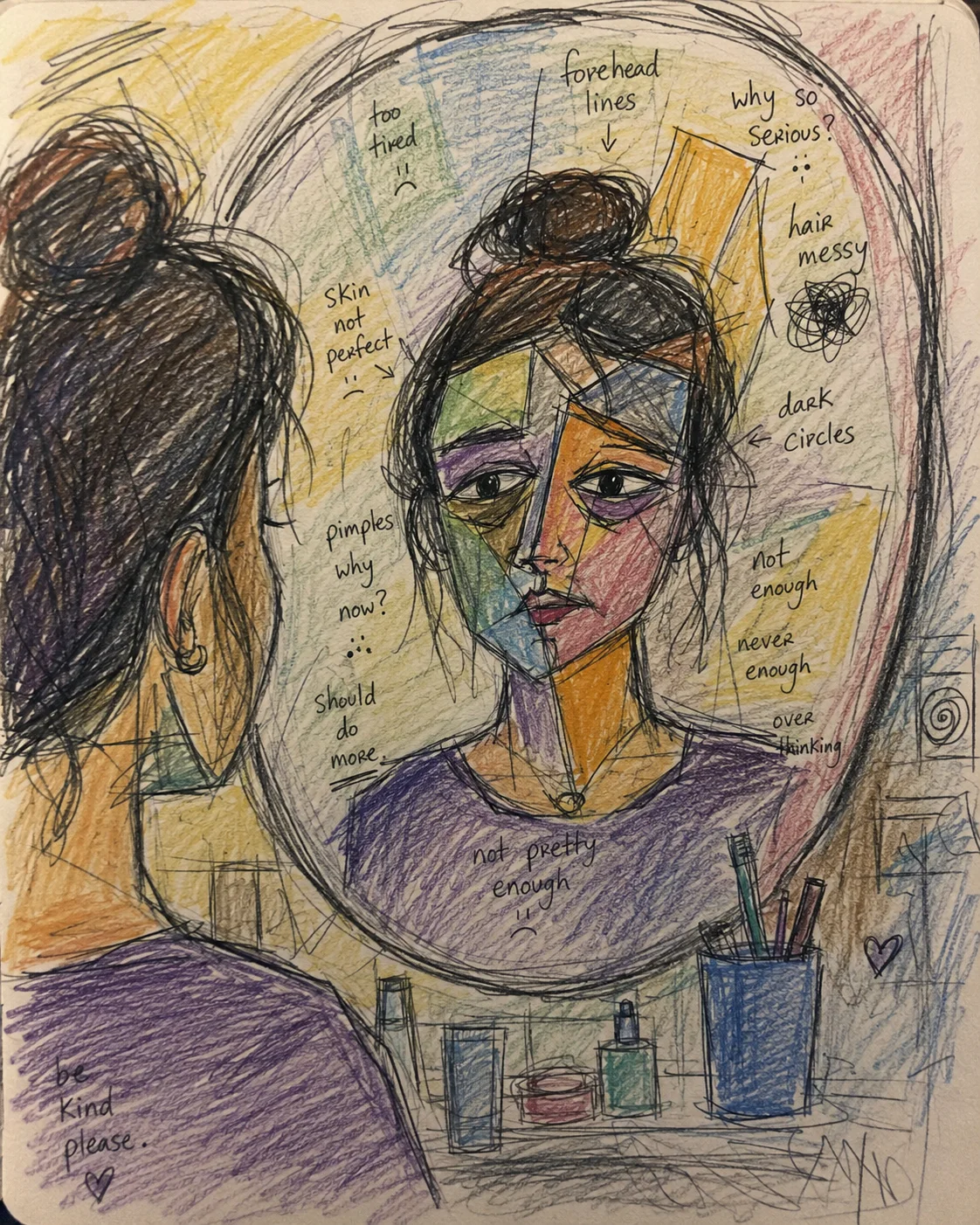
It is ridiculous that I have to tell myself—really tell myself—that I need to be myself. As a girl, I learned that I had to be good. I had to be likable, amenable, agreeable—all those words. But nobody ever impressed upon me that I should be myself, because only then would I attract the people who were actually suited to me.
For almost thirty-six years, I have struggled so hard to fit in. To be liked. To copy other people. To figure out the correct way of being a person. I have wasted an enormous amount of time reshaping myself for people I thought I was supposed to get along with. And the energy. My God, the energy I have spent trying to become whatever version of me someone else might find acceptable. Looking back, it seems ridiculous that I was always trying so hard.
Almost thirty-six years old, and today I finally understood that I needed to be me. Only then would the bees meant for me know where to land. Instead, I kept squeezing myself into molds built from other people’s ideas of who I should be. I should have told them who I was. I should have allowed them to decide whether they liked the actual person instead of exhausting myself trying to become whoever they had imagined.
So today I am coming out. Not as anything new. As everything I have been hiding.
I am a geek. I love historical facts. I stim all the time. I mean all the time. I cannot sit still. If I find one of your words, sounds, expressions, or mannerisms adorable, there is a good chance I will pick it up from you. I repeat things people have said to me inside my head. I rehearse conversations before they happen—including any conversation that requires me to order food over the phone. I have an instinct to do the exact opposite of whatever you order me to do. Ask me, and perhaps I can do it. Make it a demand, and suddenly every part of my body wants to resist. I know it does not always make sense. It feels like a compulsion. I am nurturing. I become the momma in almost every group, but I also like telling jokes.
I have severe ADHD, and I have developed rituals around not trusting my own memory. Before leaving the house, I check that everything is properly switched off and locked. Checking the stove is literally number one on my list. Still, I would rather drive all the way back home to check it again than spend the entire day stewing in the possibility that I left the gas on. I cannot deal well with the unexpected. I need time to prepare for how I am going to react. I am not exactly renowned for my flexibility.
I read and watch fantasy, fiction, romance, comedy, thrillers, horror, and sometimes complete cheese. I watch anime. I watch Bridgerton. I also enjoy The Stormlight Archive and The Hobbit. I cannot choose one genre. I cannot choose one flavor. I love everything. I love all colors. Except orange. I need to make it clear that I do not accept orange. I know it is somehow connected to losing my sibling when I was two and to a memory involving an orange, but I do not understand the association completely. I only know that something inside me still rejects the color.
I also need to clarify everything. If I tell you that I took a tablet after drinking water, but then remember that I actually took the tablet first, I will need to correct myself. It changes absolutely nothing about the story, but until I correct it, I will keep thinking of myself as a liar.
My parents were deeply problematic, so many of the ideas I grew up believing were normal were completely skewed. My mother behaved narcissistically and lied so constantly that I grew up believing many of the things she did were normal. My father was a chauvinist who controlled every aspect of life he could by being cruel to people. When I was eight, he told me I could not even iron a shirt properly. He told me I would be better off dead. That was not even close to the worst thing he said to me. But I was so committed to denying how badly my parents treated me that I used to make coffee for myself, pour it into a bottle, and pretend that বাবা had made it for me because he loved me. The depth of my denial about how crappy my parents were is still astounding.
What else can I tell you about myself? Many times, I have said shit out loud that did not sound nearly as crappy inside my head. Once, I told a girl that I was worried about her and about our exam. In the very next sentence, I accused her of cheating. I did not mean to. I promise. Inside my head, I was expressing genuine concern for her. It sounded much better there. Later that night, I realized how awful my words must have sounded to her. She is not the only person I remember.
Once, I wanted to tell a family member that they could leave their plate and that I would take care of it. Instead, I said, “People who have dishwashers don’t need you to wash their dishes for them.” I did not mean to sound condescending. At the time, I did not even understand that it sounded condescending. I was simply trying to say, Please leave the plate. You don’t have to do that. But those were not the words that came out.
To the friend whose side I left after the disaster: I am sorry. I was the first person to see what had happened. Somehow, inside my head, being the first to see it became the same as being responsible for it—or at least being the person who would be blamed. I thought my presence would make everything worse, so I left. At the time, I genuinely believed I was making your trouble lighter by removing myself from it. Only now do I understand that you may have wanted me to stay. Later, when our friendship broke down, I thought it was about money. Perhaps some of it was. But I did not understand that there might have been another wound underneath it: when something terrible happened, I disappeared. If I could live that moment again, I would stay.
I would use my words instead of deciding for you what you needed. I would ask:
What do you need from me?
How can I make this easier for you?
And I would do whatever you needed me to do—help clean up, make calls, talk, or simply sit beside you without trying to fix anything. I cannot redo that day. I understand that describing what I would do now does not change what I did then. But I am sorry that I left. I wish I had stayed.
To the person I looked at questioningly for eating pizza with utensils: I was not trying to mock you. I was trying to say something—anything—because I did not know how to begin a conversation with you. It turns out that saying nothing would have been better.
There have been so many moments when I said or did something without intending to hurt anyone, but I hurt them anyway. Often, I cannot imagine an apology that feels like enough. I wish I could find everyone I have hurt without realizing it and explain that I did not intend to be an ass. But I understand now that my intention did not make my words hurt any less. The fact that I did not know how to communicate what I meant does not undo what the other person heard or experienced.
Some of those moments still haunt me at night. I have stayed awake replaying the conversations inside my head and imagining different versions of them—versions where I said something softer, where I explained myself more clearly, where I stayed, or where I came back later and made things right. I wonder how I would apologize if I ever had the chance, and I have doubted whether I could even manage a proper apology when I could not say the first thing without messing it up. How could I make you understand that I really was concerned all those times, when I could not manage to say even one simple sentence in a way that sounded like concern?
I am not saying any of this to ask those people to relieve me of my guilt. They may remember these moments differently. They may not forgive me. Some of them may not remember me at all. But I still want to say it plainly:
I am sorry.
Being honest about myself means admitting both things: I have hurt people without meaning to, and I have loved people without always knowing how to show it. I love spending time with my son and my husband. My siblings might not know this, but I adore spending time with them too—whether we are doing something together or simply chatting. I wonder how many times I have felt love, concern, or affection for someone but failed to communicate it in a way they could recognize. How many times did I assume people knew how much they mattered to me because the feeling was so obvious inside my own head? It was obvious to me. That does not mean I ever showed it to them.
Over the years, I have grown a lot. Especially since my son was born, I have learned more about myself and begun accepting myself as I am. Talking about what happens inside my head—what I think, what I feel, and how I reach the conclusions I do—has always felt so embarrassing that I barely ever did it. I do not think I am smart. I tend to believe that everything I have accomplished so far has been a fluke. Talk about impostor syndrome, am I right?
I love learning about religions, but I am not religious. I hate extremism, whether it is religious or political. I feel fatigued. I do not want to do work I dislike, but I also do not know what I actually like. I am very sensitive, and I cannot take criticism lightly. It becomes personal—not revenge personal. More like I feel so bad that I cry personal. And I will cry. I am so unsure of everything I write that I run it through ChatGPT to find out whether I even make sense. Yeah. I have zero confidence in myself. So little confidence that, in the past, I said yes to countless things while everything inside me screamed no.
I wonder where that came from. Was it my mother finding a piece of eggshell in the first egg I ever fried and deciding that it meant I would never be good at cooking? Was it hearing, “No one is ever going to marry you”? “Who is going to be your friend?” Was it my father saying that other children worshiped their parents while we could not even fetch a glass of water correctly? I do not know.
But now that I am a parent, I understand the importance of practice. Nobody is born already knowing how to do everything. Even talent needs time, mistakes, encouragement, and repetition before it can become skill. I understand how one cruel sentence, spoken while a child is still learning, can convince them that there is no point in trying again. And I understand how that sentence can follow them for the rest of their life.
My son is sensitive, like me, so I try to give him what I never received. Then, because apparently I cannot do anything without questioning myself, I worry about the opposite happening. I often tell my husband that I do not want to be so liberal that our child grows up to become an extremist like Ned Flanders. Yes, that is a genuine fear I have. My son is not even six, and he has taught himself Russian, Arabic, and Sanskrit letters and numbers on top of English, French, and বাংলা.
I hope I can nurture him into becoming the best version of himself—not the version of him I imagined before I knew who he was. I hope I do not dim his light by being cruel. I hope I do not dull his individuality by trying to make him easier for other people to accept. And perhaps I need to offer myself the same thing. Perhaps I am not supposed to discover the correct way to be a person. Perhaps I am supposed to discover who I already am underneath thirty-five years of performing, copying, pleasing, apologizing, and trying to fit.
I do not know exactly who that person is yet. That is the annoying part. But for the first time, I am trying to find out without asking everyone else for the correct answer. And if someone does not like the person they find? Fine. At least this time, it will actually be me they do not like.