That Doesn’t Happen to Us
On Autism, Denial, and the Violence We Call Discipline.
Why is it that all my thoughts gather in my mind just as I am trying to sleep, making me want to write—but the moment I sit in front of a screen, every thought disappears?
I never seem to be able to hold on to them. I don’t understand why.
My therapist, of course, would blame the ADHD.
ADHD—the rich person’s disorder. A first-world problem. The kind of condition that we middle-class people refuse to take seriously. Things like that cannot possibly happen to us. In our homes, it is either stubbornness or deliberate misbehavior.
A child is getting older but still does not speak? They must be stubborn.
An older son smashes plates when he is angry? He just has a hot temper.
These could never be signs of a developmental disability or difficulty with emotional regulation. Because those things simply do not happen to us.
ADHD, autism, or another disability—the name changes, but the denial does not.
The possibility that someone in our family might have a disability feels like a curse. What will people say if they find out?
Instead of acknowledging, “My child is on the autism spectrum,” we would rather refuse to recognize it at all. If we do not name it, no one will know. No one will talk.
Meanwhile, the fact that the child is not receiving the help they need disappears completely from view. It is as if the child is the last person worth worrying about rather than the first.
Our society spends far more energy worrying about what people will say than asking what is happening to the child.
It would not be entirely wrong to call this ignorance or a lack of awareness. Many people in our country do not have access to the information, resources, or support they would need to understand these conditions and talk about them.
But what about those who do have access?
They choose to close their eyes.
If they see someone who appears visibly disabled or different, they run in the opposite direction. They want no association with that person, as though difference itself were contagious.
But how can we blame society alone? Even families with neurodivergent or disabled members do not always make a real effort to understand them.
They use beatings, punishment, and scolding to control whatever they can. If that does not work, there is always “the madhouse.”
Let the professionals who are already responsible for more patients than they can handle take care of one more.
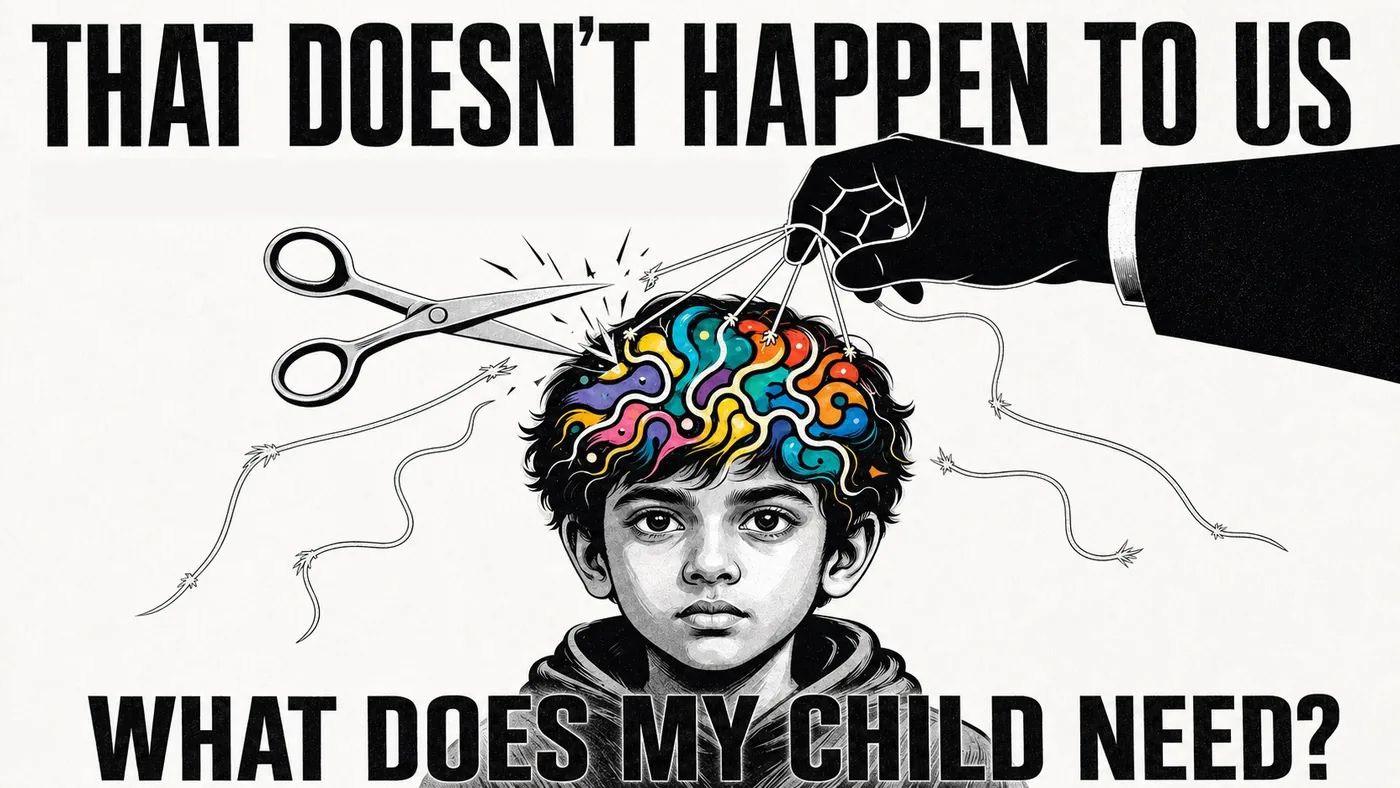
What does the child need? How could we make their life easier? How could we prepare them to live in this world?
Those are not the questions that occupy us.
First, let us find out what other people will say.
I am the mother of a person on the autism spectrum.
When I notice something in my child that needs attention, I do not only have to fight to find him help.
I have to fight a system that is still learning how to coexist with people whose minds work differently.
I have to fight my family, who refuse to accept that something needs attention.
I have to fight the beliefs planted inside me—the ones that constantly tell me I am doing too much. That I am spoiling my child by giving him too much affection.
A person spends the entire day caring for a child who cannot regulate himself, feed himself, or communicate what he needs—a child who screams because he has no other way to explain why something feels unbearable.
At the end of the day, does that person have any energy left to deal with anything else?
What option is left except to collapse onto the bed and immediately pass out?
There is none.
For years, there were nights when I barely made it to bed before passing out. There were days when I fell asleep just before a meeting. Days when I lost my temper with my beautiful child—who was not deliberately trying to make my life difficult.
He simply did not know how to regulate himself or tell me that the noise around him had become more than he could bear.
Still, we keep going.
We gather whatever fragments of energy we can find, and we keep fighting.
We fight generations of conditioning that tell us, “The mother spoiled that child by giving him too much affection.”
We fight our own families.
We fight a system that was never built with neurodivergent people in mind.
We keep fighting so that, one day, our children might be able to navigate this world on their own terms instead of being reduced to the word “abnormal.”
The idea that you can love your child too much makes no sense to me—in any language.
How can love be too much?
How can wanting to understand and help your child be too much?
I do not understand.
“If they cry too much, leave them alone. They will eventually fix themselves.”
In what world does it make sense to treat a human being this way?
If an adult were crying in distress and everyone abandoned them until they stopped, what would we call that behavior?
What would we call it if a Muslim or Jewish person were forced to eat pork? Or if a Hindu person were forced to eat beef?
Would we not plainly call it abuse?
The reasons for refusing food may be different, but the question of a person’s right to their own body remains.
Why, then, outside a medical emergency, is it considered acceptable to force-feed a child who cannot communicate through speech?
A child who cannot explain how the food tastes, smells, or feels to them. A child who cannot tell us what their body is experiencing.
How has this behavior become so normalized that a parent who refuses to do it is considered strange—or even irresponsible?
This is especially important for a neurodivergent child who may not have the words to explain why they cannot tolerate a particular texture, sound, smell, light, touch, or person’s presence.
Our society takes that child’s entire experience and buries it beneath one convenient judgment:
“They need discipline.”
Children need boundaries, guidance, and opportunities to learn. Of course they do. But sensory distress is not disobedience, and punishment is not a substitute for support.
How much longer will we ignore, avoid, and deny neurodivergence?
How long will it take us to put our children’s needs first?
Why can we not think beyond, “What will people say?”
When will we finally stop and ask:
What does my child need?
How can I help them?
How can I teach them essential skills in a way they can actually learn?
How can I make their life a little easier?