Notice the cost · protect tomorrow’s energy
Kabbo’s Energy Theory: Borrowing From Tomorrow
A child-created model for understanding daily energy, rest, borrowing from tomorrow, and what repeated energy debt can teach us about burnout.
- Published
- Last reviewed
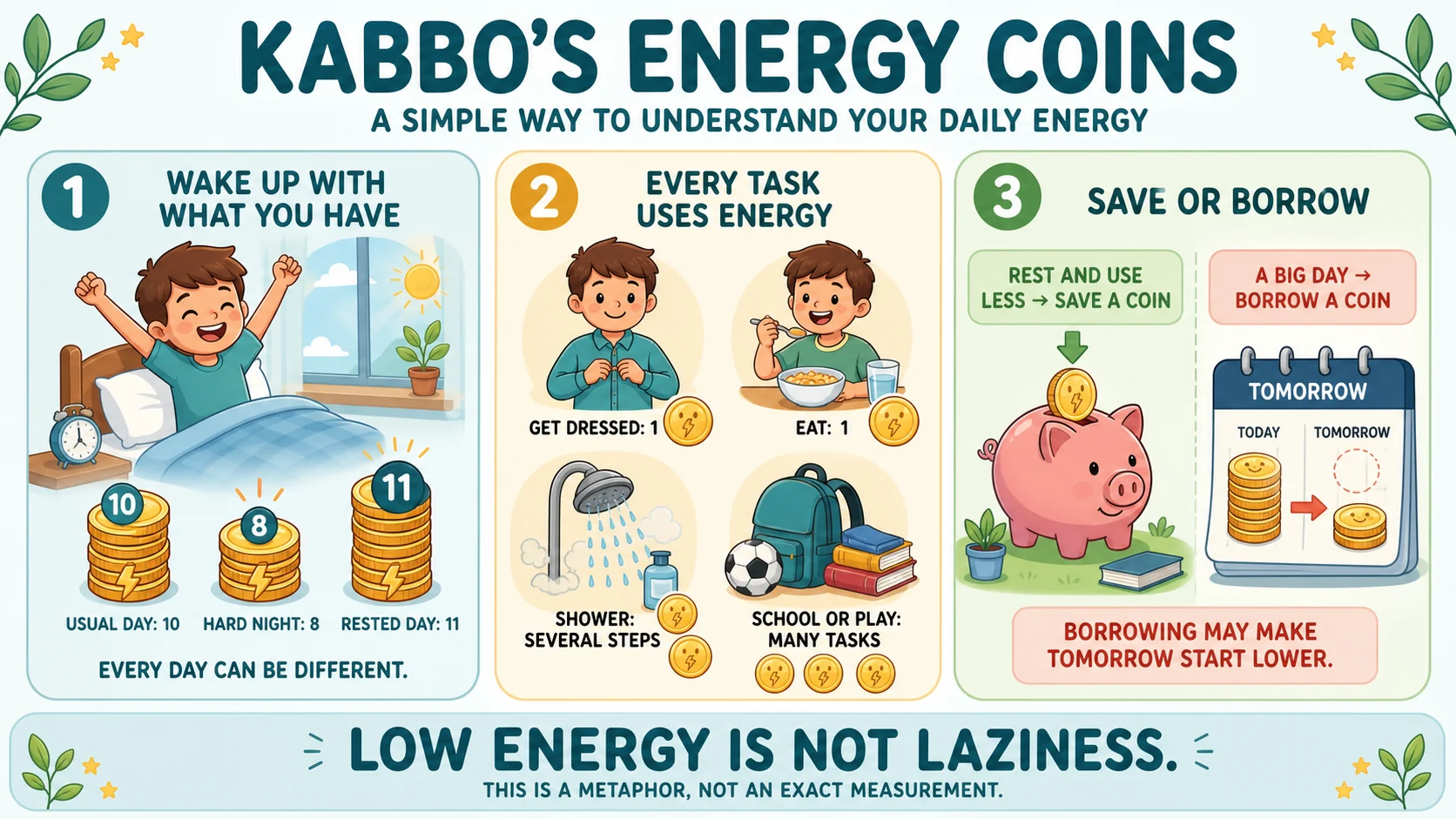
Kabbo talks about waking up every morning with a certain amount of energy.
Let’s say you normally wake up with ten energy. Every individual thing you have to do costs one energy. Getting dressed costs one. Eating breakfast costs one. Going to school or work costs one. Taking a shower costs one—or perhaps several, depending on how many separate tasks your brain thinks a shower contains or what your brain considers one task.
Simple enough, right? One task = one energy.
But you do not necessarily wake up with the same amount every morning. Some days you have a little more energy, and some days you have less. It depends on how well you slept, how stressed you are, whether you are sick, and what happened the day before.
Maybe your usual amount is ten, but you wake up with eight because you had a terrible night’s sleep. Maybe you wake up with eleven because you had a nice massage, slept well, and actually relaxed the day before. On average, though, your energy regeneration remains more or less the same.
Someone who generally wakes up with around ten energy will not usually wake up with only two unless something significant has happened—illness, crisis, prolonged stress, or severe exhaustion. In the same way, someone whose usual amount is six will not suddenly begin waking up with ten every day simply because other people expect them to. That six is not laziness. It is their actual available energy.
What Kabbo’s model looks like
Use the buttons to see how sleep, saving, borrowing, and repeated overload affect the following days.
Saving energy for later
According to Kabbo, sometimes you can save an energy.
If you wake up with ten energy but only use nine, perhaps that extra one remains available for later. It becomes a small reserve—something you can use on another task or carry into the next day.
That explains why rest is not necessarily “doing nothing.” Sometimes rest is how you stop yourself from spending the last energy you have. It may even allow you to save something for tomorrow.
Borrowing from tomorrow
The model also works the other way: you can borrow energy from the future.
Suppose you wake up with ten energy, but there is a special event that requires twelve. Maybe it is a party, a family gathering, a school event, an appointment, or something else you cannot avoid. You can still do it. You can use twelve energy today.
But the extra two do not appear from nowhere. You borrowed them from tomorrow. So instead of waking up with your usual ten the next morning, you may wake up with eight. That day, you will need more rest or fewer tasks because part of its energy has already been spent.
We do this all the time. We stay up late to finish something. We push ourselves through an event. We socialize long after we have stopped having the energy for it. We tell ourselves, “I’ll rest tomorrow.” And sometimes that works—if tomorrow is actually allowed to be a day of rest. The problem begins when tomorrow arrives and expects just as much from us as yesterday did.
Kabbo’s theory and Spoon Theory
When Kabbo explained this, I realized that his theory is extremely similar to—actually, almost exactly like—Spoon Theory.
Writer Christine Miserandino originally used spoons to explain what it was like to live with lupus. Each spoon represented a limited unit of energy, and every daily activity required giving one or more away. The point was that people living with chronic illness often have to consciously budget energy for tasks other people can do without thinking about the cost. The concept has since become widely used to describe limited and unpredictable energy.
Kabbo uses energy instead of spoons, but the core idea is the same:
- You have a limited amount.
- Every task has a cost.
- Your starting amount can change.
- And spending more than you have comes with consequences.
So where does burnout fit?
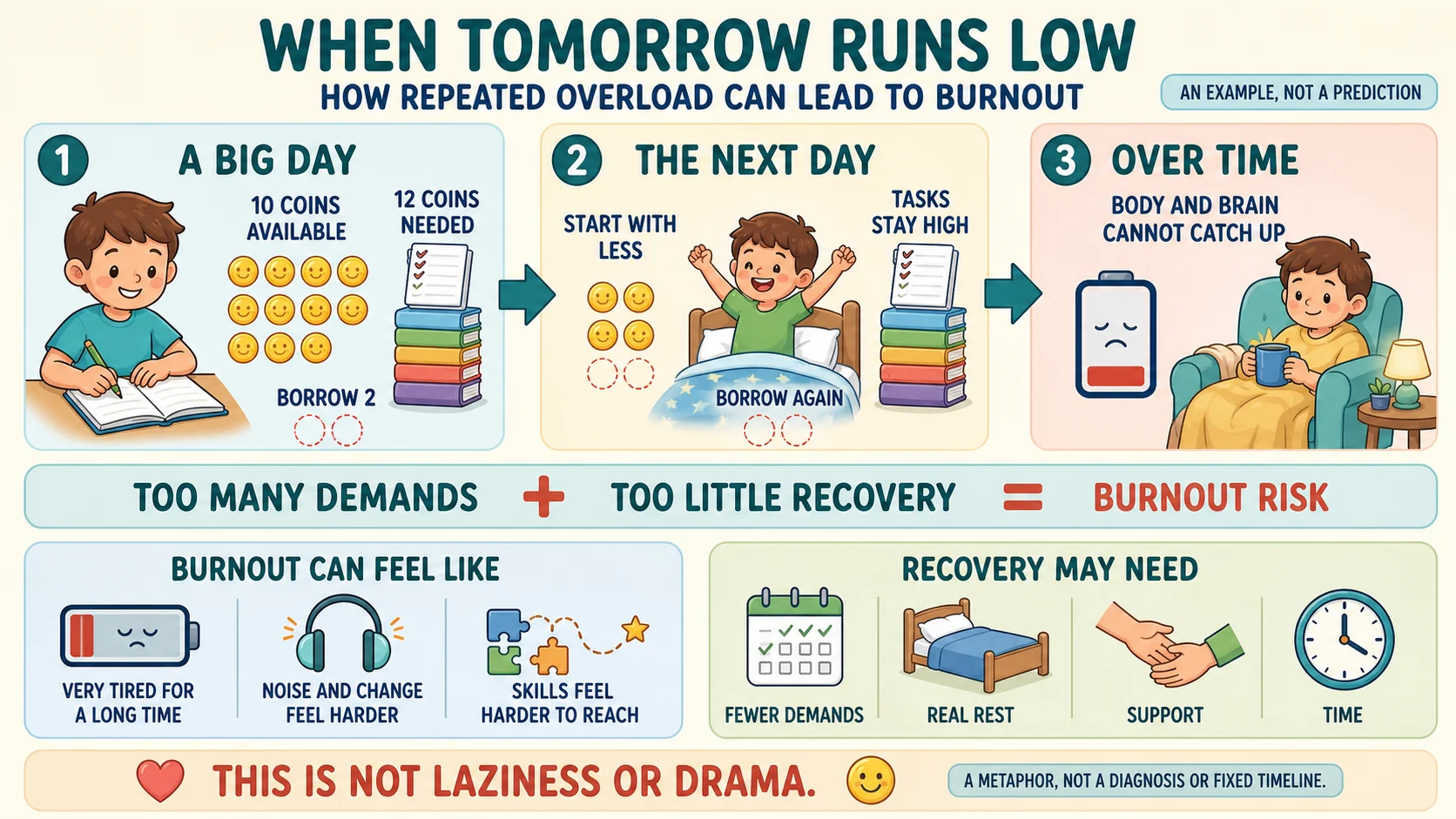
Being tired is reaching zero at the end of one day. Burnout is repeatedly reaching zero, continuing anyway, and borrowing from a future that is running out of energy to lend you.
Imagine waking up on Monday with ten energy while your day requires twelve. You borrow two from Tuesday. On Tuesday, you wake up with eight—but the day still demands eleven. Now you borrow three more. Wednesday begins with even less energy, but the number of tasks has not changed. You keep borrowing because there is work, school, parenting, cleaning, appointments, sensory overload, social expectations, and all the small tasks no one else counts as tasks.
Eventually, you are no longer borrowing one or two energy for a special occasion. You are operating in a constant deficit. That is when the system starts to collapse.
Tasks you could previously do may become extremely difficult. Your tolerance for noise, people, decisions, and unexpected changes may become much lower. Resting for one night may no longer restore your usual amount.
Research describes autistic burnout as prolonged exhaustion, reduced tolerance for sensory input, and a loss of previously available skills or functioning. It can happen when life’s demands repeatedly exceed someone’s abilities without enough support or relief. That makes Kabbo’s energy debt a useful metaphor, even though it is not a literal medical calculation.
Burnout does not mean that someone’s energy permanently becomes two. It also does not mean that eight days of rest will automatically restore eight missing energy. Bodies are unfortunately not that mathematically convenient.
Recovery can be slow and uneven. It may require reducing demands, getting genuine support, resting without guilt, changing expectations, and no longer performing “normal” at a cost the person cannot sustain. In Kabbo’s language, burnout is what happens when tomorrow is already bankrupt.
Why this model matters
What I like about Kabbo’s theory is that it removes morality from energy.
Having six energy instead of ten does not make someone lazy. Needing two energy for a task that costs someone else one does not make them dramatic. Refusing a task because you know you cannot afford it does not mean you are not trying. And completing everything today does not always mean you managed your energy well. Sometimes it only means you stole enough energy from tomorrow to make today look successful.
It seemed a little convoluted when I started writing it at 11:43 p.m. But I assure you, it makes sense. Actually, the more I think about it, the more I wonder whether the rest of us have been making energy unnecessarily complicated.
Kabbo’s version is simple:
- You wake up with what you have.
- Everything costs something.
- You can occasionally save.
- You can occasionally borrow.
- But if you keep borrowing from tomorrow, eventually tomorrow will have nothing left to give.
Today
10
available: 10needed: 10
Tomorrow
10
available: 10needed: 10
Next day
10
available: 10needed: 10