What Actually Is “20/20 Vision”?
A six-year-old’s question sent me down a rabbit hole about what the two numbers measure—and what 20/20 vision does not tell us.
Four visual explanations
What the numbers mean
Use the arrows, numbered buttons, keyboard arrow keys, or swipe to compare 20/20, 20/40, 20/15, and the other parts of vision an eye chart does not measure.
1 / 420/20: normal distance visual acuity
“20/20 vision.” It is one of those phrases I have heard and used my entire life without ever really thinking about what the numbers mean. I knew 20/20 = good eyesight. That was pretty much the extent of my knowledge.
Then my six-year-old asked me what 20/20 actually means. And I realized I had absolutely no idea.
I am not an eye professional. I am not even sure what the correct word for an eye professional is without stopping to think about whether I mean an optometrist or an ophthalmologist. I am also very, very far removed from biological sciences. So naturally, when my child asked a simple question, I went down a rabbit hole until I understood it well enough to explain it to him.
This happens a lot in our house. My son wants to understand everything. And I’ve found that simply explaining something verbally isn’t always the best way to get a new concept through to him. He loves visual information. Cells at Work! was a particularly successful example—the anime turned cells and the immune system into characters with jobs and stories, and suddenly something enormously complicated had a structure he could follow.
So lately, when he asks me about something unfamiliar, I’ve been trying to turn the answer into something he can see.
And 20/20 vision is actually surprisingly easy to visualize once you understand what those two 20s are doing.
First: 20/20 does NOT mean “perfect eyes”
This was probably my biggest misconception.
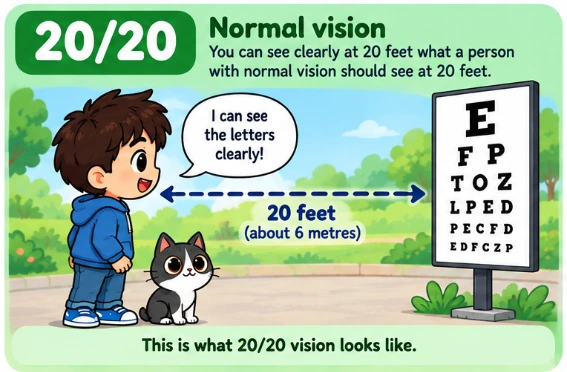
Having 20/20 vision doesn’t mean your eyes are perfect. It means you have what is considered normal distance visual acuity—essentially, normal sharpness or clarity of vision at the testing distance. The American Optometric Association makes this distinction directly: 20/20 describes distance clarity, not every aspect of vision.
Think about an eye chart. You stand a certain distance away and try to read progressively smaller letters. A traditional Snellen visual-acuity test uses a distance of 20 feet, or roughly 6 metres. (MedlinePlus)
That is where the first 20 comes from.
The easiest way I found to explain it to a six-year-old
Imagine Numberblock One is standing 20 feet away from a sign. The sign has a tiny Numberblock on it.
A person with standard vision should be able to recognize that Numberblock from 20 feet away. If my son can also recognize it while standing 20 feet away: 20/20.
That is really it.
The top number tells us: “How far away are YOU?”
The bottom number basically tells us: “How far away could someone with standard vision be and still see this same detail?”
With 20/20 acuity, you can see at 20 feet what should normally be visible at 20 feet. (American Optometric Association)
And suddenly those mysterious numbers make considerably more sense.
So what is 20/40?
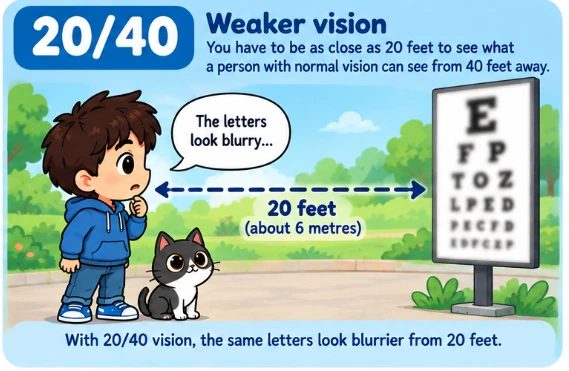
Back to our imaginary Numberblock sign. My son is standing 20 feet away. But this time the picture is blurry.
He can only make it out from 20 feet away even though someone with standard visual acuity could make out that same detail from 40 feet away.
That is 20/40 vision.
So when the bottom number gets bigger, the measured distance acuity is poorer. A person with 20/40 acuity needs to be at 20 feet to resolve detail that someone with standard acuity could resolve at 40 feet. (American Optometric Association)
And 20/15?
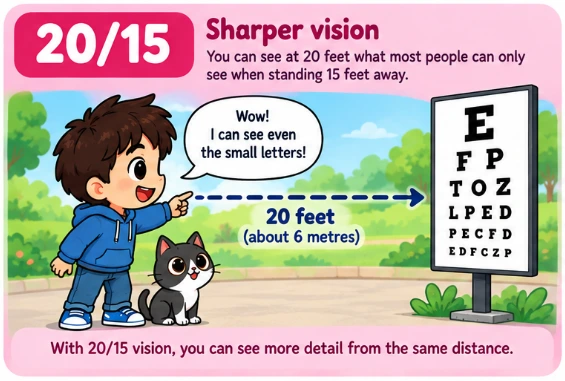
Now we reverse it. My son stands at 20 feet and can identify something that a person with standard vision would normally need to move to 15 feet to see as clearly.
That is 20/15. His distance visual acuity is sharper than 20/20. Plenty of people can have distance acuity better than 20/20. (Cleveland Clinic; College of Optometrists)
For a child, I would reduce the whole thing to:
20/20: I can see it from the normal spot.
20/40: I need to be closer.
20/15: I can see tiny details from farther away.
Not a technically complete definition, obviously, but enough to make the idea click before introducing the actual numbers.
But here is the part I found particularly interesting: 20/20 doesn’t test everything your eyes do
This was the other thing I hadn’t really appreciated.
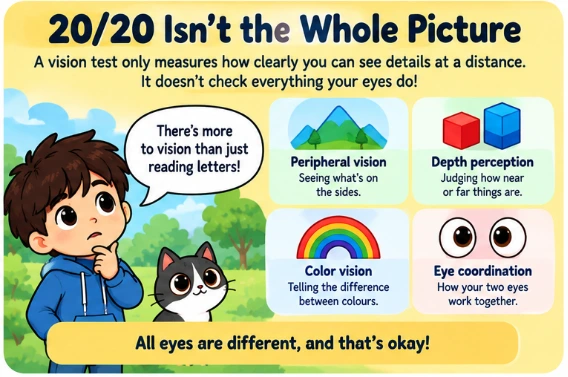
That familiar eye chart is testing how clearly you can distinguish detail at a distance. It isn’t giving your entire visual system a score. Someone can have 20/20 distance acuity and still have problems with other aspects of vision.
A comprehensive eye examination can separately evaluate things such as peripheral vision, depth perception, colour vision, focusing, and how the eyes work together. (American Optometric Association)
That gave me another way to explain it to my son.
Imagine your eyes are a team of superheroes. One superhero’s power is:
“I CAN SEE TINY THINGS FAR AWAY!”
That is the power the 20/20 test is checking.
But the team has other powers. One helps you notice something approaching from the side without turning your head. One helps you judge whether something is near or far away. One helps distinguish colours. And your two eyes have to cooperate so your brain can make sense of what both of them are seeing.
Getting an A+ from Captain See-Tiny-Things-Far-Away doesn’t automatically mean every other member of the team gets an A+ too.
That is why saying someone has “20/20 vision” is useful—but saying they have perfect eyesight goes much further than the measurement actually tells us. The AOA notes that even a child who sees clearly at 20/20 can still have difficulty with focusing, tracking, or eye coordination. (AOA school-aged vision guidance)
And apparently 20 feet isn’t sacred either
This was my final little huh, I didn’t know that discovery.
The concept doesn’t actually depend on America and its insistence on measuring things in feet. The same acuity can be written as 6/6 when testing and recording the distance in metres. Twenty feet is approximately six metres, so 20/20 and 6/6 describe the same standard distance acuity. (MedlinePlus; College of Optometrists)
Which means after all that research, the grand mystery behind “20/20” turned out to be considerably less mysterious than I had imagined.
It is essentially a comparison:
You at 20 feet / standard vision at 20 feet.
And I love questions like this from my son because they expose how many things I “know” without actually knowing them. I knew 20/20 meant good vision. He wanted to know why.
Turns out, those are two very different levels of knowing.
This is a plain-language explanation, not an eye examination or diagnosis. If you are concerned about your child’s vision, an optometrist or ophthalmologist can assess more than distance acuity alone.