Stretching for When You’re No Longer 20
One missed night of stretching, one very angry sciatic nerve, and the small, boring movements that keep my body functional.
Health note: This is my personal experience, not medical advice. Sciatic pain can have different causes, and exercises are not suitable for everyone. If movement worsens your symptoms, causes new pain, or makes you feel unwell, stop and seek advice from a qualified healthcare professional.
Yesterday I felt feverish and so tired that my entire daily routine went out the window. I was stuck to the couch all day and then the bed all night. No TV, no phone, no music, no audiobook. Just me, my body, and full system shutdown.
Thankfully, my husband, my brother, and my brother’s wife took care of my son so completely that I did not have to worry at all. My sister-in-law even kept track of his hydration. Honestly, great to have family.
But this morning, I woke up with horrible pain in my back and thighs, and my sciatic nerve was absolutely not in a forgiving mood. It was like my body had sent a formal complaint: you skipped your stretches, now suffer.
I told my husband my body was killing me because I did not do my simple stretches last night. He very casually said, “Then do them now.”
Why had I not thought of that?
Seriously, the amount of obvious solutions my brain can refuse to access sometimes is impressive.
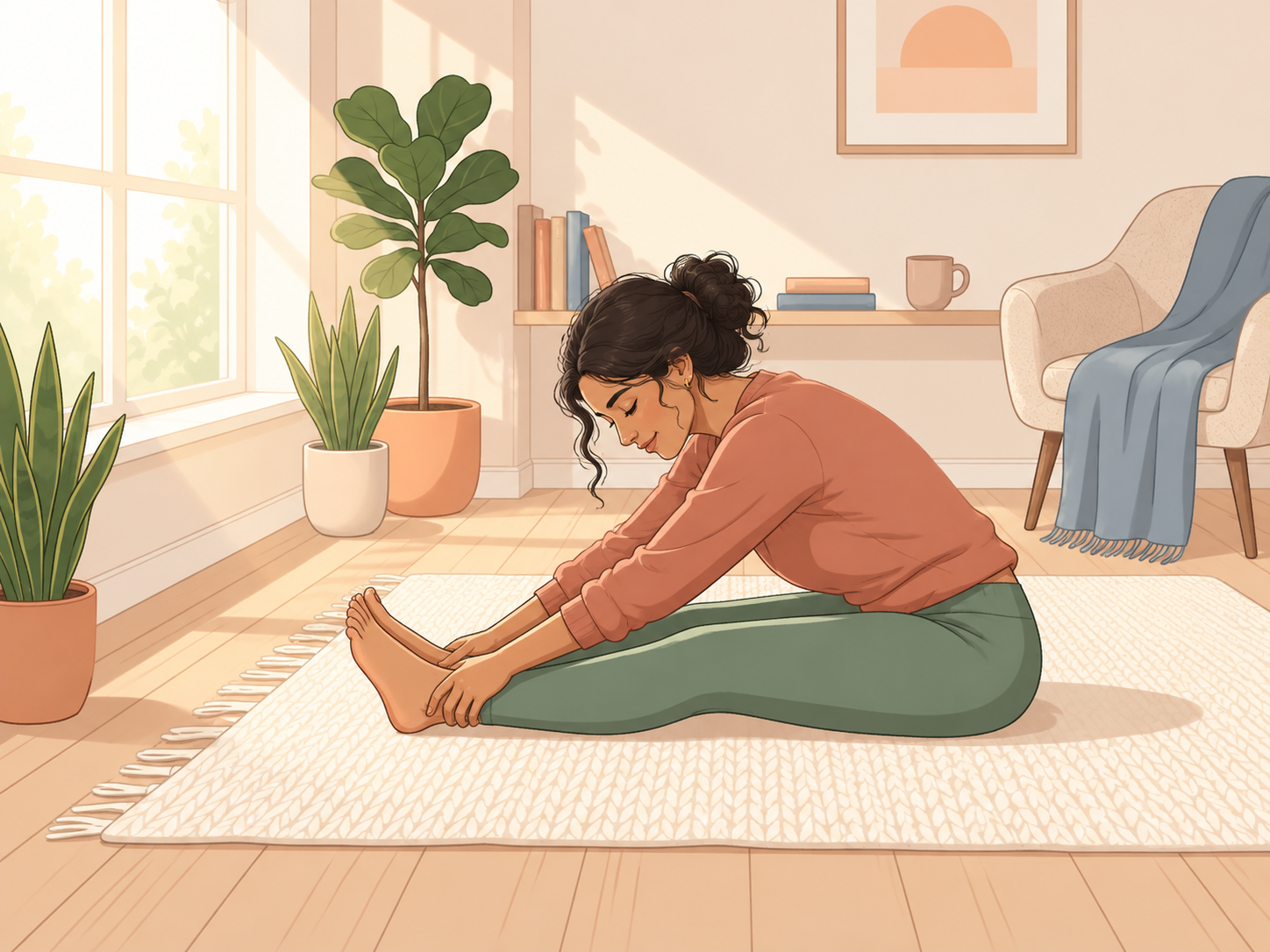
So I got on the floor and did the handful of movements I usually do. Nothing dramatic. No weightlifting. No running. No cycling. No “beast mode.” Just small, boring, gentle movements that apparently keep my body from becoming a haunted chair.
This is what I did:
- Straight leg raises — I lay flat on the floor, kept one leg down, and raised the other leg up 10 times. Then I switched legs.
- Side clamshells — I lay on my side, folded my knees, and opened and closed the top leg like a butterfly wing. Then I repeated on the other side.
- Side leg raises — Still lying sideways, legs straight, I lifted the top leg as high as I comfortably could, 10 times per side.
- Glute bridges — I lay on my back, knees bent, and raised my hips 10 times while keeping my upper back on the floor.
- Piriformis stretch — I held it for a count of 10, then repeated on the other side.
- My “flipped U” stretch — I do not know if this is the official name. It is probably not. But I know what I mean, my body knows what I mean, and we held it for 10 counts.
That was it. That is all it took to make the horrifying pain calm down enough for me to continue my day. It did not vanish completely, but it eased. And sometimes that is the whole victory: not perfect, just functional.
This is also why I keep coming back to stretching. Sciatic pain is not something I can bully out of my body with motivation quotes. But gentle movement matters. Mayo Clinic notes that while resting for a day or so may provide relief, staying inactive can make sciatica symptoms worse, and gentle low-back stretching may provide some relief. Cleveland Clinic also lists gentle movement and stretching among the self-care options that may help relieve pressure on the sciatic nerve.
The important word is gentle. I am not trying to prove anything to the floor. NHS guidance on back exercises says stretches should feel like a gentle stretch, not soreness or discomfort, and that you should stop if exercises worsen symptoms or cause new pain.
And that is what I am trying to learn: maintenance does not have to look impressive. Sometimes taking care of my body is not a full workout set with matching clothes and heroic music. Sometimes it is me on the floor in whatever I slept in, doing 10 leg raises because apparently my spine has terms and conditions.
There is another layer to this too.
I grew up being told that being muscular was not feminine. That if I did exercises or built strength, I would look like a man. Every time I did anything that might give me muscles, that warning was there. It was said to me decades ago, but it stuck. Of course it did. These things stick like cheap glue and generational nonsense.
So even now, part of me is still fighting that old brainwashing.
But the older I get, the more I understand that strength is not about looking masculine or feminine. Strength is being able to get off the floor. Strength is carrying groceries. Strength is supporting your spine. Strength is keeping your hips, back, and legs from declaring independence every time you miss one night of stretching.
My body does not need me to be ornamental. It needs me to be functional.
So yes, I stretch. Not because I am trying to become a gym person. Not because I suddenly love exercise. I still do not understand running and going nowhere. But these tiny stretches? They help. They keep the pain from taking over. They remind me that my body needs care before it starts screaming.
And every time I choose that care, I am also quietly arguing with a 30-year-old lie.
Muscle is not unfeminine.
Movement is not vanity.
Stretching is not small.
Sometimes it is the difference between being stuck in pain and being able to live your day.