Live with the pattern · protect your nervous system · seek care when it changes
A Lifetime of Living With Migraine
A personal account of growing up with migraine, finally finding preventive care, and building a practical toolkit for light, sound, nausea, and daily life.
- Published
- Last reviewed
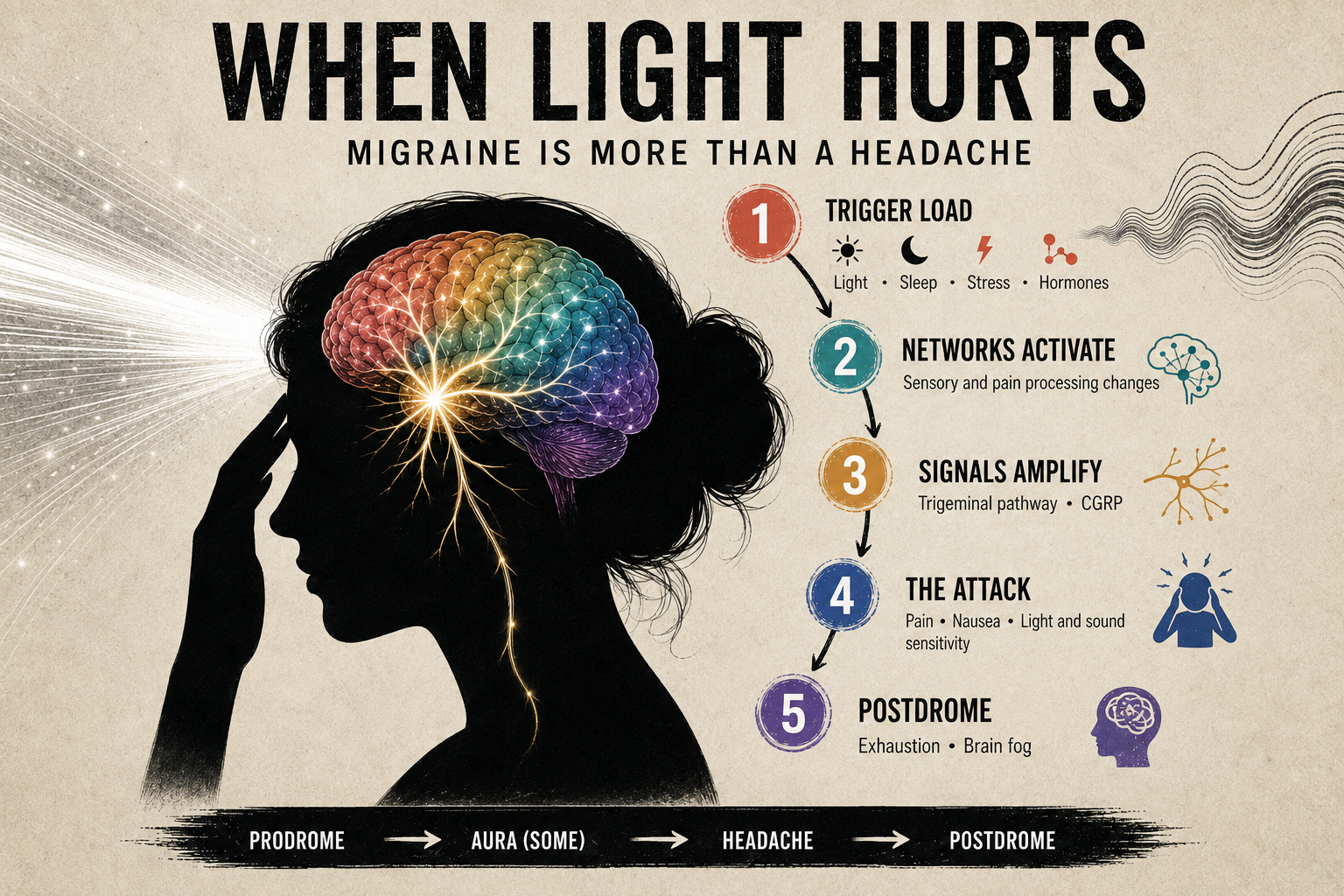
I have suffered from migraines from a very early age. My first vivid memory of one takes me back to boarding school in Kurseong, Darjeeling.
Back then, I did not know the word migraine. I could only say that I had a terrible headache. Thinking it might be a vision problem, my dad took me to an eye doctor and got me glasses, perhaps hoping they would solve it.
They did not.
Even worse, I often forgot to wear those glasses. That earned me harsh punishments, including being slapped ten times in a row. Ironically, the punishment for forgetting the thing that was supposed to cure my headaches only gave me more headaches—but that is a story for another time.
As I grew older, I quietly developed ways to avoid the things that made the pain worse. I preferred staying indoors. When I had to be outside, I kept my eyes closed whenever I could. When that was not possible, I learned to squint against the light.
Eventually, I adjusted.
Not because the migraines disappeared, but because I learned to live with the constant possibility of pain. At the time, I did not think of these things as accommodations or symptom management. I thought I was simply being difficult about sunlight.
Then I Got Pregnant
The migraines became significantly worse during my second trimester of pregnancy with Kabbo.
The pain became so intense that it made me throw up. I could not keep my eyes open. I could not tolerate light, and even ordinary sounds became unbearable. I spent entire days inside a blacked-out bedroom, relying on the quiet sound of an audiobook to keep me company.
Even then, the volume had to stay below a very specific threshold. One level too high, and the sound that had been comforting a second ago became another source of pain.
During that period, I was prescribed Gravol, mostly so I could sleep through the worst of the nausea and pain. Gravol contains dimenhydrinate, an anti-nausea medication that can cause significant drowsiness. It did not treat the migraine itself. It simply helped me survive the attack by sleeping through part of it.
Knowing what I know now, I also want to say this clearly: a new, severe, or dramatically worsening headache during pregnancy should not automatically be dismissed as hormones or migraine. Persistent severe headaches—especially with vision changes, swelling, high blood pressure, upper abdominal pain, confusion, or neurological symptoms—can be warning signs of conditions such as preeclampsia and need prompt medical assessment. The American College of Obstetricians and Gynecologists explains the warning signs here.
What Is a Migraine, Anyway?
A migraine is not simply a very bad headache. It is a complex neurological disease that changes how the brain processes pain and sensory information.
The pain may throb or pulse and may affect one side of the head, both sides, or move around. An attack can also involve nausea, vomiting, exhaustion, brain fog, dizziness, and extreme sensitivity to light, sound, smell, or movement. Some people experience migraine symptoms without significant head pain at all. The National Institute of Neurological Disorders and Stroke describes migraine and its phases in more detail.
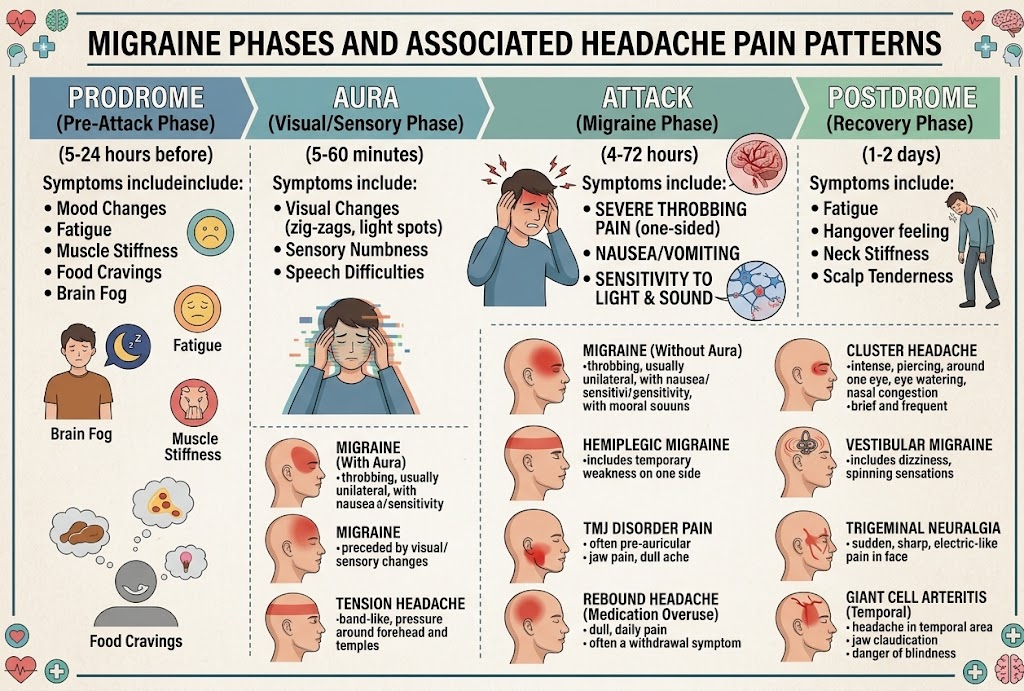
A migraine attack may move through four phases:
Prodrome → Aura for some people → Headache → Postdrome
Not everyone experiences every phase. Many people never have an aura. Some notice fatigue, neck stiffness, food cravings, mood changes, or excessive yawning hours before the pain begins. Others receive no recognizable warning at all.
The important thing is that the nervous system is not being dramatic. It is not “just sensitivity.” During an attack, ordinary light can hurt. Normal sound can hurt. Movement can hurt. Even thinking can feel like work.
When I hid inside a dark room, I was not avoiding life because I was lazy. Darkness was symptom management.
Why Does It Happen?
There is no single, neat answer.
Migraine appears to involve a combination of genetic susceptibility, brain chemistry, sensory processing, and environmental or bodily factors. Hormonal changes can influence migraine, which may have contributed to what happened during my pregnancy, but hormones are only one possible piece of the puzzle.
Commonly reported triggers include:
- Bright or flickering light
- Changes in sleep
- Stress—or the sudden release of stress
- Hormonal changes
- Dehydration
- Skipped meals
- Certain sounds or smells
- Weather changes
- Long periods of screen use
But triggers are not perfectly predictable. Something may trigger an attack one day and cause no problem the next. Sometimes several smaller triggers pile up until the nervous system crosses its threshold. Sometimes an attack happens without any obvious explanation.
That unpredictability is part of what makes migraine so exhausting. You are not only dealing with pain. You are constantly trying to calculate what your brain might tolerate today.
Finally, Someone Listened
After Kabbo was born, I continued hiding in the dark whenever I could. This became especially difficult because my job required me to spend hours looking at a computer screen. When a migraine arrived, I could barely open my eyes long enough to see what was on the screen, let alone work.
I brought it up with doctors again and again. Eventually, one of them truly listened and prescribed propranolol.
Propranolol is a beta-blocker that can be used to help prevent migraine attacks. It is not designed to stop an attack that has already begun, and it can take several weeks to make a noticeable difference. The NHS provides a useful explanation of propranolol for migraine prevention.
I still take my prescribed dose—10 mg, three times a day.
That is my dose, based on my health and my doctor’s instructions. It is not a recommendation for anyone else. Propranolol affects heart rate and blood pressure, may not be suitable for everyone, and should not be started, changed, or stopped suddenly without medical guidance.
It is also important to clarify something I misunderstood for a long time: propranolol is preventive, but that does not mean nothing can be done after an attack begins. Acute migraine treatments exist. The right rescue medication depends on the person, their health, other medications, pregnancy status, and the type and frequency of their attacks.
The Toolkit I Built One Attack at a Time
In my desperate search for ways to manage this painful, infuriating condition, I have built an entire migraine toolkit.
None of these things is a cure. Some help prevent attacks. Some reduce triggers. Some simply make the pain easier to endure. But when you live with migraine, “easier to endure” is not a small thing.
Propranolol
This is the preventive foundation of my routine. I take it consistently as prescribed to reduce the likelihood of an attack. I do not treat it as rescue medicine after the pain has already started.
Oakley Clifden Polarized Glasses
I use Oakley Clifden sunglasses with Prizm Deep Water Polarized lenses.
They were designed for high-light environments and have removable side shields and a bridge blocker that help block glare and reduce the amount of light reaching my eyes from different directions. The polarized lenses also cut glare from reflective surfaces such as roads, water, and snow.
They do not treat migraine, but they make it possible for me to spend time outdoors without feeling completely attacked by the light.
That distinction matters. These glasses are not a cure. They are an accommodation—one that lets me participate in ordinary life without paying quite as heavily for it afterward.
The American Migraine Foundation notes that sunglasses and tinted lenses can be useful tools for people experiencing migraine-related light sensitivity. Photophobia is reported by the vast majority of people with migraine.
Room-Darkening Curtains
Room-darkening curtains give me control over the light in at least one part of the house. During an attack, that room becomes my safe place.
This may sound excessive to someone who has never felt physical pain from ordinary daylight. To me, it is basic infrastructure.
The American Migraine Foundation includes blackout curtains among the practical strategies that may help manage light sensitivity at home. Its guide also discusses cold compresses, hydration, and reducing glare.
Cold Compresses and a Migraine Relief Cap
Cold has always been one of the fastest ways for me to make the pain feel slightly less violent. I use cold compresses, gel headbands, and a reusable migraine relief cap that surrounds the head with cooling pressure and can also cover the eyes.
The cap does not magically end an attack. It gives me cold, pressure, and darkness without requiring me to hold an ice pack against my head for an hour. That matters when even lifting an arm feels like too much work.
Shokz Clip-On Earphones
During an attack, complete silence can feel lonely, but regular in-ear headphones can create pressure and ear pain that make everything worse. I use Shokz OpenDots ONE, which clip onto the outer ear instead of sitting inside the ear canal.
They are not a migraine treatment. They simply allow me to listen to an audiobook without the uncomfortable plugged-ear sensation that ordinary earbuds can create.
I still keep the volume extremely low because open-ear does not mean sound cannot hurt.
Gravol
During pregnancy, my doctor prescribed Gravol to help with nausea and to let me sleep through some of the worst attacks. Its active ingredient, dimenhydrinate, treats nausea and vomiting and commonly causes drowsiness.
It was a survival tool, not a migraine cure. Anyone who is pregnant, breastfeeding, taking other sedating medications, or considering frequent use should speak with a doctor or pharmacist rather than copying what was prescribed to me.
Acupuncture
I have also tried acupuncture. The evidence is not absolute, but research suggests that it may modestly reduce migraine frequency for some people. It should be performed by a properly trained practitioner using sterile, single-use needles. The U.S. National Center for Complementary and Integrative Health summarizes the evidence and safety considerations.
The Small Daily Bureaucracy of Staying Okay
Today, with these preventive measures and accommodations in place, I am generally okay.
But okay does not mean cured.
My okay is held together by a small daily bureaucracy: medication, curtains, glasses, carefully controlled volume, cold caps, sleep, food, water, and knowing when to stop before my body stops me.
To another person, these things may look like an unnecessarily complicated collection of habits and products. To me, they are the infrastructure that lets me function.
If I miss even one important part of the routine—if the light is too bright, the sound is too loud, my sleep is disrupted, or I push myself beyond what my nervous system can manage—a migraine is always waiting to say a big old “hi.”
I did not outgrow migraine.
I finally learned its language, and then I built a life that listens.
Product note: I am not sponsored by any of the companies mentioned here. These links identify the products or types of tools I have personally used. What helps me may not help everyone, and personal comfort tools are not substitutes for diagnosis or medical treatment.