The FrouFrou “Son”
Unlearning the need to be things.
When I started this project, I told myself I would write one piece a day.
That isn’t much, right?
And yet, I failed on Day 2.
The pressure I felt simply because I had set this goal for myself was unbearable. No one else knew about it. No one else saw me fail. Still, the disappointment I felt when I fell asleep and couldn’t stay awake to write became enormous inside my head.
So I woke up early the next morning, sat beside my sleeping son, and started typing on my phone.
He is a light sleeper, and the sound of a keyboard would wake him. During those brief moments when his eyes open in the morning, he also needs to see me beside him. If I’m not there, he wakes up fully and comes looking for me.
My priority was to keep him asleep while still trying to accomplish what I had set out to do.
Sitting there quietly beside him, I thought about the way he experiences enormous emotions over things that appear small to everyone else. Not being able to return to a video he was watching. Not being able to draw the perfect line.
In those moments, his feelings are huge.
People around us don’t understand what the big deal is. But I have always understood that part of him. His feelings are like mine: big, difficult to explain, and overwhelming. The why and the how behind them are not always available to either of us.
But understanding his feelings does not mean I always know how to support him.
I don’t.
I am still fumbling my way through it, adding my own disappointment and cascading emotions to failures I never expected from myself.
Where did this expectation of perfection come from?
Mine came, at least partly, from my parents. They gave me the “killer eyes” whenever I did something they considered out of line or inappropriate.
But where did my child learn it?
Do I unknowingly do the same thing to him? Maybe I don’t give him the exact killer eyes, but does he still feel the heavy weight of my expectations?
To be honest, I don’t know.
Maybe that is why psychology fascinates me so much. I want to understand what exists underneath our behavior—what is inherited, what is learned, and what we pass on without realizing it.
Sometimes I think that if I had been given the opportunity to study psychology, I might have done something better with my life. Maybe I wouldn’t feel like such a failure as an engineer or scientist.
I recognize the self-deprecation the moment the thought enters my mind, but sometimes I can’t stop it.
I spent most of my life fighting the idea that I was incapable. To prove otherwise, I chose the hardest subject I could imagine—physics—and stuck with it. I earned my bachelor’s degree in physics, completed a master’s degree in engineering, and became a machine-learning engineer.
Then I discovered that I didn’t really like it.
Maybe I did not choose my path as freely as I once believed.
My parents taught me that being feminine was inherently bad. If I had not grown up with that idea, perhaps I would have felt safe choosing my own subject and my own path.
When we were children, my father burned all our dolls because they were “useless.”
My mother once found a recording of me speaking in different voices, pretending to have a conversation between two women. She made fun of me for it.
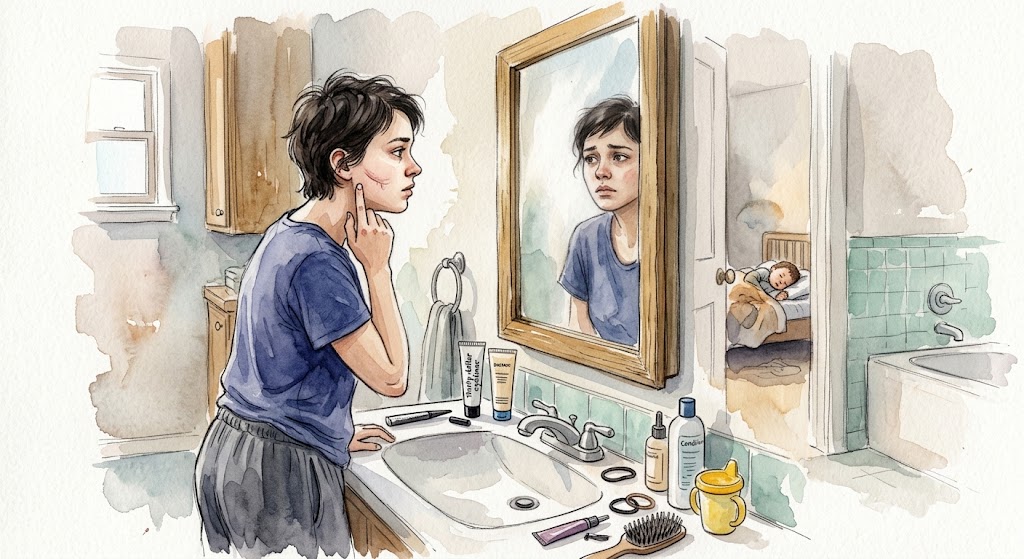
Whenever she thought we were spending too much time looking in the mirror, she grabbed our hair and roughly chopped it off.
Even now, we are taunted and shamed for any amount of self-care—whether it is using conditioner or plucking our eyebrows.
Growing up in that environment conditions you to avoid anything considered feminine.
It creates a deep fear of being ridiculed for standing in front of a mirror a little too long. It teaches you not to grow long, flowing hair because someone else might decide they have the right to chop it off.
Boy, I have issues, don’t I?
My mother constantly told people—in front of us—that her daughters were her “sons,” as though being a daughter were something shameful.
So we worked hard to become son-like.
Meanwhile, our internal daughters remained trapped somewhere deep inside us. They are parts of ourselves we are still trying to find.
These survival mechanisms are now so deeply integrated into my life that when my husband tells me I look pretty, I don’t believe him. I assume he is simply being nice.
When my son says I look nice, I tell myself it is only because he is a gentle child.
He is a gentle child. That part is true.
But it is also true that I am incapable of accepting a compliment. I automatically put myself down, carrying an entire knot of complicated feelings about my appearance and my worth.
I am sure my sisters have similar feelings, but they don’t talk about them. Both of them are tougher than I am.
I am the “frou-frou” one.
Always too emotional. Always the soft one. The fragile one.
For most of my life, I have carried a little shame about that. But now that I am saying it out loud, I have to wonder why.
Why should softness be something to hide?
What is the point of writing all of this?
Am I simply putting my damage on display because I am finally becoming confident in my own voice? Am I learning not to care whether someone considers this too emotional, too feminine, or too “frou-frou”?
Or does this need to have a better point?
Even as I ask that question, I catch myself devaluing my own reason for writing. I am doing it again. I am stuck inside the same loop.
Maybe that is the point.
To catch myself in the act.
To look closely enough to discover something about myself. To understand that my sensitivity is not a failure. It may be the very thing that allows me to recognize what my son is feeling when his world becomes too big.
Maybe the next time my mother looks down on me for spending one minute drawing a line over my eye, I will hold my head up. Maybe I will choose not to carry her judgment inside me. Maybe I will choose grace instead of disappointment.
And perhaps that will help me become a better mother. Perhaps it will help me break the cycle of expectation before I pass all of it on.
Am I naive enough to hope that I can leave my son with no scars?
Probably.
No parent is given that promise.
But perhaps the attempt still matters. If I keep noticing, questioning, apologizing, and repairing, maybe I can leave him with fewer scars.
Maybe I can leave impressions that do not have to become wounds.