Medical Gaslighting that Women Face
A personal account of decades of dismissed pain, the evidence behind medical gaslighting, and practical ways women can question, document, and seek second opinions.
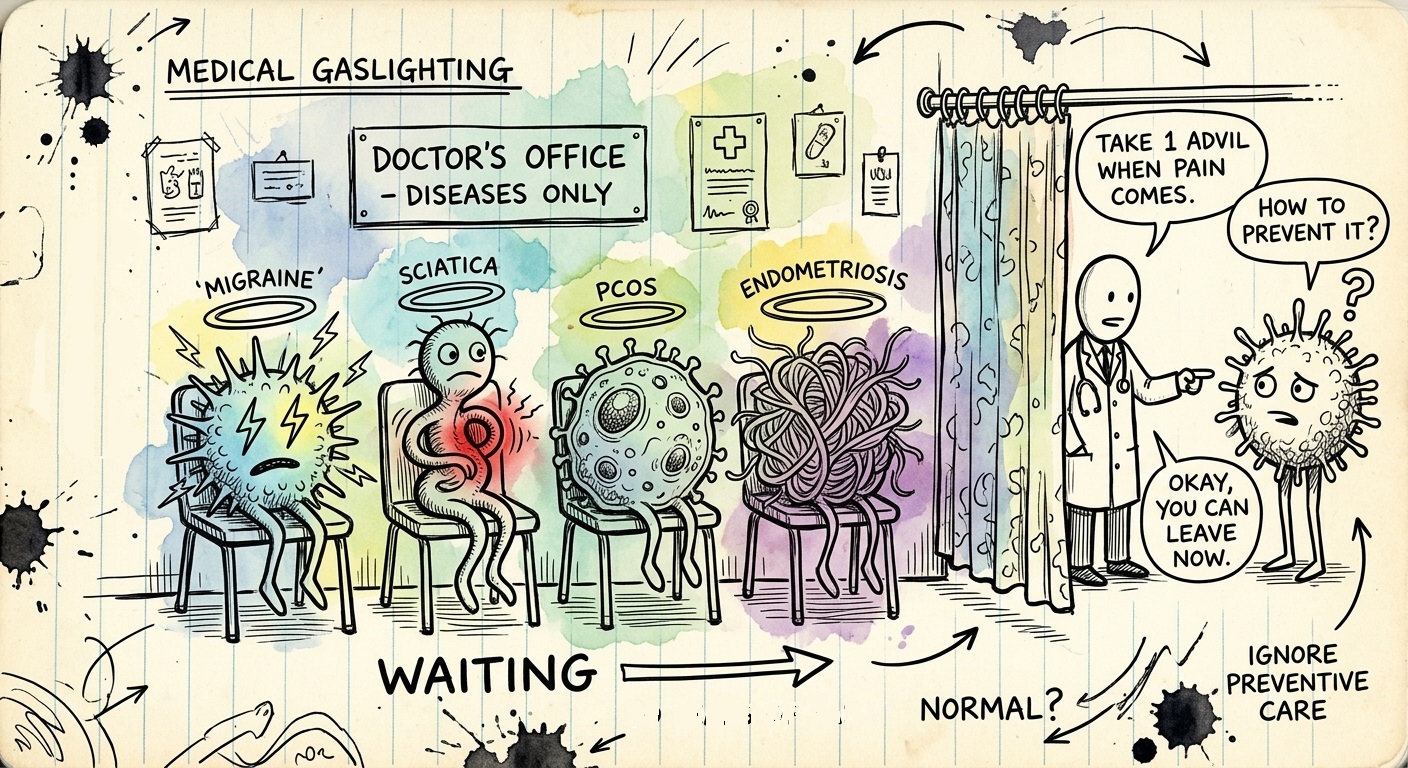
I was six or seven years old when the pain started. It was a sharp, persistent ache running through my back and legs. It made normal childhood things feel impossible, and nights were terrible. But at six years old, I did not have the vocabulary to explain what I was feeling. I did not know the word radiating. I only knew that I hurt.
What followed was a decades-long parade through doctors’ offices. I saw at least ten specialists across neurology, orthopedics, gynecology, and general medicine. At different points, I was prescribed strong medications, including corticosteroids, to quiet the symptoms. Some of those medicines may have been reasonable attempts to help. The problem was that the pain kept returning, nobody could explain why, and eventually my continued suffering was treated as evidence against me.
Several doctors told me I was faking it. My parents came from a generation that treated doctors as unquestionable authorities. So, as doctor after doctor failed to find an explanation, my parents’ anxiety grew. Eventually, they began wondering out loud whether I was lying too.
Imagine being a child in pain and slowly realizing that the adults responsible for protecting you have started debating whether your pain exists.
It took until I was thirty-six—nearly three decades later—to receive an explanation for the sciatic pain and learn a few movement adjustments that transformed my quality of life.
Can you believe that? I had to wait thirty years. Thirty fucking years for something as recognizable as sciatica.
If even one doctor had genuinely listened to me—really talked to me and allowed me to explain—I might not have spent thirty years of my life in pain. I might not have stayed awake night after night crying. I might not have lost entire days to pain that would not leave, no matter what I did. I could not sit comfortably. I could not lie down comfortably. Sometimes I could not find a single position that made existing inside my own body feel bearable.
Thirty years—and then one doctor finally listened. They asked me about the pain and encouraged me to keep talking instead of deciding what the answer was before I had finished the question. Once someone actually heard the whole story, they promptly recognized the sciatica and helped me make changes that improved my life.
So no, I am not saying all doctors are bad. I am saying almost the opposite. It was a doctor—not someone outside medicine—who finally diagnosed me correctly and made my life better. That is exactly why the previous thirty years make me so angry. Medicine could help me. I simply had to find a doctor willing to listen long enough to use it.
Listening is not an optional kindness doctors offer when they have extra time. Listening is an active part of diagnosis. So is asking questions. So is encouraging patients to speak instead of rushing to fit them inside a conclusion that has already been made.
Taboo, judgment, and bias have no place in a doctor’s office. Not when someone’s health—and potentially decades of their life—depends on being heard.
It would almost be easier to accept if this were only my story.
It is not.
How Many Ways Can a Woman Be Told She Is Overreacting?
A woman has severe period pain?
“That is normal. Periods hurt.”
She has pelvic pain, painful sex, or difficulty with penetration?
“Relax. Stop being afraid. Try harder.”
She reports exhaustion, widespread pain, dizziness, migraines, or brain fog?
“It is probably stress.”
She has unexplained weight changes, irregular periods, or excessive hair growth?
“Lose weight first.”
She reports chest pain or breathlessness?
“Are you anxious?”
She struggles with pain after childbirth?
“You had a baby. What did you expect?”
The disease changes. The sentence barely does.
Women with endometriosis, adenomyosis, PCOS, fibroids, vulvodynia, vaginismus, migraine, fibromyalgia, ME/CFS, Long COVID, autoimmune illnesses, chronic musculoskeletal pain, and heart disease have all described some version of the same struggle: before receiving treatment, they must first prove that they are reliable witnesses to what is happening inside their own bodies.
That does not mean every woman with one of these conditions is dismissed. It does not mean every delayed diagnosis is caused by sexism or every doctor is cruel. It means the pattern is large enough that we can no longer keep calling each case an unfortunate misunderstanding.
Research has found that women’s pain is more likely to be judged as exaggerated, emotionally driven, psychosomatic, vague, less credible, less urgent, or less severe—particularly when no visible cause has yet been found. International review of gender bias in musculoskeletal-pain care
One emergency-department study found that female patients with pain complaints were less likely than male patients to receive pain medication, and clinicians were more likely to doubt women’s reports of pain. Study of sex bias in pain-management decisions
This bias is not distributed equally. Race, disability, body size, poverty, gender identity, communication differences, and a history of mental illness can all affect whose pain is considered believable. Research has found particularly severe underestimation of pain among women of colour. Study of intersecting race and gender bias in pain assessment
Some women enter the examination room already carrying a credibility deficit.
This Is Not Only About “Women’s Diseases”
The problem is especially visible in reproductive and gynecological care, but it does not stop there. A recent systematic review of endometriosis research found reported diagnostic times ranging from less than a year to twelve years, depending on the country, population, and definition used. There is no single reliable global average, but substantial delay remains well documented. Systematic review of time to endometriosis diagnosis
In a large international study of women with PCOS, more than one-third reported waiting longer than two years for a diagnosis, and nearly half saw at least three healthcare professionals first. Only a small minority were satisfied with the information they received when finally diagnosed. Study of PCOS diagnostic experiences
The same problem appears outside gynecology. A systematic review of axial spondyloarthritis found longer diagnostic delays among women and noted that the condition had historically been understood through a more typically male presentation. Systematic review of sex bias in axial-spondyloarthritis diagnosis
A recent review of lupus diagnosis also identified being female as a factor associated with longer diagnostic delay. Systematic review of delayed lupus diagnosis and treatment
Patients with migraine, fibromyalgia, ME/CFS, and Long COVID have described having to prove that their symptoms are physical and legitimate rather than products of anxiety, weakness, or imagination. Research on Long COVID, contested illnesses, and medical gaslighting
Even heart disease is not immune. Women presenting with chest pain have been found less likely than men to receive cardiology referrals in some settings, while women’s cardiovascular symptoms remain vulnerable to being mistaken for anxiety or considered less urgent. American Heart Association report on women’s heart health
So no, this is not simply about periods. It is about credibility.
Who is believed immediately? Who must arrive with folders, photographs, spreadsheets, symptom diaries, witnesses, and years of suffering before someone says, “Perhaps we should investigate”? And who gives up before that happens?
When “I Don’t Know” Becomes “Nothing Is Wrong”
Not every medical mistake is gaslighting. Doctors are human. Symptoms overlap, tests have limitations, and some conditions are genuinely difficult to identify. Two competent doctors can look at incomplete evidence and reach different conclusions. A doctor saying, “I do not know yet,” is not gaslighting.
The problem begins when “I cannot explain your pain” becomes “You are not in pain”; when “The test was normal” becomes “You imagined it”; and when “I do not know what this is” becomes “You are dramatic, anxious, attention-seeking, or lying.”
Medical gaslighting is an increasingly used term for the repeated dismissal or distortion of a patient’s symptoms and lived experience in a way that causes the patient to doubt their own perception or judgment. Researchers still debate whether deliberate intent is necessary. Some use the term medical invalidation when the dismissal may not be intentionally manipulative but still leaves the patient confused, ashamed, and unsure whether to trust their own body. Review of medical gaslighting and medical invalidation
I cannot know what every doctor intended. I know what their words did.
They taught me to question myself.
Why Does This Keep Happening?
Is it cultural? Ignorance? A failure of medical education? Sexism? A healthcare system that gives doctors fifteen minutes to solve problems that have existed for fifteen years? Is it because uncertainty frightens both doctors and patients, so “You are anxious” sometimes feels more comfortable than “I do not know”?
The answer is probably all of it.
Women were historically excluded or underrepresented in important areas of clinical research. In the United States, the NIH Revitalization Act of 1993 required women and racial and ethnic minority groups to be included in NIH-funded clinical research unless there was a valid reason for exclusion. That was a major correction, but it did not apply to every clinical trial everywhere or instantly repair decades of missing knowledge. Inclusion alone is not enough; studies must enrol enough women and analyse and report outcomes by sex when relevant. NIH inclusion policy
Then there is culture. In many South Asian families, reproductive health, pelvic pain, sexual dysfunction, and even periods are still discussed through embarrassment—if they are discussed at all. Girls are taught to endure. Women are taught not to make other people uncomfortable. Patients are taught that questioning a doctor is disrespectful.
The doctor speaks. We nod. The doctor dismisses us. We wonder whether we explained it badly. The doctor becomes irritated. We apologize. The doctor says it is normal. We go home and continue hurting.
A Doctor Is Not a God
Doctors possess knowledge most patients do not have. Their education, clinical experience, and evidence-based medicine matter.
But expertise is not infallibility.
A medical degree does not transform an opinion into divine law. A doctor can be skilled and still miss something. They may be working with incomplete evidence. They can be tired, rushed, biased, overly certain, or simply wrong.
Refusing to treat a doctor like a god does not mean rejecting science. It means refusing to surrender your place in decisions about your own body.
A good doctor should be able to explain:
- What diagnosis they suspect.
- What other possibilities they considered.
- Which dangerous causes have been ruled out.
- What has not yet been ruled out.
- Why they recommend a particular test or treatment.
- What the important risks and benefits are.
- What reasonable alternatives exist.
- What may happen if you wait or refuse.
“I do not know” is an honest medical answer.
“You must be imagining it because I do not know” is not.
A Second Opinion Is Not Betrayal
You do not owe loyalty to a diagnosis.
A second opinion may confirm the first doctor’s recommendation, and that confirmation can be valuable. It may also clarify the diagnosis, reveal another treatment option, or identify something that was missed.
Systematic reviews show that second opinions often agree with the first opinion, but a meaningful proportion produce changes in diagnosis or treatment. The numbers vary widely by specialty, setting, and patient group, so a second opinion is not proof that the first doctor was wrong. It is another independent examination of the evidence. Systematic review of patient-initiated second opinions
Consider seeking another opinion when:
- Your symptoms persist or worsen despite treatment.
- Your diagnosis remains uncertain.
- Your symptoms and test results do not seem to match.
- You are being offered major surgery or an irreversible procedure.
- The proposed treatment carries serious risks.
- You have a rare or complicated condition.
- Different specialists give contradictory explanations.
- Your concerns are repeatedly dismissed without a medical explanation.
- You do not understand why a treatment is being recommended.
- You no longer feel able to communicate safely with the doctor.
Neither the first nor the second doctor automatically owns the truth. If their recommendations differ, ask both to explain their reasoning.
A second opinion should give you more information—not simply another authority to obey.
Know What You Can Ask For
Exact patient rights vary by country, province or state, healthcare setting, legal capacity, and whether the situation is an emergency. They are not absolute or identical everywhere.
But patients are not powerless.
You Can Ask Questions
You can ask:
- “What else could cause these symptoms?”
- “If this test is normal, what happens next?”
- “What would make you reconsider this diagnosis?”
- “Why are you recommending this treatment?”
- “What are the alternatives?”
- “What are the risks of waiting?”
- “Can you refer me to someone with more experience in this condition?”
You are entitled to an explanation in language you can understand. You are not required to nod simply because a medical word sounds impressive.
Informed Consent and Refusal
A capable adult generally has the right to receive information about a proposed treatment and decide whether to accept it. Emergencies, incapacity, substitute decision-making, and some public-health laws can create exceptions.
Ontario’s Health Care Consent Act says treatment consent must relate to the treatment, be informed and voluntary, and not be obtained through fraud or misrepresentation. It also recognizes withdrawal of consent. Ontario Health Care Consent Act
US federal hospital rules recognize a patient’s right to participate in care decisions and request or refuse treatment, although that does not create a right to demand medically inappropriate tests or treatments. US Centers for Medicare & Medicaid Services guidance
India’s Charter of Patients’ Rights and Responsibilities includes informed consent for specified tests and treatments, access to records, and the ability to seek a second opinion. Implementation can depend on the state and healthcare setting. India’s Charter of Patients’ Rights
Bangladesh’s BMDC professional code emphasizes competent care, clear communication, record-keeping, confidentiality, and patient autonomy, although the precise legal mechanism for enforcing each protection may depend on the situation. BMDC ethical code
You can say:
- “I understand your recommendation, but I need more information.”
- “I would like time to consider this.”
- “I want another opinion before agreeing to this non-emergency procedure.”
- “I do not consent to this examination.”
- “Please stop.”
Refusing treatment can carry risks. A responsible doctor should explain those risks without threatening, humiliating, or coercing you.
Medical Records
Ask for consultation notes, test results, imaging reports, medication lists, referrals, and discharge summaries. You will need them for a meaningful second opinion.
In the United States, HIPAA generally gives patients access to a broad range of health information, with limited exceptions. It is more accurate to say patients have a right to access their records than to say they own the original file. US Department of Health and Human Services guidance
Rules differ elsewhere, but you can still ask how to obtain copies and whether a fee applies.
Chaperones and Support People
You can request a trained chaperone during an intimate examination. Depending on facility rules and privacy considerations, you may also ask whether a trusted person can accompany you.
The American Medical Association’s ethical guidance says doctors should honour a patient’s request for a chaperone. India’s patient charter calls for another woman to be present when a male practitioner physically examines a female patient. AMA guidance on medical chaperones
Complaints and Accountability
If a doctor behaves abusively, discriminates, acts negligently, or seriously violates professional ethics, ask about the hospital’s patient-relations or grievance process. You may also be able to complain to the professional regulator responsible for licensing doctors in your jurisdiction.
A complaint does not guarantee justice.
But a white coat should not place anyone beyond accountability.
Refusing to Be Silenced
It took me nearly thirty years to find relief for a problem that became manageable once it was properly understood. I cannot get those years back. I cannot return to my six-year-old self and give her the vocabulary she did not have. I cannot sit beside her in every doctor’s office and tell the adults in the room:
“She is not lying. You simply have not found the answer yet.”
But I can say it now—for her, for myself, and for the next girl who is taught to doubt her body before she is allowed to question a doctor.
Your pain can be real even when its cause has not yet been found. A normal test does not prove that you imagined your symptoms. A doctor’s uncertainty is not evidence of your dishonesty.
Ask questions. Request explanations. Keep your records. Bring support when you can. Seek another qualified opinion when you need one. And refuse to confuse professional expertise with godlike authority.
Medicine should be a partnership between a doctor’s knowledge and a patient’s knowledge of their own lived experience.
Not worship. Not obedience. Not silence.