The Odyssey: A Nolan Masterpiece That Goes Straight to the Heart
A personal review of Christopher Nolan’s The Odyssey: its clear emotional storytelling, memorable performances, mythic scale, sound, and bittersweet ending.
About this review
- Subject
- The Odyssey
- Format
- Feature film
- Review stage
- Watched in full at home
- Spoilers
- Includes plot details and discussion of the ending.
Spoiler warning: This review contains spoilers, including discussion of the ending.
I watched Christopher Nolan’s The Odyssey at home. With a six-year-old on the spectrum, a three-hour cinema outing is not always feasible for our family. Given the opportunity, though, I would absolutely have chosen to see this on a cinema screen. Even at home, it was immersive enough to make me wish I could experience it on that scale.
I am not a filmmaker, but I watch a lot of films. I know when a story has pulled me into its world, and I know when I am struggling to remain interested. With The Odyssey, nearly three hours simply flew by.
I have not read Homer’s Odyssey. My familiarity with this world comes partly through the stories we encounter elsewhere, including Troy: the Brad Pitt and Eric Bana film, with Orlando Bloom and Diane Kruger. I still remember weeping as Hector’s body was dragged before the city. That image has stayed with me for years. Nolan’s film brought me back to the same mythological world through another man: Odysseus, whose idea for the Trojan Horse helped end the war, and whose journey home forces him to confront what that victory cost.
There is something compelling about following the man behind such a famous act of cleverness into its consequences. We know the Trojan Horse as the brilliant trick that won a war. Here, the deception carries a terrible moral weight. Odysseus turns a gift into a weapon, exploiting the trust that makes hospitality possible. Nolan places that breach of Zeus’s law at the centre of his adaptation: the treatment of strangers becomes a measure of whether a civilisation can hold together. (Nolan discusses that choice in his Radio Times interview.)
What interested me was watching Odysseus continue to resist forces he cannot outwit so easily. His determination carries him forward, but his attempts to defy the gods also seem to keep him trapped. The cleverness that helped him win at Troy cannot simply deliver him home again.
I also appreciated the moments when the film brings its enormous story into sharp, understandable focus. Lupita Nyong’o makes an impression in her brief appearances as Helen and her sister, Clytemnestra. In particular, Helen’s explanation of the war’s interests in power and trade routes says aloud what I have long suspected about the familiar story. Within the film’s telling, Helen becomes the excuse that allows powerful men to pursue what they want. Her name gives the slaughter a more flattering explanation.
These moments of clarity are part of what I loved about the storytelling. I understood the references, followed the relationships and recognised what the characters were trying to communicate. I never felt that I had to disentangle a complicated timeline before I could care about the people inside it. The film moves through memories and different strands of the story, but the emotional direction remained clear to me. It had room to breathe, and it never felt rushed.
The language helped enormously. These characters speak in a way I can connect with. Their feelings reach me without having to pass through the stiff, ceremonial English that films sometimes give to people from the distant past. I liked hearing anger, frustration, affection and impatience expressed in recognisable ways. The mythology remains enormous; the conversations make its people accessible.
At the centre of it all, Matt Damon gives a good performance. I have generally thought of him as a good actor rather than a great one, and at times an overrated one. This film does not entirely change that opinion, although there is plenty in his Odysseus that I believe.
I believe the tired veteran. I believe his cleverness, his affection for the people around him and his longing for home. Every fresh delay makes that longing more painful. His relationships work for me, too: with Anne Hathaway’s Penelope, with his soldiers and with Eumaeus. Those connections give the man substance beyond his reputation.
His guilt comes through particularly clearly in the underworld, when he encounters Sinon, played by Elliot Page. What I feel less strongly is his pride. I can see the exhaustion and the remorse, but the arrogance I expect from this character is harder to find in Damon’s performance. I understand the man suffering the consequences more readily than I feel the pride that helped bring him there.
Anne Hathaway leaves me with a similar reservation, although for a different reason. Penelope has spent years holding Ithaca together, surrounded by men who want her husband’s place. When she tells her son that he has no idea how difficult it has been, I understand her. But I do not feel the full weight of those years through the performance. The dialogue communicates a burden that the acting does not quite make me carry with her.
That does not mean I disbelieve her relationship with Damon. Their chemistry works for me. I can believe them as a couple and still want more from her portrayal of Penelope’s exhaustion, loneliness and grief. Against the rest of this cast, her performance did not land as strongly as I wanted it to.
Tom Holland, meanwhile, makes Telemachus’s youth convincing. His scenes with Robert Pattinson show how young he is in this company. His conversation with his mother about taking the throne does something similar: he can talk about claiming it, but he has very little understanding of what ruling would actually require. I liked that gap between the position he thinks he should occupy and the experience he has to bring to it. Holland gives a respectable, grounded performance that allows him to remain a young man who has much to learn.
Pattinson, though, steals the show.
His Antinous is such a villainous git that he made me want to bash him. That is a compliment to the performance. I had a similar reaction to him as the preacher opposite Holland in The Devil All the Time: he can make a character thoroughly repellent and still make you want to watch every moment he is on screen. I can see why Nolan wanted to work with him again.
The final confrontation is especially satisfying. Once Antinous is cornered, the swagger gives way to whining. He becomes a rat with nowhere left to run. Pattinson makes that collapse into cowardice wonderfully unpleasant, and I enjoyed it immensely.
Zendaya’s Athena offers a very different presence. She has the raw beauty I associate with the gods, but what I liked most was how she stays with Odysseus across his journey. I remember her sitting with him, returning to him, remaining part of his experience through all these changes in circumstance. Her encounters with Damon give that divine presence a continuity that worked for me.
The gods themselves are fascinating because their relationship with human suffering feels so unequal. The comparison between a human and an ant makes that difference immediately understandable. Why would beings with such power see our lives as we see them?
That was also how I found myself reading Poseidon’s treatment of Odysseus. After the blinding of his son, the Cyclops, I might have expected swift, decisive revenge. Instead, his treatment of Odysseus felt to me like prolonged toying. It made me wonder how much this particular child mattered to a god with so many offspring. I read something chilling in that distance: the suffering that overwhelms a human life can seem almost casual on a divine scale.
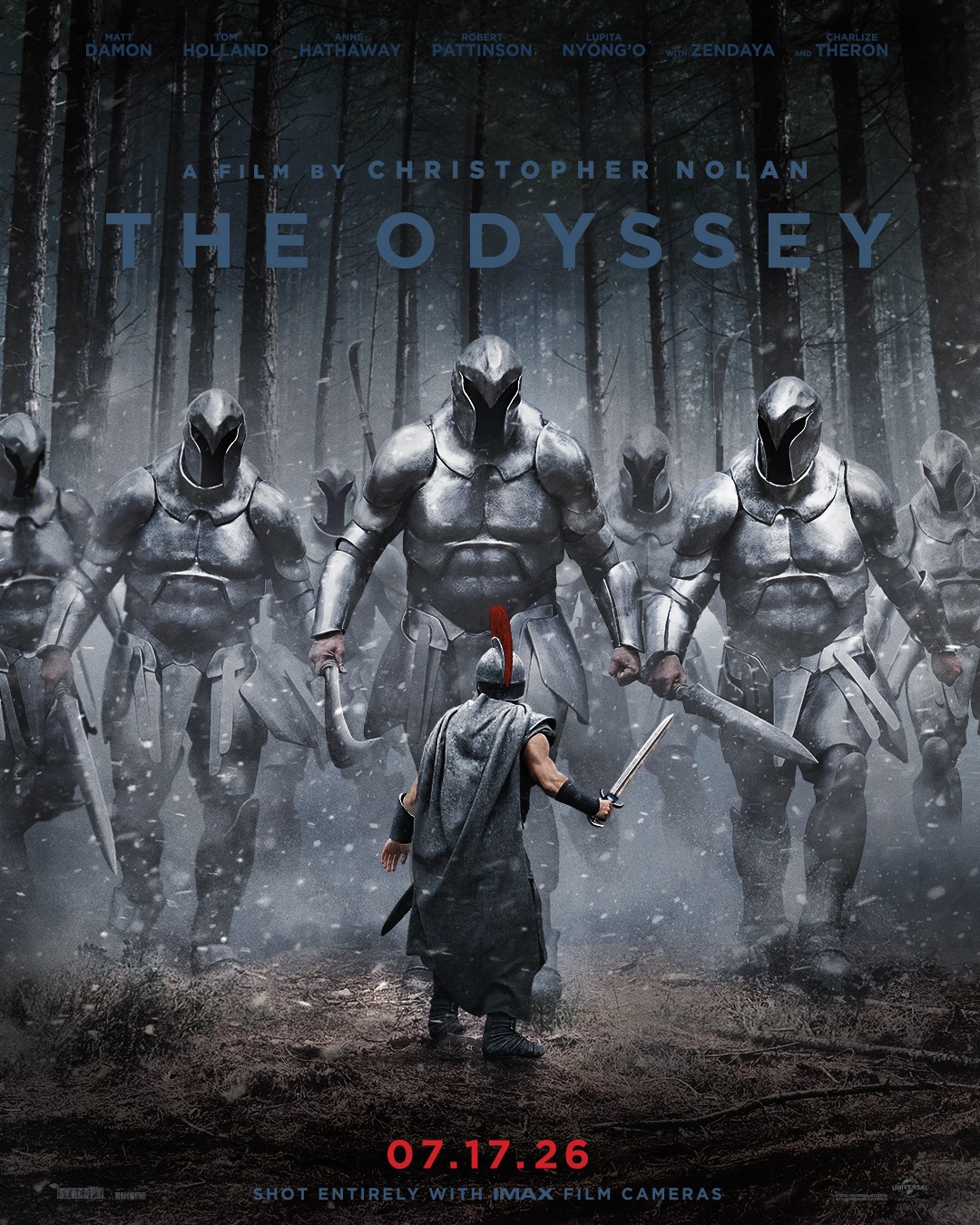
The film plays with physical scale just as effectively. One of my favourite sequences was the encounter with the giants. I loved it simply for how it looked, but the way it began was a particularly nice surprise.
The men approach what appears, from behind, to be a figure in armour. When they speak to him, it turns out they are dealing with a child. An adult-human-sized child, admittedly, but a child nonetheless. And they start shouting at him. Imagine meeting a child and deciding that this is the sensible way to introduce yourself. Of course he gets frightened and runs away. The problem for the men is what comes back with him.
When the fully grown giants arrive, the scale of the encounter changes completely. To my eyes, they are shooing away the vermin that have frightened their little one, much as we might deal with rats. These soldiers suddenly seem very small. I loved the surprise of that reveal and how thoroughly it changes the way we look at the encounter.
The Cyclops and the underworld also brought Guillermo del Toro to mind. There is something in their design and atmosphere that felt like an ode to his work. Nolan has, in fact, spoken about learning from del Toro to see more in a monster than its monstrous appearance. That connection makes sense to me, particularly when I think about the Cyclops. (Nolan discusses del Toro’s influence here.)
Circe, Calypso and the Cyclops each appear long enough to establish their presence. I did not need much more time with them. They retain the qualities I associate with their mythological personas while revealing brief flashes of something recognisably human. Circe gives in and lets the men go when she does not have to. In Calypso repeatedly feeding Odysseus the lotus, I see vulnerability. And then there is the Cyclops, crying like a baby.
Those glimpses matter. They let these figures remain powerful, strange and frightening while allowing us to recognise something familiar in them.
I liked the clothing and make-up for a similar reason: they looked natural within this world. The weathering of the armour was a detail I appreciated even more after learning how it was achieved. Costume designer Ellen Mirojnick explains that the pieces were aged by hand using chemical patinas, physical abrasion and actual impacts. The worn surfaces had been worked into the material. I am glad that effort went into them; the result helped me believe in what these people had endured. (Universal’s production notes describe the process.)
Then there is the sound, which deserves as much attention as anything we see.
What struck me was how closely the music and the sounds of the world seemed to belong together. Ludwig Göransson composed the score, and Nolan has explained the decision to avoid a conventional orchestra for this film. That choice suited my experience of it beautifully. (Nolan discusses the score with Classic FM.)
Inside the Cyclops’s cave, I remember water droplets and echoes. During the raid on Troy, there are gongs, screams and people yelling. With Calypso, there is the ocean, the wind and the seagulls. These sounds give each place its own presence. I felt surrounded by the elements involved in the scene.
There is music, of course, but I was rarely conscious of it as something sitting separately over the action. It felt woven into what was happening. Göransson’s account of turning Troy’s bronze alarms into a musical motif helps explain that impression: a sound belonging to the scene becomes part of the score itself. (The production notes describe that transition.)
I loved that. I did not feel a familiar swell of violins arriving to announce the emotion. The scene seemed to generate its own sound, and I felt the effect of it before stopping to think about the music.
By the time Odysseus reaches home, all those experiences are coming back with him. I particularly liked that he takes Agamemnon’s advice from the underworld and enters his own home as a beggar. After everything he has survived, he still has to discover what is waiting for him. His return cannot simply restore the life he left behind.
The ending felt tragic to me. Watching Odysseus wounded in Penelope’s arms, with her pleading for him not to die, I took him to be dying. That shaped the way I experienced the images of their departure: the two of them heading west, chasing the sun, while their son takes the throne.
I understand that their voyage can be read as a departure into exile. But as I watched those images alongside his wounded body, the journey felt like a glimpse of the life they had always wanted and would never truly have. They could finally see that adventure together, yet I could not experience it as a straightforward happy ending. I felt the sadness of everything that had come between them and the future they imagined.
This was also where my reservation about Hathaway returned. The situation moved me, and I understood its tragedy, but her performance did not bring me to tears. I expected to feel that moment more intensely through her. The sadness was there in what the ending meant to me; the acting did not quite carry it all the way.
Even with those reservations, my overall response is clear. The Odyssey is a masterpiece to me. It held my attention, made its enormous world understandable and gave me specific images, sounds and performances that I am still thinking about.
I would choose to see it on a cinema screen if I had the chance. But even at home, it had me completely.
Unmistakably Nolan. No confusion. Straight to the heart.