A bladder story · a prescription plan · immense relief
Monurol: The Little Sachet That Saved My Sanity
A personal account of recurrent UTIs, finally being heard, and why one prescribed dose of Monurol changed the fear around every familiar warning sign.
- Published
- Last reviewed
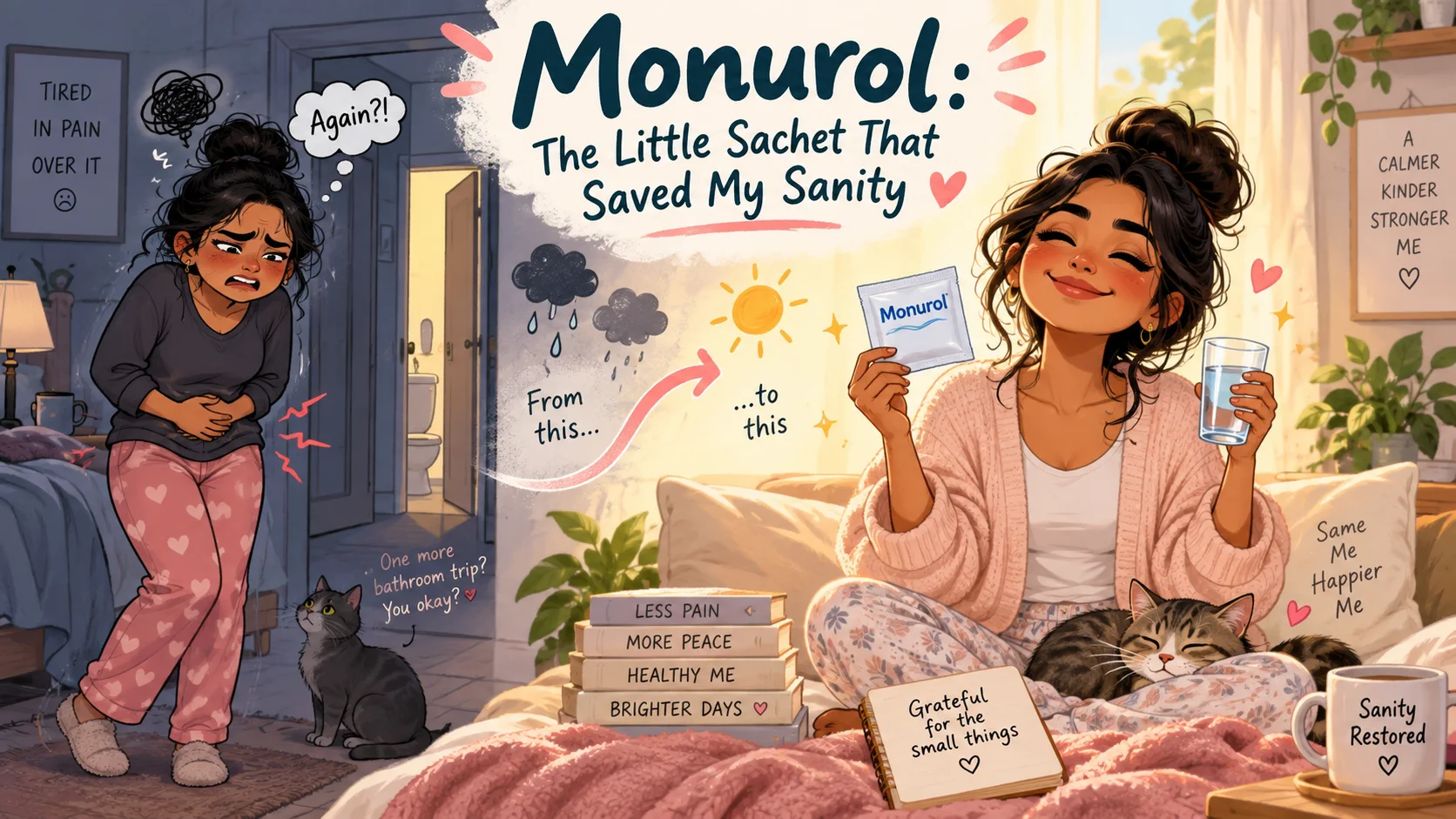
I have immense gratitude for whichever pharmacist, researcher, doctor, scientist, pharmaceutical goblin, or group of bladder-saving humans came up with the idea of Monurol.
Because honestly?
That little sachet has saved me more times than I can count.
This is not sponsored. I have not been paid, gifted the medication, or influenced to write this in any way. I am thanking the people who made Monurol genuinely, from the bottom of my heart, because their work is why I no longer have to suffer through UTIs the way I once did.
If you have never had recurring UTIs, this may sound dramatic. If you have had them, you already know. There is a very specific panic that starts when you feel that first tiny warning sign. The burning. The pressure. The oh no, not this again. Your whole body knows before your brain even finishes the sentence.
For me, that fear comes from years of suffering. During my undergraduate years, I had UTIs so often and so badly that at one point I genuinely thought I might die if one reached my kidneys. I do not know what would have happened without treatment. I do know the fear was real, and kidney infections can become serious.
It took months of antibiotics before the cycle finally stopped. The doctors left no stone unturned. They tested me for what felt like every possible bacterium that could have set up illegal housing in my urinary tract.
And yes, there were factors in my own life. Hygiene. Lack of proper guidance. Not knowing the right way to clean. Cultural silence. Body shame. No one really sitting me down and explaining how easily bacteria can travel, especially when you have a short urethra. All of it together. One big disaster package with burning urination as the subscription gift.
That does not mean a UTI is proof that someone is dirty. It is not a cleanliness report card. Anatomy, sex, bladder emptying, hormones, health conditions, hydration, and other factors can all affect risk. The Government of Canada’s urinary-health guide explains some of those factors and recommends medical assessment when UTI symptoms appear.
Eventually, the long-running infection cycle stopped. But even after that, I was still left with random bouts of UTI. It commonly happened if I had diarrhea and my butt-washing situation was not perfectly managed, or if I had sex the night before. Sex was a huge trigger. So were other things I would never have thought to connect to UTIs until life personally educated me, rudely and repeatedly.
The doctor who understood the pattern
Then one day, a doctor who was subbing for my family doctor actually understood my plight. She was a woman, and she got it right away. No long lecture. No dismissive face. No “are you sure?” energy. She understood the pattern, prescribed me Monurol, and told me how to use it when I felt an uncomplicated UTI coming on.
Thank you, Dr. Panesar.
I mean that sincerely.
Because since then, it has been about three years, and I have not suffered through a UTI for more than a day. Three years. After years and years of pain, panic, burning, peeing tiny amounts every five minutes, and mentally preparing my last words because my bladder decided to become a war zone.
This is not me telling people to self-prescribe antibiotics or treat every urinary symptom with a random sachet. Please do not go feral with antibiotics. Burning, urgency, and pelvic discomfort can have causes other than a bacterial bladder infection. This is me talking about a prescription medication and an individualized plan given to me by a doctor who understood my history of recurrent uncomplicated bladder infections.
And what a plan.
One sachet. One drink. Done.
For me.
That last part matters. My prescription is not somebody else’s diagnosis or treatment plan.
What Monurol actually is
Monurol is fosfomycin tromethamine, a prescription antibiotic. Health Canada’s Drug Product Database currently lists it as a marketed oral powder for solution under DIN 02240335, with each single-dose sachet containing the equivalent of 3 g of fosfomycin.
The Canadian indication is specific. According to the current Monurol product monograph, it is authorized for acute uncomplicated lower urinary tract infection — acute cystitis — in women 18 and older when caused by susceptible E. coli or Enterococcus faecalis. It is not indicated for a kidney infection, pyelonephritis, or a perinephric abscess.
That matters because people often say “UTI” like it is one single thing. It is not. A bladder infection and a kidney infection are not the same level of problem. Fever, chills, significant flank or back pain, vomiting, or feeling systemically unwell are not casual “let me drink the sachet and see” symptoms. They need prompt medical assessment. Pregnancy, recurrent infections, symptoms that are unusual for you, or symptoms that do not improve also deserve professional guidance.
Monurol is a bladder-focused antibiotic, not a magic potion for every infection anywhere in the urinary tract.
But for what it is meant to do?
I love it.
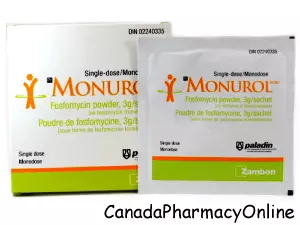

The science of it is actually fascinating. Fosfomycin kills susceptible bacteria by interfering with an early step in bacterial cell-wall construction. The monograph says the drug is not metabolized; part of the dose is eliminated unchanged in the urine, where concentrations remain measurable for roughly three days after a single dose. That is why “single dose” does not mean “works for only a few hours.”
The patient information says improvement or complete relief is generally expected within two to three days. If symptoms have not improved by the fourth day, or infections keep returning, contact the prescriber. That part is important because when you are burning and miserable, one day can feel like fourteen business years.
The monograph also explains that bladder irritation can remain briefly even after the antibiotic has started killing bacteria. Waking up the next morning with symptoms does not automatically prove the medication failed. But worsening symptoms, red flags, or no improvement are reasons to get medical advice rather than improvising.
Even bladder fairy dust has boundaries
The Canadian instructions say to dissolve the entire sachet in about 125 mL — half a cup — of cold water, stir, and drink it immediately. It is recommended on an empty stomach or at least two to three hours after eating. Do not swallow the powder dry. I am including that to explain how this strange little prescription works, not to prescribe it to anyone reading this. Follow the directions from your own prescriber, pharmacist, and medication leaflet.
And do not just take another sachet the next day because you are annoyed the burning has not vanished yet. The monograph says repeated daily doses did not improve clinical success or bacterial eradication compared with the single dose, but they did increase adverse effects.
See? Even my beloved bladder sachet has boundaries.
It also has possible side effects. The patient information lists things including abdominal discomfort, nausea, diarrhea, dizziness, headache, rash, and vaginal infection. Serious allergic reactions and C. difficile-associated diarrhea are among the serious warnings. Monurol contains sucrose and flavourings with sulphites, and the monograph tells people to discuss kidney problems, hemodialysis, pregnancy, breastfeeding, allergies, and other medicines with a healthcare professional before taking it. This is not an exhaustive list; the current Canadian patient information is included near the end of the product monograph.
For me, the beauty of Monurol is not just that it works. It is that it interrupted the fear cycle. Before, the first sign of UTI felt like the beginning of a long punishment. I knew the suffering that could come next. I knew the spiralling. I knew the urgency, the pain, the constant bathroom trips, the anxiety of “is this going up to my kidneys?” I knew the mental exhaustion of having to convince people that no, this is not just a little inconvenience.
Now, because of the plan my doctor gave me, I do not feel helpless in the same way. I still take it seriously. I still know when symptoms are beyond uncomplicated cystitis and need medical attention. I still respect antibiotics and the fact that resistance exists. But I also have something that works for me when the familiar early signs show up.
And after years of suffering, that feels huge.
So yes, thank you to whoever came up with Monurol. Thank you to the people who figured out that one sachet could concentrate in the urine and keep working. Thank you to the researchers, pharmacists, physicians, and everyone involved in making this tiny powder packet exist.
But mostly, thank you to Dr. Panesar, who listened, understood the pattern, and gave me a practical solution instead of making me feel dramatic about my own bladder.
Because I had suffered enough.
And sometimes healthcare does not need to be poetic. Sometimes it is just one doctor who gets it, one prescription that makes sense, and one little sachet that stops a familiar nightmare from becoming a whole week of pain.
Monurol, you are expensive little orange-mandarin-tasting bladder fairy dust.
And I remain grateful.