A Modern Eye Exam, Two Sets of Eyebrows, and a $760 Bill
A morning of eye tests, a near-vision question, four possible frames and the unexpectedly high cost of new glasses.
I had decided that I had done nothing useful today. I had, however, gone to the optometrist, completed several tests I could not name, tried on what felt like a hundred pairs of glasses and spent considerably more money than I had hoped to spend.
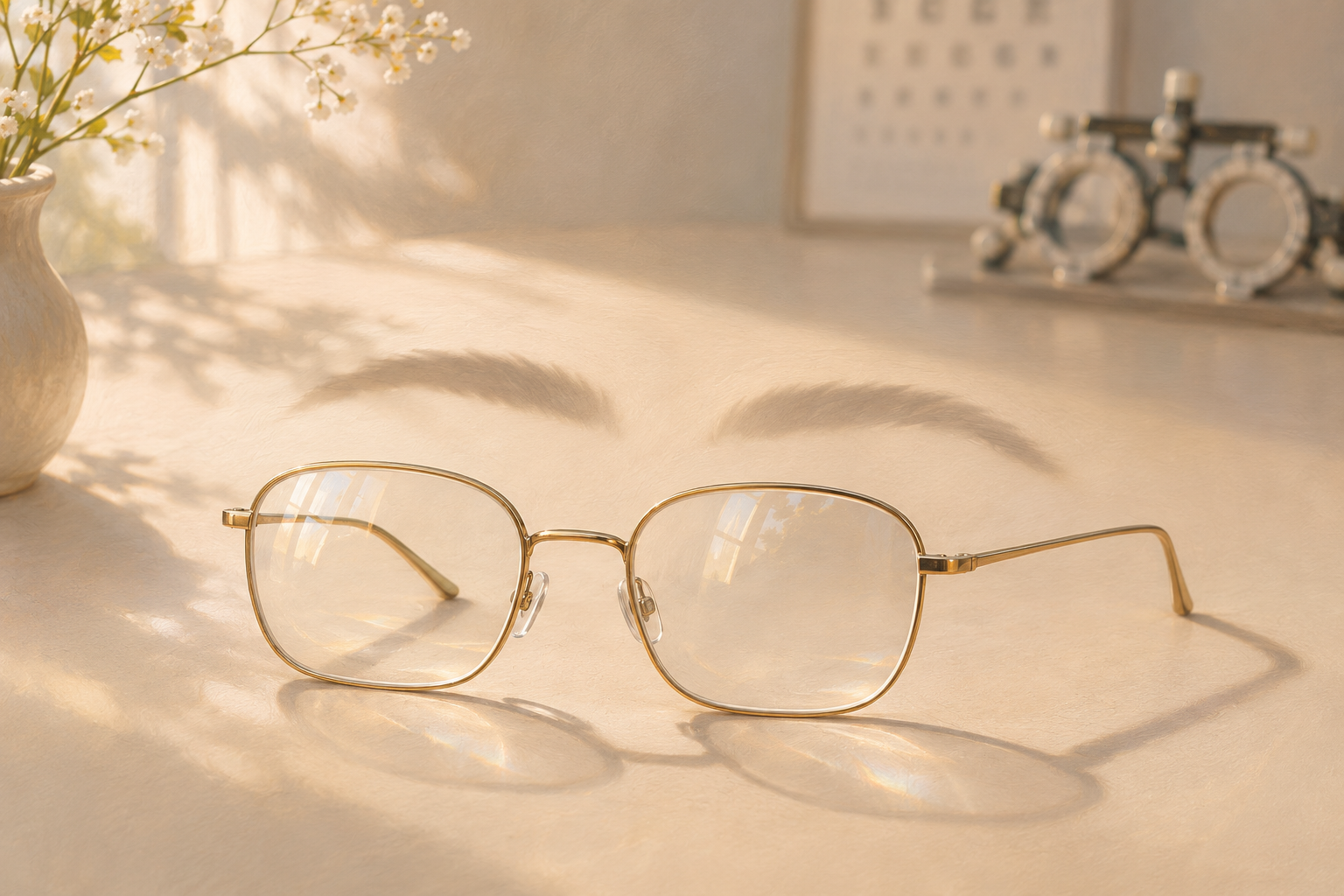
The reason for the appointment was straightforward. At night, lights scatter like crazy, and reading things close to me has become difficult. So, at nine in the morning, I went to 8 on Second to find out what was happening.
Before seeing the doctor, I went through a succession of machines. In the first test, I pressed a button whenever I noticed something appear or move, with each eye tested separately. Then came the balloon. Finally, there was a flash so bright that, for a moment, improving my eyesight seemed an unlikely purpose for it.
I followed the instructions. What I could not have explained afterwards was what each machine had actually measured.
That seemed worth finding out.
The button-clicking test was a visual-field test. These tests check which parts of the area in front of and around us we can see while looking at a fixed point. Depending on the instrument, the targets may be lights or patterns. The results help identify areas of reduced sensitivity or missing vision. It is a different question from whether we can read small letters clearly.
The balloon test is an autorefractor. The picture gives the eye something to look at while the machine estimates its focusing error. That measurement gives the optometrist a starting point for determining a prescription; it is not necessarily the final prescription itself. The College of Optometrists of Ontario explains this equipment and its uses.
The bright flash was probably retinal photography: an image of the light-sensitive tissue at the back of the eye, including structures such as the optic nerve and blood vessels. The clinic lists digital retinal photography among its services. These are likely identifications based on my recollection, rather than confirmed names from my examination record. 8 on Second’s explanation of its examinations and imaging
My last examination had been about three years earlier. I honestly do not remember much about it, but the practice still had pictures of my eyes from that visit. That is one useful thing about imaging: the doctor can have a record to compare with later examinations.
When I saw the optometrist, she said my eyes looked great. I assumed the photograph had contributed to that assessment, although I cannot know how much of her conclusion came from each part of the examination. I read letters on a distant screen, and she examined my eyes with another instrument while asking me to look towards her ear. I cannot tell from memory whether that was a slit lamp, used to examine the eye under magnification, or an ophthalmoscope, used to look inside it.
The question that stayed with me was about reading. I remembered looking at the distant screen. How had we arrived at the power I needed for things close to my face?
The answer is not simply that a machine measures the distance prescription and the doctor adds something according to age. Professional guidance describes assessing near vision and determining any reading addition with the person’s preferred reading or working distance in mind. I cannot reconstruct every measurement from memory, so I still want a clearer explanation of how my own near prescription was determined. The American Optometric Association’s clinical guidance on presbyopia
The optometrist told me that the change was normal with age. She mentioned an addition that I remember as “0.6” and described lenses that would help me see nearby things through the bottom and distant things through the top. They would be something like progressives, she explained, but easier for me to manage.
That sounds consistent with what is often called an anti-fatigue or accommodative-support lens: a lens with a small increase in focusing power in its lower portion. Some products offer a +0.60-dioptre boost, which could explain the number I remember. It does not establish the exact lens I ordered; the written order would confirm that. Essilor’s description provides one example of this design.
She also said the lenses would include a blue-light filter to help with eye fatigue. That led to another distinction worth understanding.
The prescription, the extra near-focusing power, an anti-reflective coating and a blue-light filter do different jobs. They should not be treated as interchangeable explanations for why a pair of glasses might help.
For blue-light filtering specifically, the evidence is less reassuring than the marketing often sounds. A Cochrane review of 17 studies involving 619 people found that blue-light-filtering lenses may provide little or no short-term improvement in computer-related eyestrain compared with lenses without that filter. That finding concerns the filtering feature; it does not tell me whether my new prescription or near-vision support will help. Cochrane’s review
I have not received the glasses yet, so I cannot report a result. When I asked whether I would see better at night, the optometrist said yes. For now, that is what I have been told, rather than something I have experienced.
All these machines also made me wonder what an ordinary eye examination would have looked like a few decades ago.
Quite a lot would have been recognisable. A primary-eye-care guideline published in the Canadian Journal of Optometry in 1980 described taking a history, assessing focusing and binocular vision, and examining the outside and inside of the eyes. Its equipment list included distance and near charts, trial lenses and frames, and instruments for examining the eye. The purpose already extended well beyond handing someone a pair of glasses. The historical examination guideline
Nor did automated measurements suddenly arrive in the last few years. The journal Eye published a review of autorefractors back in 1987. The machinery has developed, but the idea of using a machine to estimate a prescription is decades old. “A review of autorefractors,” 1987
The familiar process of changing lenses and asking which looks clearer also remains useful. Moorfields Eye Hospital, for example, still describes examining children using a trial frame into which different lenses are inserted by hand. An older method can remain appropriate within modern care. Moorfields’ explanation of refraction testing
That matters when comparing places. Seeing a manual instrument does not establish that a clinic is behind the times. Equally, seeing an impressive scanner does not tell us everything about the quality, accessibility or completeness of an examination.
I wanted to know whether the technology I encountered was available across Canada’s provincial capitals. Publicly available clinic information provides the following snapshot.
These are examples checked in November 2026, rather than a survey of every practice or a ranking of cities. They show that equipment is advertised locally; they do not establish that every patient receives every test, or that the tests are included in every examination fee. OCT means optical coherence tomography, a scan that shows layers of tissue within the retina.
| Provincial capital | Example practice or listing | Advertised equipment or testing |
|---|---|---|
| Victoria, British Columbia | Maycock Eyecare | Digital retinal photography, Optos wide-field imaging and visual-field testing |
| Edmonton, Alberta | iSight Eyecare | Retinal photography, OCT and visual-field testing |
| Regina, Saskatchewan | Advance Eye Care Center | Optomap retinal imaging and OCT |
| Winnipeg, Manitoba | St. Vital Vision Centre | Retinal imaging, OCT and visual-field analysis |
| Toronto, Ontario | Downtown Vision Optometrists | Optos retinal imaging, OCT and automated visual-field testing |
| Québec City, Québec | SKYVISION Optométrie | OCT and retinal photography |
| Fredericton, New Brunswick | FYidoctors’ Regent Street practice listing | OCT, Optomap, automated visual-field testing and autorefraction |
| Halifax, Nova Scotia | Miller Optometry | Wide-field retinal photography and OCT |
| Charlottetown, Prince Edward Island | Family Vision Centre | Optomap retinal imaging and visual-field testing |
| St. John’s, Newfoundland and Labrador | Dr. Boulay Optometrists | Comprehensive examinations with OCT |
There is evidence of digital retinal imaging or OCT availability in all ten provincial capitals. That finding does not support a simple division between technologically advanced capitals and capitals still waiting for modern eye care. It also leaves important questions unanswered about affordability, waiting times and access outside these cities.
The American comparison requires similar care. I did not find a reliable public state-by-state equipment inventory that would justify declaring particular states technologically outdated.
What is documented is uneven access to clinicians. Georgia’s House Rural Development Council reported in 2024 that optometrists were concentrated around metropolitan Atlanta and other northern areas. In southwestern Georgia, it reported approximately one optometrist for every 23,000 residents. That is a workforce and access problem, rather than evidence that the available doctors use obsolete machines. Georgia’s 2024 report, page 16
A 2026 New Mexico agency analysis also identified shortages of eye-care providers and difficulties accessing ophthalmic surgeons, particularly for rural and older residents. That concerns access to specialist care, which is broader than the routine examination I attended. New Mexico’s agency analysis
A machine being available somewhere in a city is one thing. Being able to reach an appropriate clinician, afford the visit and obtain the prescribed glasses is another part of the experience.
Which brings me back to the part of my appointment that required no advanced imaging whatsoever: looking at my own face.
I have very low brows. With many frames, I look as though I have acquired a second set of eyebrows. One pair belongs to me; the other has arrived with a price tag.
I tried on pair after pair. I cannot claim it was literally a hundred, but it certainly felt that way. I had started with a fairly firm idea of what I did not want, including metal frames. Eventually, I settled on a gold-toned metal frame.
Naturally.
I initially thought the pair I ordered was the Ray-Ban RB7553 Optics. Looking through the clinic’s website afterwards, I also found the GU2685, Kemi and Hongdae, which all look similar to me. These are possible matches, rather than a confirmed identification of what I bought. I will need to check the order to settle that particular mystery.
What I am certain of is that choosing a pair did not produce the sudden feeling that I had found glasses I loved.
The total came to $760 for the examination, frames and lenses. Insurance paid $480, leaving $280 for me to pay. The frame itself was approximately $195–$200.
That distinction matters: I did not pay $760 for the frame alone. But understanding the breakdown did not make the amount I paid feel small. I had hoped to spend less, and I left feeling guilty about spending so much on glasses I was not even convinced looked nice on me.
They told me the glasses would take about two weeks.
So this is not yet a story about a purchase that turned out wonderfully. I have had the examination, placed the order and paid the bill. I understand more about the machines than I did when I sat in front of them, but I am still waiting to find out how much the new lenses will help.
In about two weeks, I should know more about seeing through them.
Whether I will like seeing myself in them remains a separate question.