You Can See Everything: Elizabeth Holmes, Uncomfortable Sympathy, and the Fear of Being Fooled
Nathan Fielder and Lance Oppenheim’s documentary left me weighing my sympathy for Elizabeth Holmes against the harm she caused—and questioning how much I could really know from what I was shown.
About this review
- Subject
- You Can See Everything
- Format
- Documentary film
- Spoilers
- Major spoilers for You Can See Everything.
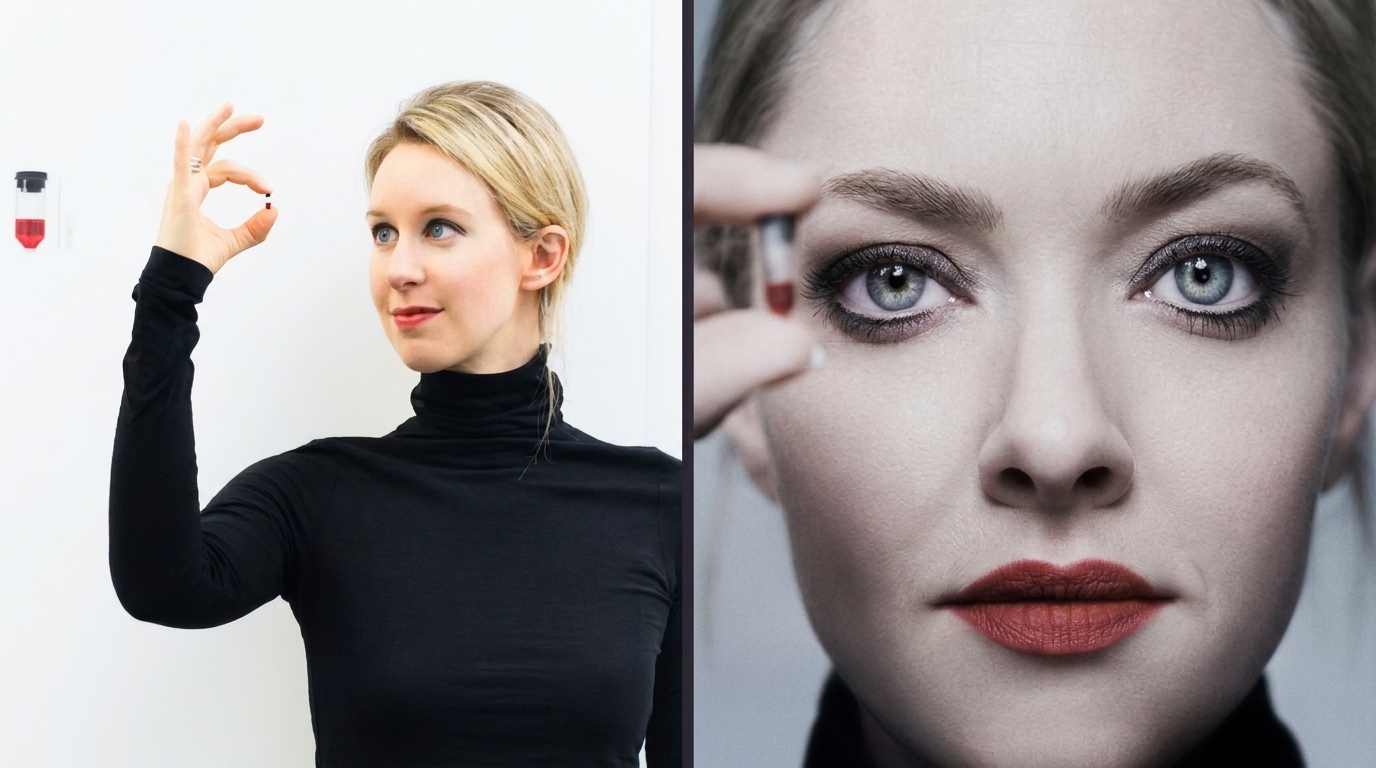
Major spoilers for You Can See Everything.
When my husband turned on You Can See Everything, I wasn’t quite sure what we were settling into. Another account of Theranos? An attempt to rehabilitate Elizabeth Holmes? For a while, Nathan Fielder and Lance Oppenheim’s documentary seems content to let us watch her at home with her partner, Billy Evans, and their children. She is welcoming, apparently unguarded, and remarkably ordinary. Whatever else I expected from this story, I did not expect the eggs to bother me so much. (A24 film details for You Can See Everything)Holmes is beating eggs when Billy takes over. Asked why, he explains that he wanted her to be able to concentrate on speaking to Nathan. Holmes, however, seems to understand it differently: he doesn’t think she is beating them properly. What stays with me is how readily she appears to accept that explanation. It is a small domestic moment, and couples take over tasks from each other all the time. Yet something about the difference between his explanation and hers makes me uncomfortable. I begin watching their relationship much more closely.
I came into the documentary knowing about Theranos. Holmes was convicted of defrauding investors; this was considerably more serious than an ambitious invention failing to work. Still, I wanted to understand the person behind the story. I am susceptible to a comeback, to someone making a terrible mess of things and eventually finding a way to do better. The possibility of understanding her appealed to me, even when forgiveness felt like a much more complicated question. (The criminal case and verdict)
There is another layer to my frustration with Holmes: I hate that she has become an excuse to distrust women in research. Women trying to build something in science or technology should not have to answer for her deception. Her wrongdoing belongs to her. Yet I worry about how easily one prominent woman’s failure can become a story people tell about women’s competence generally. Watching her, I carried that anger alongside my curiosity. Neither conveniently cancelled the other out.
Then Billy begins talking about their connection, about being so deeply in love that he can understand her without her needing to speak. That might sound romantic in another context. After the eggs, I find myself wondering how much room there is for her to say something he hasn’t already decided she means.
The documentary unsettles me in a different way when Holmes watches Abbott and Costello’s Who’s on First? routine. She appears to be following the words without finding her way into the joke. As an autistic viewer, I recognize something in that experience: everyone else seems to know what is funny, while you are still trying to understand what, exactly, is happening. That recognition makes me wonder whether she might be autistic, but a filmed reaction to a comedy routine cannot establish that. What I can speak about is my own response. I know the effort involved in learning that people do not always mean what they say, and that misunderstanding them can itself become the entertainment. It took me time to recognize those patterns. Even now, some comedy leaves me outside the joke, looking in.
Watching Holmes, I wonder whether she feels any of that discomfort, or whether I am bringing my own history into a moment she experiences quite differently. She reminds me a little of Drax from Guardians of the Galaxy, taking language literally while everyone else operates according to another set of rules. Except this is a real person, and the consequences surrounding her are real too. Recognizing something of myself in her makes her feel closer. It does not tell me whether she is being truthful.
That distinction becomes particularly difficult to hold onto when she explains the technology.
As I understand her argument, Holmes is describing a platform designed to perform several kinds of blood tests, with each individual test needing to be developed for it. That basic concept is reasonable: one instrument can support different tests, but each test needs its own suitable chemistry and a reliable way to interpret the result. Calibration means checking its measurements against samples with known values. Validation means establishing how accurately and consistently it performs, across the range of results it is supposed to measure and in the presence of substances that might interfere. A working platform does not automatically make every test on it ready for patients. (Laboratory performance requirements)
When she talks about eleven tests, my first reaction is to wonder whether even a smaller achievement might have been extraordinary. Surely something that worked imperfectly could still represent meaningful progress? But my instinctive thought that even “80% accuracy” might count as a success needs questioning. Eighty per cent of what, measured how, and with what consequences when it is wrong? That figure alone cannot tell us whether a blood test is clinically useful or safe. An interesting research achievement and a dependable medical service require different levels of evidence.
This is where the documentary’s invitation to see Holmes as a person becomes both compelling and uncomfortable. I understand wanting to be seen as more than the worst thing attached to your name. But a personal explanation cannot settle scientific questions, and sounding misunderstood cannot erase a fraud conviction. For a few moments, I nevertheless feel the pull of a gentler story: perhaps she operates on a frequency the people around her have never quite managed to tune into.
Then she goes to prison, and there is still roughly half a film left.
At that point, I genuinely wonder what we are going to watch for the rest of it. My husband describes the documentary as more intense than some of the psychological thrillers we watch, and I understand exactly what he means. Almost every time I begin to feel confident about someone, another conversation makes that confidence wobble.
Amanda Seyfried’s arrival gives that uncertainty a voice. Having previously played Holmes in The Dropout, she watches the footage with an unusual combination of familiarity and distance. What strikes me most is how often her reactions resemble mine. She notices Billy’s behaviour. She questions the relationship. As she and Nathan examine what they have seen, they seem to be having the conversation already happening on our sofa.
Have I just been a sucker? Am I responding to someone who has been misunderstood, or to someone who understands very well how to make me feel that way?
The financial arrangement deepens that discomfort. We learn that Billy negotiated a share of the documentary’s profits, and the question becomes how much Holmes knew about it. His account of what she knew leaves me wanting clearer answers. There is a substantial difference between knowing a documentary is being made, knowing money has been discussed, and understanding the terms of an agreement involving your own life.
The film’s closing card says Billy ultimately relinquished his profit share. Reporting published since then complicates that account: Fast Company reports that an amended arrangement would direct a payment to an unnamed children’s charity, while the directors dispute the characterization that a subject retained profit. So I cannot describe this as a confirmed personal payday for Billy. Even with those competing accounts, the uncertainty about who knew what remains central to the experience of watching it. For me, the troubling part is the difficulty of getting a direct answer from Holmes herself. (Fast Company’s reporting on the financial arrangement and closing card)
When Nathan tries to speak to her in prison and Billy resists the questions being pursued, I find myself returning to that first kitchen scene. His behaviour increasingly looks controlling to me. I want to hear her explain what she understood, what she agreed to, and what she wants, without someone else supplying the interpretation.
Yet even the eventual prison encounter comes with another complication: the film presents it through a reconstruction with Amanda Seyfried, based on Fielder’s recollection, rather than footage recorded inside the prison. We are watching an account of a conversation, performed for us. That matters in a film that has made me scrutinize every pause and expression for clues. (Fielder and Seyfried discuss the reconstruction; Amanda Seyfried on IMDb)
By the end, I still feel concern about the relationship we have been shown. I understand the impulse to reach for a label that might explain it, but I cannot establish coercion or a psychological condition from this film. What I can say is that I wanted Holmes to have space to answer independently. I also had to acknowledge that concern for her present circumstances does not resolve questions about her past behaviour. Someone can have caused serious harm and still deserve to be heard without another person speaking over them.
What makes You Can See Everything so absorbing is how personally involved I became in trying to work it all out. I watched Holmes, then Billy, then Nathan and Amanda Seyfried, and eventually began watching my own reactions. Why did literalness make someone feel more trustworthy to me? Why did recognizing a familiar discomfort make me so ready to supply a sympathetic explanation? And how much of my certainty came from the people themselves, rather than the way their story was being shown?
I finished the documentary still thinking about the eggs. Such a small moment, and I had built so much around it. Perhaps that is why the film stayed with me: it made me feel that I could see something important, then left me questioning how much I could really know.